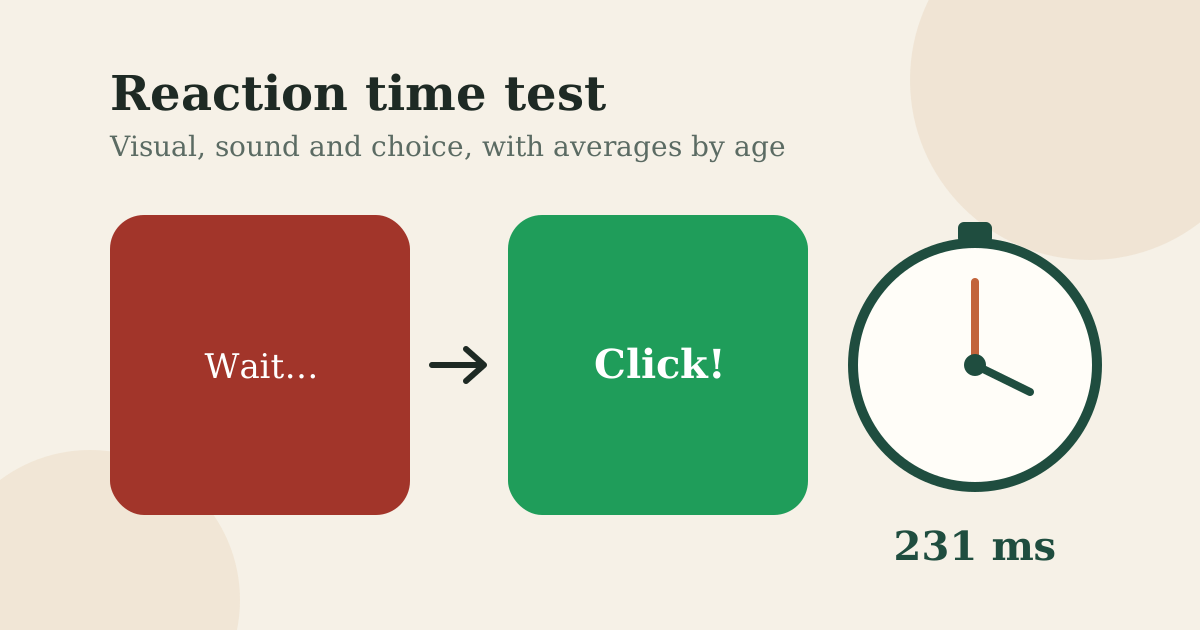
In short: F1 drivers launch their cars about 0.2 seconds after the start lights go out, according to Formula 1. That is roughly 200 milliseconds. For comparison, the average adult reacts to a simple light in about 231 ms in a calibrated lab, and most people score 250 to 300 ms on online tests, where the screen and mouse add delay. Get under 200 ms here and you matched an F1 driver.
How the F1 lights-out test works
Part game, part F1 reaction timer, the test copies the start sequence used in Formula 1 and times how long you take to respond once the lights go out.
- Click, tap or press space to line up on the grid.
- Five pairs of red lights come on, one column at a time, a second apart.
- Once all five are lit there is a random hold of between 0.2 and 3 seconds, the same range Formula 1 describes for its own starts.
- The lights go out. Click, tap or press space as fast as you can.
Jump starts in the test
Going while any light is still on is a jump start, and so is a response under 100 ms after lights out, which is too fast to be a real reaction to what you saw. Either way, the start doesn't count and you line up again, rather like a driver who has to serve a penalty.
Your score, history and challenges
Each start gives one reaction time, compared with the 0.2-second average F1 launch. This browser remembers your best launch, your recent starts and a running average, so you can keep working on your starts across sessions with no account needed. Send a friend your result with Challenge a friend: the link lines them up against your time and shows who got away quicker.
How fast are F1 drivers' reactions?
Formula 1's own explainer on race starts puts it plainly: "On average, they launch their cars just 0.2 seconds after the lights go out" (Formula 1, 2024). That 0.2 seconds covers seeing the lights go out and getting the car moving.
F1 figure from Formula 1. Lab figure from a study of 1,469 adults (Woods and others, 2015). Online median from Human Benchmark.
Are you faster than an F1 driver?
Possibly, though the comparison isn't perfectly fair in either direction. In your favour: your screen, browser and mouse add delay that an F1 car's start does not, often 10 to 50 ms on a computer and more on some phones and TVs, so your true reaction is faster than your score. In the drivers' favour: they react under race pressure, with a field of rivals behind them, and their response is a co-ordinated clutch and throttle movement rather than a click.
So treat 200 ms as the target. A result under it means you have reactions on a par with the drivers on the grid, at least on a good day. Most people land somewhere around 250 to 300 ms online, and our reaction time test shows what counts as a good time for everyone else.
How a real F1 race start works
Cars line up on the grid in ten staggered rows of two, each eight metres behind the car in front, with the fastest qualifier on pole at the front. On a gantry above the grid, "five red starting lights illuminate one-by-one. Then, after a randomly-chosen and computer-controlled wait of between 0.2 and 3 seconds, they all go out at once" (Formula 1).
Getting away cleanly is a matter of hands and feet working together. Former Haas driver Mick Schumacher explains that a driver has to "feed the clutch out [using a paddle switch on the steering wheel], but also simultaneously apply power", aiming for just a little wheelspin. It's a fine balance: a quick reaction followed by too much wheelspin can still cost places.
"When you're in the moment, you don't think about anything. If you were to think about everything, the reaction time will slow down. If you do it by instinct it's just going to be that bit faster."
Mick Schumacher, on F1 race starts, in Formula 1's F1 Explains podcastJump starts and how they are judged
A driver who moves before the lights go out has jumped the start and can be penalised. Under Article 48.1 a) of the Formula One Sporting Regulations, whether there was a jump start is judged by a transponder: an FIA-supplied sensor fitted to every car.
That rule was tested at the 2024 Saudi Arabian Grand Prix. The stewards found that video "appeared to show that Car 4 moved before the start signal was given", but the transponder on Lando Norris's McLaren "did not indicate a jump start", so they took no further action (FIA stewards' decision).
Norris's own description of the moment shows how fine the line between reacting and anticipating can be. "Things happen so quickly, like it was pure instinct, not a reaction, not an input," he said afterwards (Motorsport Week). Your test can't be fooled the same way: any click while a light is on counts as a jump start.
Why the random wait matters
If the lights always went out a fixed time after the fifth came on, drivers would simply count and go, and the start would test timing rather than reactions. The random hold of up to three seconds removes that option. A driver who tries to guess either gets lucky, goes far too early, or loses a fraction of a second waiting for a moment that hasn't arrived.
This test uses the same 0.2 to 3 second range, so the only reliable strategy is the one drivers use: stay relaxed, watch the lights, and respond to them going out. You'll notice that your quickest-looking results sometimes come from starts where the hold was short. Over several starts, your average tells you more than any single lucky launch.
The 100 ms cut-off has a sporting precedent too. Athletics draws its own line at the same point: sprinters who respond to the gun in under 100 ms are given a false start, even though researchers have measured some athletes reacting a little faster (Pain and Hibbs, 2007).
How F1 drivers train their reactions
One of the best-known tools is the Batak board: a wall of lights that come on at random, which the driver has to hit as quickly as possible. Jenson Button, the 2009 world champion, set a Guinness World Record on one in 2023, hitting 58 lights in 30 seconds. He described it as "a device that racing drivers use for reactions, stamina and peripheral vision, which is the big one people don't often think of" (Guinness World Records).
Peripheral vision matters because racing reactions are rarely about one light in front of you. Drivers have to notice a car moving alongside, a flag at the side of the track or a gap opening ahead, often while looking somewhere else. That is choice reaction rather than the simple reaction this test measures, and the choice mode of our reaction time test gives a small taste of it.
Getting better off the line
- Use the fastest setup you have. Clicking a wired mouse, or hitting the space bar on a laptop or desktop, registers sooner than most touchscreens or wireless mice.
- React, don't predict. Guessing earns jump starts. Keep your attention on the lights and let them going out trigger you.
- Stay loose. As Schumacher says, overthinking slows you down. Rest your finger on the button or key without pressing.
- Test when you're rested. Tiredness costs real milliseconds: one study found that 17 to 19 hours without sleep left people performing some tasks no better than at a 0.05% blood alcohol level (Williamson and Feyer, 2000).
- Judge yourself by your average. Do several starts and watch the average in your results, not just your best one.
For training beyond the start line, our guide on how to improve reaction time covers drills, warm-ups and what the research says works.
Frequently asked questions
What is the average F1 driver reaction time?
About 0.2 seconds. Formula 1's own explainer says drivers launch their cars, on average, 0.2 seconds after the start lights go out. That is around 200 milliseconds, measured from lights out to the car moving.
Are you faster than an F1 driver?
If your reaction on this test is under about 200 ms, you matched the average F1 launch, and your screen and mouse were adding delay the car does not have. Typical online results sit around 250 to 300 ms, so beating an F1 driver is possible but takes a sharp, well-timed response.
How long do the F1 lights stay on?
The five red lights come on one by one, and once all five are lit there is a randomly chosen, computer-controlled wait of between 0.2 and 3 seconds before they all go out together. The random wait stops drivers from timing the start instead of reacting to it.
What happens if an F1 driver jumps the start?
Moving before the lights go out is a false start and is penalised. Under Article 48.1 a) of the Formula One Sporting Regulations, the judgment is made from an FIA-supplied transponder fitted to each car. At the 2024 Saudi Arabian Grand Prix, video appeared to show Lando Norris moving early, but the transponder did not register a jump start, so no penalty was given.
Why does the test call my time a jump start?
Because you clicked while the lights were still on, or within 100 ms of them going out. Under 100 ms is faster than a genuine reaction to a visual signal can be, so the test treats it as a guess, just as sprinting treats reactions under 100 ms as false starts.
How do F1 drivers train their reactions?
One common tool is a Batak board, a wall of lights that come on at random and must be hit as fast as possible. Former world champion Jenson Button, who set a Guinness World Record of 58 lights in 30 seconds on one in 2023, described it as a device racing drivers use "for reactions, stamina and peripheral vision".
Is this test the same as a real F1 start?
The light sequence and random hold work like the real gantry, but the response is very different. A driver releases the clutch paddle and feeds in the throttle while managing wheelspin; you click a button. Treat the comparison as a fun benchmark, not an exact match.
Can I improve my F1 start reaction time?
A little. Be rested, watch the lights rather than counting, and respond to them going out rather than trying to predict it. For the most accurate timing, play on a computer and use a wired mouse or the keyboard. Our guide to improving reaction time covers what helps and what doesn't.
Sources
- Browning-Brant, C. (2024). Rapid decisions, driver skills and intricate procedures: why race starts are so critical in F1, Formula 1.
- FIA stewards (2024). 2024 Saudi Arabian Grand Prix, decision on Car 4, alleged false start (PDF).
- Lawrence, D. (2024). FIA reveal why Norris wasn't penalised for Saudi GP jump start, Motorsport Week.
- Punt, D. (2023). F1 legend Jenson Button sets reaction-based world record ahead of 2023 season, Guinness World Records.
- Woods, D. L. and others (2015). Factors influencing the latency of simple reaction time. Frontiers in Human Neuroscience, 9, 131.
- Pain, M. T. G. and Hibbs, A. (2007). Sprint starts and the minimum auditory reaction time. Journal of Sports Sciences, 25(1), 79–86.
- Williamson, A. M. and Feyer, A.-M. (2000). Moderate sleep deprivation produces impairments in cognitive and motor performance equivalent to legally prescribed levels of alcohol intoxication. Occupational and Environmental Medicine, 57(10), 649–655.
- Reaction time test, Human Benchmark: median online result and device delay.
From the grid to reasoning
You've tested your reactions. Now test how you reason: 36 questions across four kinds of thinking, with an estimated IQ as soon as the last question is done.
Take the free IQ test