How the IQ test for kids works
Choose your child's age from the menu and the test builds a new set of puzzles for that age straight away. Every age from 6 to 12 has its own mix: 16 puzzles at 6 and 7, 20 at 8 and 9, and 24 from 10 to 12. Each set has the same number of puzzles in every area, and they start easy and get harder as the test goes on.
The puzzles for each age step up gradually. Number puzzles follow what children usually learn at school at that age, from adding within 10 at age 6 to fractions from 10 and percentages at 12. Shape and logic puzzles add harder ideas only at the ages when most children can handle them: mirror images from 8, working out an order from several clues from 9, and "we can't tell" reasoning from 11. These are our best judgements from school standards and research on how children's thinking develops, not results from testing large groups of children. Every child is different, so if the puzzles feel too easy or too hard, try the age above or below.
After each answer, your child sees whether it was right and a short explanation of why. That turns the test into a learning activity as well as a challenge: a wrong answer becomes a chance to see how the puzzle works. There is no time limit, because young children do better when they can think a puzzle through, and every round is generated fresh, so they can play again without meeting the same puzzles.
What the kids' IQ test measures
The puzzles cover four kinds of reasoning, the same broad areas that children's intelligence tests look at:
| Area | Younger children (6 to 8) | Older children (9 to 12) |
|---|---|---|
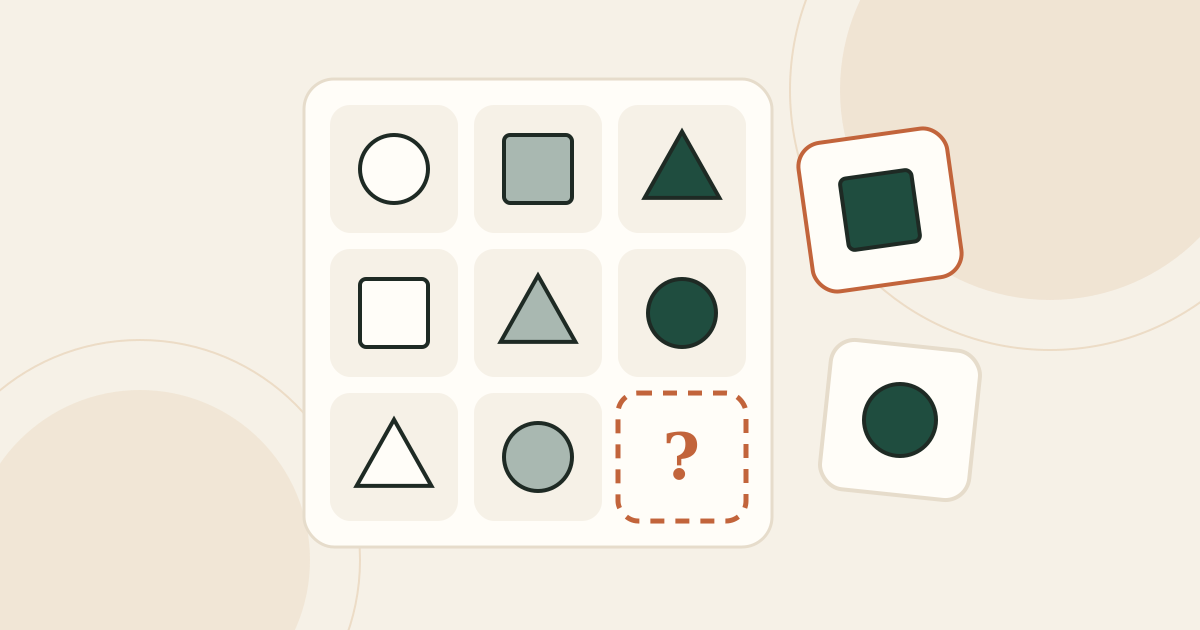
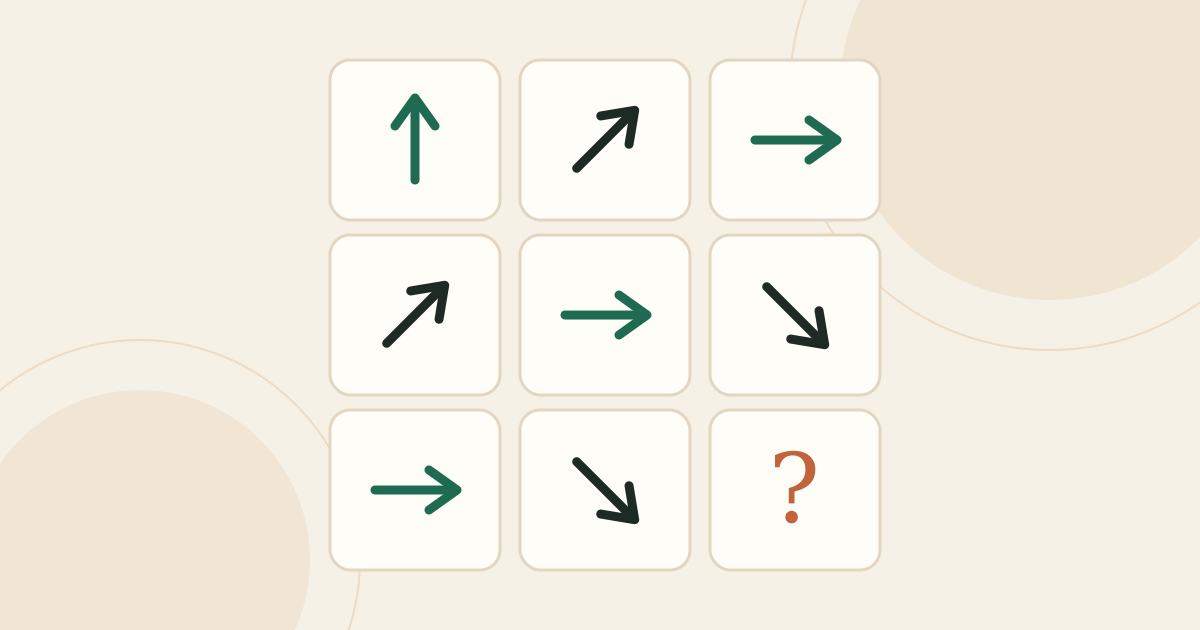
| Patterns | What comes next in a row of shapes, growing dot patterns, turning arrows | 3×3 picture grids, sequences with two rules at once, hidden rules |
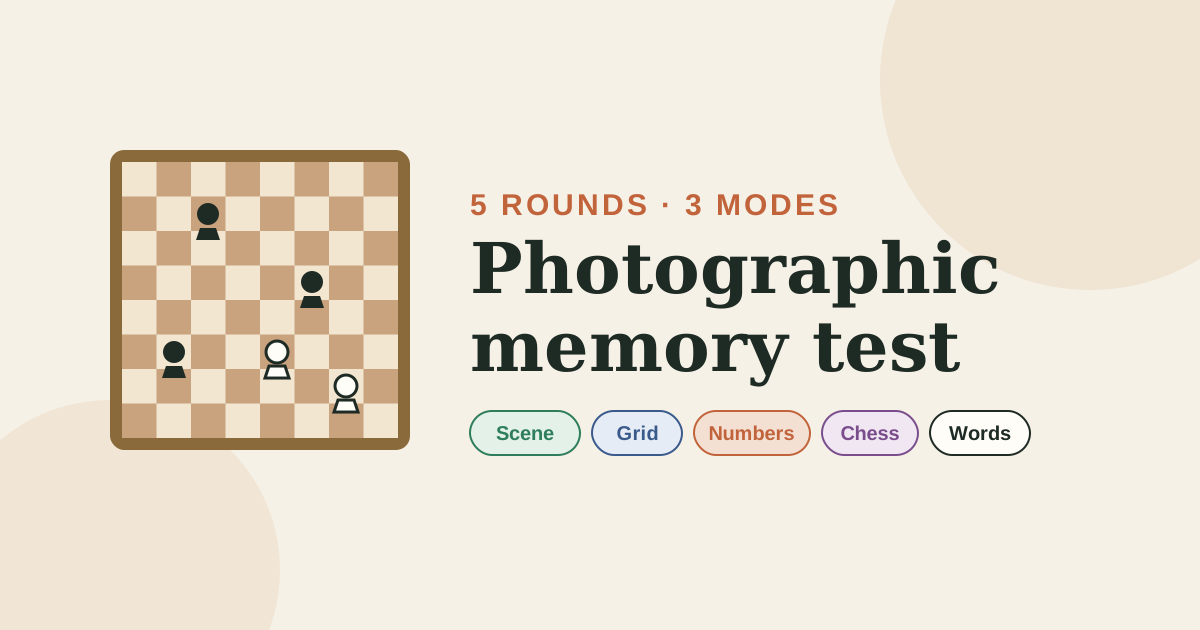
| Shapes | Matching, counting shapes, shadows, simple turns, counting cubes, mirrors at 8 | Turning versus flipping, counting squares and cubes, symmetry |
| Logic | Odd one out, things that go together, opposites, who has more, who is tallest | Analogies, putting people in order, "yes, no or can't tell" reasoning |
| Numbers | Counting, adding and taking away, number patterns, missing numbers | Sequences, times, money and sharing problems, fractions, percentages at 12 |
The pattern and shape puzzles need almost no reading, which makes them fairer for younger children and for children still learning English. The logic and number puzzles use short sentences, and a grown-up can read them aloud.
Why the kids' test doesn't give an IQ number
An IQ score is a comparison. It says how a child's performance compares with that of many other children of the same age. A 7-year-old and an 11-year-old who solve the same puzzles are at very different points for their ages, so a real IQ score needs results from a large, carefully chosen group of children at every age. That's what test publishers spend years collecting, and it is what a free online test doesn't have.
This idea is as old as IQ testing itself. The first intelligence test, published in France in 1905 by Alfred Binet and Théodore Simon, was designed to find schoolchildren who needed extra help, and it compared each child with what typical children could do at each age. Our guide What is IQ? explains how today's scores work. Rather than invent a number, we give your child an honest puzzle score and a profile of their strongest areas. Our methodology page explains how we approach scoring across Assessivo.
How children's IQ is tested by professionals
Formal IQ tests for children are given one-to-one by a trained psychologist, using printed materials and a tablet or booklet rather than a website. The best known come from the Wechsler family:
- WPPSI-IV for children aged 2 years 6 months to 7 years 7 months.
- WISC-V for children and teenagers aged 6 to 16.
These tests are usually arranged through a school or a clinic, for example when a child may need extra support or may be gifted. Our parent's guide to IQ testing for children explains the tests, how to arrange one and how to read the scores. Our guide to the Wechsler IQ tests explains how they are scored. Scores for young children also change more over time than scores for adults, which is one more reason professionals interpret them with care.
Tips for parents
- Pick a good moment. A quiet place, when your child is rested and not hungry, makes a big difference to how they do.
- Read aloud for younger children. For 6 to 8-year-olds, read the logic and number questions out loud if needed, but let your child choose every answer.
- Choose their real age. If the puzzles turn out much too easy or too hard, try the age above or below next time.
- Don't give hints. The explanations after each puzzle do the teaching. Helping during a puzzle hides what your child can already do on their own.
- Praise the effort, not the score. Notice careful thinking and good guesses. Children who see puzzles as a challenge to enjoy tend to keep trying when things get hard.
- Keep it a game. If your child gets tired or frustrated, stop and come back another day. A new set of puzzles will be waiting.
Reading the results
At the end you'll see the number of puzzles your child got right, up to three stars, and a bar for each of the four areas. The profile is usually the most interesting part: it is very common for a child to be much stronger with shapes than with words, or the other way round. You can also open every answer with its explanation.
Remember that one sitting is a snapshot. A child who is tired, rushed or unfamiliar with a type of puzzle can do much better next time, and the last puzzles in each area are meant to be hard. The results are for fun and practice, and shouldn't be used to label a child. If you have questions about your child's learning, talk to their teacher.
Building reasoning skills at home
Everyday play builds the same skills the puzzles use. Jigsaws, building blocks and tangrams practise picturing shapes as they turn and fit together. In one study of 53 families, children aged 2 to 4 who played with puzzles more often did better on a spatial task at age 4½, even after accounting for family income and parents' education. The study shows a link rather than proof of cause, but puzzle play is an easy habit to encourage.
For patterns, make bead or brick sequences and ask "what comes next?" For logic, play "odd one out" and riddle games. For numbers, use board games with dice, cooking and shopping. Short, regular, enjoyable practice works better than long sessions. For ideas on the kinds of question older children and adults meet, see our sample IQ test questions.
Privacy: nothing is saved
The kids' test runs entirely in your browser. Your child's answers and results are never sent to us or stored anywhere, the page uses no cookies or browser storage, and Google Analytics is switched off on this page. When you close or reload the page, the results disappear. You can read more in our privacy policy.
Frequently asked questions
Is this a real IQ test for kids?
It uses the same kinds of puzzle as children's IQ tests, covering patterns, shapes, logic and numbers, but it does not give an IQ score. A child's IQ can only be worked out by comparing them with a large group of children of the same age, which a free online test cannot do. Your child gets a puzzle score and a profile of their strongest areas instead.
What age is the kids' IQ test for?
Children aged 6 to 12. Choose your child's age and they get puzzles made for that age: 16 puzzles at ages 6 and 7, 20 at ages 8 and 9, and 24 from age 10. From age 13, people can take our standard free IQ test.
How long does it take?
Roughly 10 minutes for 6 and 7-year-olds, 10 to 15 minutes at 8 and 9, and 15 to 20 minutes from 10 to 12. There is no time limit, so children can take as long as they need.
Is my child's data saved?
No. The test runs entirely in your browser. No answers or results are sent to us or stored anywhere, and analytics are switched off on this page. When you close the page, the results are gone.
What is a good score?
Getting most of the puzzles for their age right is a strong result, and the profile often tells you more than the total: many children are much stronger in one area than another. Because the puzzles are new each time and get harder as the test goes on, it is normal to miss some of the last ones.
How can I get my child's IQ tested properly?
Formal IQ tests for children, such as the WISC-V for ages 6 to 16, are given one-to-one by a qualified psychologist, often an educational psychologist arranged through the child's school. Talk to your child's teacher or school first if you have questions about their learning or think they may be gifted.
Sources
- Levine, S. C., Ratliff, K. R., Huttenlocher, J. and Cannon, J. (2012). Early puzzle play: a predictor of preschoolers' spatial transformation skill. Developmental Psychology, 48(2), 530–542.
- Wechsler Preschool and Primary Scale of Intelligence, Fourth Edition, Pearson: WPPSI-IV age range.
- Wechsler Intelligence Scale for Children, Fifth Edition, Pearson: WISC-V age range.
- Intelligence test, Encyclopaedia Britannica: Binet and Simon's 1905 test and mental age.