Assessivo

Sample IQ Test Questions with Answers

Twelve practice questions in the same styles as a real IQ test. Pick an answer, see if you're right, then open the step-by-step solution.

12 questions4 areas of reasoningEasy to hardEvery answer explained

How it works: there are three questions in each of the four areas found on most IQ tests, going from easy to hard. Choose an answer to check it straight away, or press Show answer to see the solution and a tip for that type of question. Your score builds up as you go, so the page works as a short practice IQ test.

What kinds of questions are on an IQ test?

An IQ test is not a quiz about facts. Instead of asking what you know, it gives you unfamiliar problems and looks at how you solve them. Most tests mix several kinds of questions, because people are rarely equally strong at all of them. Someone who spots number patterns quickly may find shape puzzles slower, and the other way round.

The sample IQ test questions below cover the four areas used in the Assessivo IQ test, which are also among the most common in IQ tests generally:

Pattern questions

Fluid reasoning questions

Fluid reasoning is the ability to solve problems you have never seen before. These questions show a pattern and ask you to work out the hidden rule, using shapes, symbols or letters rather than knowledge you have learned.

Question 1Easy

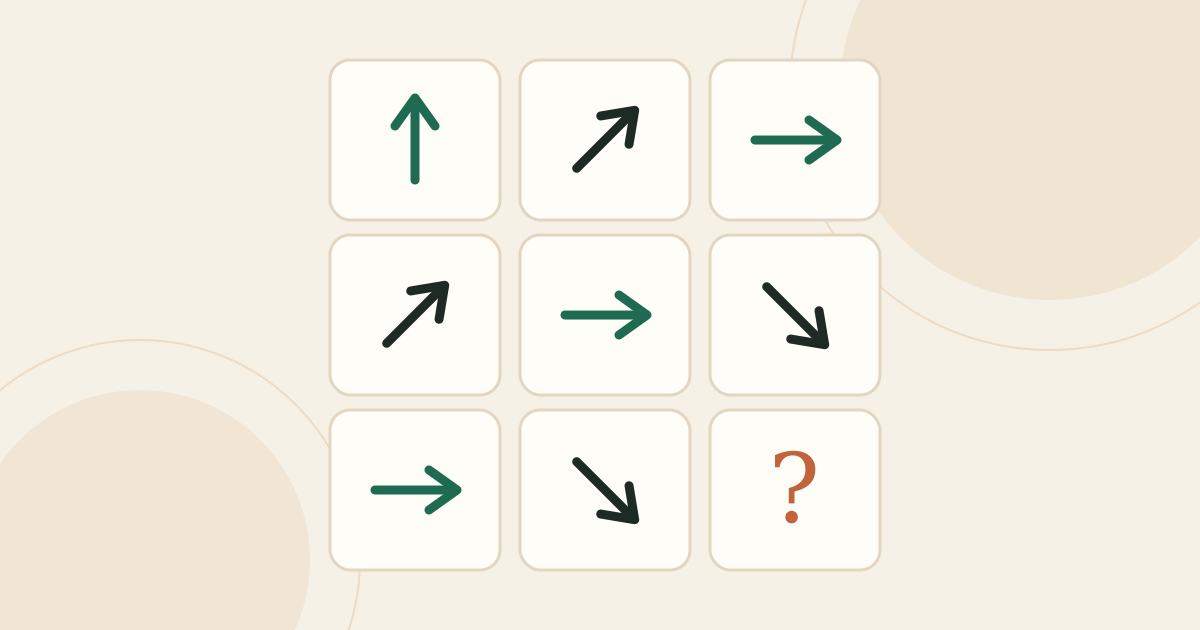
The arrow turns in the same way at each step. Which arrow comes next?

?

Show answerHide answer

Answer: C. The arrow turns 45 degrees clockwise at each step, an eighth of a full turn: up, up-right, right, down-right. The next eighth of a turn points it straight down.

How to spot this type: Check one feature at a time: direction, size, number or shading. In a sequence, usually just one or two features change by the same step each time.
Question 2Medium

Which option completes the grid?

?

Show answerHide answer

Answer: A. Two rules work together. Every row and every column contains one circle, one square and one triangle, and the shading always goes white, grey, black from left to right. The bottom row already has a triangle and a circle, so the missing shape is a square, and it sits in the black column: a black square.

How to spot this type: Read along the rows first, then down the columns. Grid puzzles like this, often called matrix questions, usually combine two or three simple rules.

Question 3Hard

Which letter comes next in the series?A   C   F   J   O   ?

Show answerHide answer

Answer: C. Count the steps through the alphabet between letters: A to C is 2, C to F is 3, F to J is 4 and J to O is 5. The next step is 6, and six letters after O is U.

How to spot this type: When the gaps in a series are not the same, write the gaps down. They nearly always follow a simple pattern of their own. With letters, it helps to turn them into numbers (A = 1, B = 2 and so on).

Verbal and logic questions

Logical reasoning questions

Logical reasoning questions test how well you follow relationships and draw conclusions. You need to read carefully and accept only what the information actually tells you.

Question 4Easy

Author is to book as composer is to ...?

Show answerHide answer

Answer: B. An author creates a book, so the matching pair is the thing a composer creates: a symphony. An orchestra, a piano and a conductor are all connected with music, but a composer doesn't create any of them.

How to spot this type: Turn the first pair into a short sentence, such as "an author writes a book", then try each option in the same sentence. Only one will fit exactly.

Question 5Medium

Four friends sit in a row of four seats, numbered 1 to 4 from left to right. Ana sits in seat 1. Ben sits next to Ana. Cara does not sit next to Ben. Which seat is Dev in?

Show answerHide answer

Answer: D. Ana is in seat 1, so Ben, who sits next to her, must be in seat 2. The seats next to Ben are 1 and 3, so Cara cannot be in seat 3, which leaves seat 4 for her. Dev takes the only seat left: seat 3.

How to spot this type: Start with the fixed facts, such as "Ana sits in seat 1", and place people one at a time. Sketching four boxes is faster than holding everything in your head.

Question 6Hard

No reptiles have fur. Some pets are reptiles. Which statement must be true?

Show answerHide answer

Answer: A. The pets that are reptiles cannot have fur, so some pets do not have fur. "No pets have fur" goes too far, because the statements tell us nothing about pets that are not reptiles, such as cats and dogs. The other two options contradict or go beyond what we are told.

How to spot this type: Questions that ask what "must be true" are testing whether you can resist conclusions that are likely or familiar but not proven. Ignore what you know about the real world and use only the statements given.

Enjoying these? Try the real thing.36 questions, 25 minutes, with your IQ score and percentile straight away.
Take the free IQ test

Shape and visual questions

Spatial reasoning questions

Spatial reasoning is about picturing shapes and objects in your mind: turning them, flipping them and seeing how parts fit together.

Question 7Easy

Imagine a mirror standing upright to the right of this shape. Which option shows its reflection?

Show answerHide answer

Answer: B. An upright mirror swaps left and right but keeps top and bottom where they are. The square that sticks out on the left of the shape appears on the right, and the top row now runs to the left: that is option B. Option A is flipped upside down, option C is turned a quarter turn, and option D is the original shape unchanged.

How to spot this type: Pick one distinctive part of the shape, such as a square that sticks out, and follow only that part. In an upright mirror it moves to the opposite side but stays at the same height.

Question 8Medium

Which option is the same shape, only turned (not flipped over)?

Show answerHide answer

Answer: D. Option D is the shape turned a quarter turn clockwise. Options A and C are mirror images: A is flipped, and C is flipped and then turned, so no amount of turning will make them match. Option B looks close, but one of its squares is in a different place, so it is a different shape.

How to spot this type: Rule out mirror images first. Choose a corner of the shape and check whether the next part goes clockwise or anticlockwise from it. Turning keeps that order, flipping reverses it.

Question 9Hard

A large cube is painted on every face, then cut into 27 equal small cubes (3 × 3 × 3). How many of the small cubes have paint on exactly two faces?

Show answerHide answer

Answer: D. A small cube has paint on two faces only if it sits on an edge of the big cube but not on a corner. Each of the cube's 12 edges has exactly one such cube in the middle, so the answer is 12. The 8 corner cubes have three painted faces, the 6 cubes in the centre of each face have one, and the single cube in the very middle has none: 8 + 12 + 6 + 1 = 27.

How to spot this type: Don't try to picture all 27 pieces. Group them by position (corners, edges, face centres, middle) and count each group. Adding the groups back up to the total is a quick check.

Number and maths questions

Numerical reasoning questions

Numerical questions use everyday arithmetic. They are less about difficult maths and more about spotting the quickest route to the answer.

Question 10Easy

A jacket costs $80. In a sale, the price is cut by 25%. What is the sale price?

Show answerHide answer

Answer: A. 25% of $80 is $20, and $80 − $20 = $60. A quicker way: after a 25% cut you pay 75%, and 75% of $80 is $60. $20 is the amount saved, not the new price.

How to spot this type: For a price cut of x%, multiply by (100 − x)% in one step. It saves time and avoids the trap of picking the discount instead of the new price.

Question 11Medium

What number comes next in the series?2   6   12   20   30   ?

Show answerHide answer

Answer: B. The gaps are 4, 6, 8 and 10, growing by 2 each time. The next gap is 12, so the answer is 30 + 12 = 42. There is a second way to see it: each number is two neighbouring numbers multiplied together (1 × 2, 2 × 3, 3 × 4 and so on), and 6 × 7 = 42.

How to spot this type: If the gaps between numbers grow steadily, there is often multiplication behind the series. Finding a second way to reach the same answer is a good check that you are right.

Question 12Hard

A water tank is one-third full. After 12 litres are added, it is three-fifths full. How many litres does the tank hold when full?

Show answerHide answer

Answer: C. The 12 litres took the tank from 1/3 full to 3/5 full. Using fifteenths, that is from 5/15 to 9/15, a rise of 4/15. So 4/15 of the tank is 12 litres, 1/15 is 3 litres, and the full tank is 15 × 3 = 45 litres. Check: a third of 45 is 15, and 15 + 12 = 27, which is three-fifths of 45.

How to spot this type: Put the fractions over the same bottom number, work out what one small part is worth, then scale up. Checking the answer against the original wording takes seconds and catches slips.

0of 12 correct

Your practice score

Answer the questions above and your score will build up here.

Fluid reasoning 0/3
Logical reasoning 0/3
Spatial reasoning 0/3
Numerical reasoning 0/3

This is a practice score only. Twelve questions can't measure IQ. The full test uses 36 questions to estimate your IQ score.

How to get better at IQ test questions

Your underlying reasoning ability changes slowly, but how well you show it on the day can change a lot. Most lost points come from rushing, misreading or getting stuck, not from questions being too hard. These habits help across every type of question:

  • Know the question types. The first time you see a grid puzzle or a mirror question, part of your time goes on working out what is being asked. A few minutes with examples like the ones on this page removes that surprise. For more practice, try our 12-question pattern recognition test or the mental rotation experiment.
  • Look for one rule at a time. Patterns that look complicated are usually two or three simple rules working together. Find one, check it against every example, then look for the next.
  • Rule options out. If you can't see the answer straight away, test each option against the rule you have found. Crossing off two wrong options turns a guess into a fair choice between two.
  • Read the exact wording. "Must be true", "turned but not flipped" and "exactly two faces" each change the answer. Many wrong answers are correct answers to a slightly different question.
  • Use rough paper. Sketch seats, write down gaps in a series, or label the corners of a shape. Writing frees your working memory for the actual reasoning.
  • Don't get stuck. On a timed test, every question is usually worth the same. If one is taking much longer than the rest, make your best choice and move on.

Being rested matters more than people expect. Tiredness, stress and distractions cost points on reasoning tasks, so take a test when you can give it your full attention for the whole time.

How the full Assessivo IQ test compares

The Assessivo IQ test uses the same four areas as this page, with nine questions in each, 36 in total. Each attempt draws fresh questions from a pool of 960, and they get harder as you go. You have 25 minutes for the whole test, so it moves faster than this practice page.

When you finish, you see an estimated IQ score and percentile straight away, with no sign-up. To understand what your number means, our guide to the IQ scale and IQ score chart explains every score range.

Frequently asked questions

Are these questions from the real Assessivo IQ test?

No. They were written for this page so you can practise without seeing any questions from the real test. They use the same kinds of questions, so they are a fair preview of what the full test feels like.

Can I get an IQ score from these 12 questions?

No. Twelve questions are too few for a meaningful estimate, and your result here is just a practice score. For an estimated IQ score and percentile, take the full test, which has 36 questions across the same four areas.

How many questions are on an IQ test?

It varies. Professional tests are made up of several subtests with many short items each and usually take about an hour with a psychologist. Online IQ tests vary widely, from a handful of questions to 60 or more. The Assessivo IQ test has 36 questions with a 25-minute time limit.

Are IQ test questions timed?

Usually, yes. Many tests have an overall time limit, and speed itself is part of what some professional tests measure. In the Assessivo test you have 25 minutes for 36 questions, about 40 seconds per question, so it pays not to get stuck on one.

Do IQ tests include general knowledge questions?

Some professional tests include vocabulary and general knowledge tasks, because learned knowledge is one part of intelligence. Most online tests, including Assessivo's, focus on reasoning, so you need nothing beyond basic arithmetic and everyday English.

Ready for the full IQ test?

36 questions, 25 minutes, and your estimated IQ score and percentile as soon as you finish. Free, with no sign-up or email.

Take the free IQ test