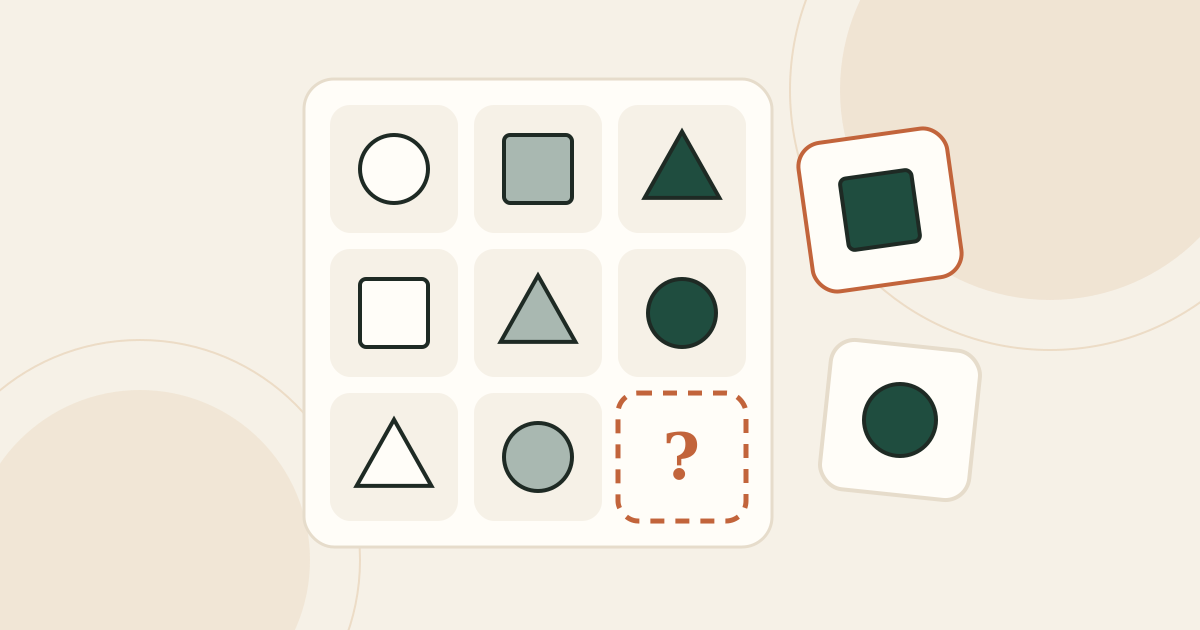
In short: a pattern recognition test asks you to find the hidden rule in a series or grid and use it to choose what comes next. It measures inductive reasoning, one of the abilities most closely tied to general intelligence, which is why pattern questions fill so much of every IQ test. The 12 questions below take about 10 minutes. Your score shows how quickly you spot rules, but it is practice feedback, not an IQ score.
Take the pattern recognition test
12 questions · about 10 minutes · free
Work at your own pace; a timer runs, but there is no time limit. After each answer you'll see the rule behind it.
- Number series
- Letter series
- Matrices
- Figure sequences
- Odd one out
What your score means
This is a practice test, so it has no norm group, the large sample of people needed to turn a score into a percentile or IQ. As a rough guide, 10 or more out of 12 is strong, 7 to 9 is solid, and anything lower usually means some of the formats were new to you. The most useful comparison is with yourself: take it again in a week, or after reading the tips below.
Proper IQ tests report scores as a deviation IQ, comparing you with people of your age on a scale where the average is 100 and the standard deviation is "usually 15 or 16" (APA Dictionary). Our free IQ test uses that scale across 36 questions on four kinds of reasoning, and our IQ scale guide explains what each range means.
The five kinds of pattern question, and how to crack them
Almost every pattern IQ test is built from the same five formats. Once you know these IQ test patterns, most new questions will look familiar.
What is pattern recognition?
The American Psychological Association defines pattern recognition as "the ability to recognize and identify a complex whole composed of, or embedded in, many separate elements". It adds that this "is not only a visual ability": in hearing, it covers recognising patterns of sound, such as the vowels in speech. A second meaning covers machines: "the identification and classification of meaningful patterns of data input by computers" (APA Dictionary).
In IQ testing, pattern recognition means inductive reasoning, "the form of reasoning in which inferences and general principles are drawn from specific observations and cases" (APA). It has been part of intelligence research from the start. When Louis Thurstone mapped the "primary mental abilities" in the 1930s, "induction or reasoning" was one of the clearest (Thurstone and Thurstone, 1941). In today's Cattell-Horn-Carroll model it is a narrow ability called Induction, under fluid reasoning (Essentials of WJ III Cognitive Abilities Assessment). In the adult Wechsler test, the WAIS-5, the Fluid Reasoning Index is made up of two pattern tasks, Matrix Reasoning and Figure Weights (Pearson).
Our guide to abstract reasoning looks at the history of matrix tests and what happens in the brain when you solve one.
Is pattern recognition a sign of intelligence?
Mostly, yes, with one important exception.
Pattern puzzles track general intelligence closely. Across several large samples, Raven's Progressive Matrices "shared approximately 50% of its variance with g", the general factor behind all mental tests (Gignac, 2015). In a Swedish study of more than 3,500 people, fluid reasoning, measured with Raven's and number series among other tests, correlated 0.83 with general intelligence, and close to 1 within groups with similar backgrounds (Kvist and Gustafsson, 2008). The neuroscientist Mark Mattson has gone further, arguing that "superior pattern processing" is the basis of "most, if not all, unique features of the human brain including intelligence, language, imagination, invention" (Mattson, 2014), though that is a theory, not a test result.
Even so, Gignac warned that "researchers are discouraged to include only Raven's in an investigation, if a valid estimate of g is sought". One pattern test is a good clue to general ability, not a measurement of it.
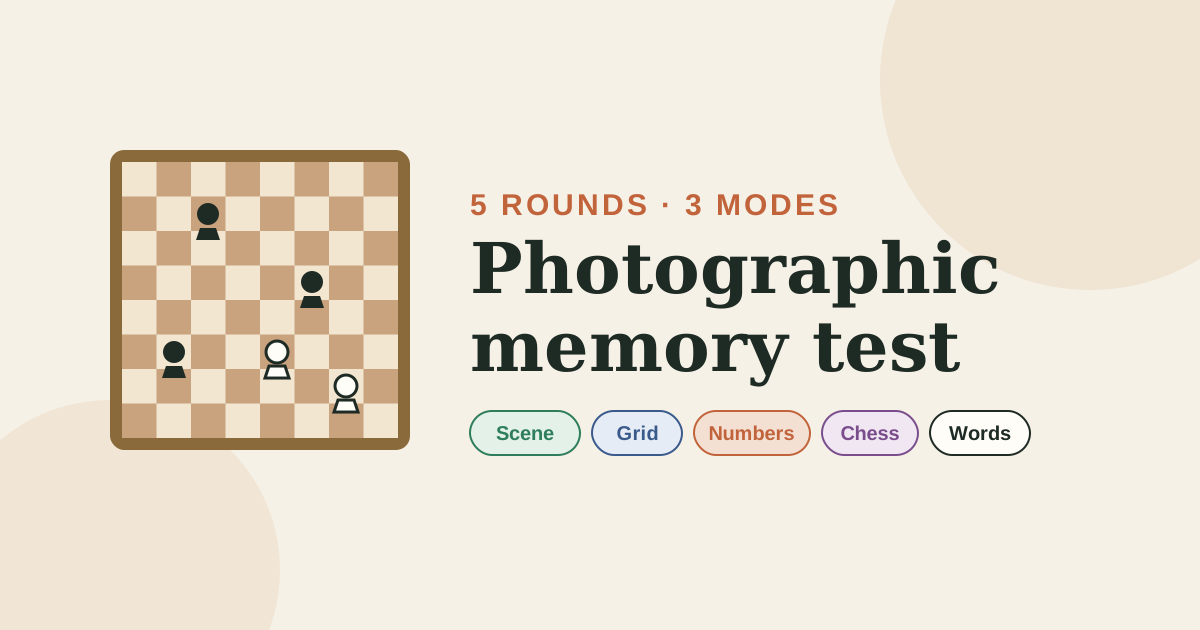
The exception: expert pattern recognition is learned. In classic studies, chess players saw a position for a few seconds and then rebuilt it from memory.
Chess players recalling a position after a few seconds
Share of about 25 pieces placed correctly
- Masters, real game
- about 93%
- Experts, real game
- about 72%
- Novices, real game
- about 33%
- Everyone, random board
- 3 or 4 pieces
Masters placed "about 93%" of the pieces correctly from real games, yet on boards with pieces scattered at random, "all players, from master to novice, recalled only about three or four pieces" (Simon and Chase, 1973). Their skill was a store of familiar patterns, estimated at around 50,000 "chunks" (Gobet and Simon, 1996), built over about a decade of play. Radiologists show the same kind of learned skill: shown a mammogram for half a second, they could tell normal from abnormal better than chance, even from the healthy breast of a patient with cancer in the other one, while being unable to say where the problem was (Evans and others, 2016).
So spotting a new rule in an unfamiliar puzzle is a good sign of reasoning ability. Spotting patterns in your own field is mostly a sign of experience.
Seeing patterns that aren't there
A brain that hunts for patterns will sometimes find them in noise. Seeing faces in clouds, plugs or burnt toast is called pareidolia. In one study, people looked at pure visual noise after being told that half the images contained a face or a letter; they "reported seeing faces or letters illusorily 34% and 38% of the time" (Liu and others, 2014). The study, nicknamed "seeing Jesus in toast", won its authors an Ig Nobel Prize (University of Toronto).
The broader habit of finding meaning in random events is called apophenia. In one study, people with stronger schizotypal and delusion-prone traits saw more connections in random sequences (Fyfe and others, 2008). It is linked to personality, not to how intelligent someone is. Good pattern tests guard against it by having one rule that explains every item, which is why checking your rule against the whole puzzle matters.
Can you get better at pattern recognition?
At pattern tests, clearly yes. A 2018 meta-analysis of 122 studies and more than 150,000 people found that retaking a cognitive ability test raised scores by 0.33 standard deviations at the second attempt, about 5 points on the IQ scale, and by 0.50 at the third, with "no further score gains after the third test administration" (Scharfen, Peters and Holling, 2018). That is why familiarity with the formats is worth real points, and why scores on pattern tests are best compared on a first attempt.
Whole populations have improved too. IQ test scores rose through the 20th century, the Flynn effect, and the gains were largest on fluid reasoning tests: about 0.41 IQ points a year, against 0.21 for crystallized knowledge, in a meta-analysis of nearly 4 million people, although the gains have slowed in recent decades (Pietschnig and Voracek, 2015). Our guide to average IQ explains why.
Can a sound increase your IQ by 40 points?
Online ads promise that listening to a short audio track, sometimes described as "sonic intelligence" or brainwave audio, will raise IQ by 40 points, often naming the Karolinska Institute in Sweden as the source. We looked for the research and could not find it.
We found no such study. A search of PubMed for Karolinska-affiliated research on sound or auditory stimulation and IQ returned no results. Karolinska's real finding on screen time and intelligence was far smaller: children who played more video games than average gained "approximately 2.5 IQ points more than the average" over two years (Karolinska Institutet, 2022).
The wider evidence on sound and intelligence points the same way. A meta-analysis of about 40 studies with more than 3,000 participants found "no support for gains in spatial ability specifically due to listening to Mozart music" (Pietschnig, Voracek and Formann, 2010). A 2023 review of binaural beats, the most common "brainwave" audio, found five studies supporting the idea, eight contradicting it and one mixed (Ingendoh, Posny and Heine, 2023).
For scale, 40 points would take someone from an average score of 100 to 140, the level of about 1 person in 260. No method known to science does that. Fake "genius" ads often borrow the name of a real university or hospital to look credible, as a fact-check of one such ad found (AAP FactCheck), and regulators have acted against unsupported brain claims before: in 2016 the US Federal Trade Commission fined the brain-training company Lumosity $2 million, saying it "simply did not have the science to back up its ads" (FTC).
Pattern recognition: humans vs AI
Computers have long been superb at some kinds of pattern recognition, such as reading handwriting or spotting faces in photos. But puzzles that need a new rule worked out from a few examples, exactly what this test asks, have proved much harder. In 2019 the AI researcher François Chollet created the Abstraction and Reasoning Corpus (ARC), a set of grid puzzles that he argued "can be used to measure a human-like form of general fluid intelligence" (Chollet, 2019).
When 1,729 people were tested on all 800 public ARC puzzles, they averaged 76.2% on the training set and 64.2% on the harder evaluation set (LeGris and others, 2024). As of December 2024, the benchmark "remains unbeaten": the best AI score on its private test set was 55.5%, short of the 85% prize target (ARC Prize 2024 report). AI scores move quickly, so check the ARC Prize site for the latest results. For now, finding a new rule from a handful of examples is one of the things people still do remarkably well.
Frequently asked questions
What is a pattern recognition test?
A pattern recognition test gives you sequences, grids or groups of numbers, letters or shapes that follow hidden rules, and asks you to find what comes next, what is missing or what doesn't belong. It measures inductive reasoning: working out a rule from examples. Pattern questions make up a large part of most IQ tests.
Is pattern recognition a sign of intelligence?
Largely, yes. Pattern puzzles such as Raven's Progressive Matrices are among the strongest single markers of general intelligence: Raven's shares about half of its variance with the general factor of intelligence. But pattern recognition in a particular field, like chess or reading X-rays, is mostly learned through years of experience, so it says more about expertise than about IQ.
Can a pattern IQ test tell me my IQ?
Not on its own. A short practice test like this one has no norm group, so it can't be turned into an IQ score. Even Raven's, the best-known pattern test, is not a complete measure: researchers advise against using it alone to estimate general intelligence. A full IQ test also covers verbal, spatial, memory and speed abilities.
What is a good score on a pattern recognition test?
On this test, 10 or more out of 12 is a strong result and 7 to 9 is solid. On normed tests, scores are given on the IQ scale, where 100 is average and the standard deviation is usually 15. Without a norm group, the most useful comparison is with your own earlier attempts.
How do you get better at pattern recognition tests?
Learn the common rules and practise them. Most number series use changing gaps or alternating operations, and most matrices use rotation, counting, adding or removing parts, or each item appearing once per row. Retaking similar tests raises scores by about a third of a standard deviation, with little extra gain after the third attempt.
What kinds of questions are in a pattern recognition test?
The usual formats are number series, letter series, matrices (a grid with a missing piece), figure sequences (shapes that change step by step) and odd one out. This test includes all five.
Can music or a sound track raise your IQ by 40 points?
There is no evidence that it can. We found no Karolinska Institute study showing that a sound recording raises IQ, a meta-analysis of about 40 studies found no specific benefit from listening to Mozart, and studies of binaural beats give inconsistent results. A 40-point gain would move an average person to the level of the top 1%.
Why do I see patterns that aren't there?
Because the brain is built to find patterns, it sometimes finds them in randomness. Seeing faces in clouds or toast is called pareidolia. In one study, people told that random visual noise might contain faces reported seeing a face 34% of the time. It is normal and not a sign of low or high intelligence.
Can AI do pattern recognition tests?
Computers are excellent at some kinds of pattern recognition, but puzzles designed to need human-style reasoning have proved hard. On the ARC benchmark of visual pattern puzzles, people averaged 64.2% on its hardest public set, and as of December 2024 no AI system had reached the 85% prize target.
Sources
- American Psychological Association, APA Dictionary of Psychology: pattern recognition, inductive reasoning, deviation IQ.
- Thurstone, L. L. and Thurstone, T. G. (1941). Factorial studies of intelligence. Psychometric Monographs, 2.
- Schrank, F. A. and others. Essentials of WJ III Cognitive Abilities Assessment, chapter 1 (Wiley excerpt).
- Pearson. WAIS-5 overview.
- Gignac, G. E. (2015). Raven's is not a pure measure of general intelligence: implications for g factor theory and the brief measurement of g. Intelligence, 52, 71–79.
- Valentin Kvist, A. and Gustafsson, J.-E. (2008). The relation between fluid intelligence and the general factor as a function of cultural background: a test of Cattell's investment theory. Intelligence, 36(5), 422–436.
- Mattson, M. P. (2014). Superior pattern processing is the essence of the evolved human brain. Frontiers in Neuroscience, 8, 265.
- Simon, H. A. and Chase, W. G. (1973). Skill in chess. American Scientist, 61.
- Gobet, F. and Simon, H. A. (1996). Recall of random and distorted chess positions: implications for the theory of expertise. Memory & Cognition, 24(4), 493–503.
- Evans, K. K. and others (2016). A half-second glimpse often lets radiologists identify breast cancer cases even when viewing the mammogram of the opposite breast. PNAS, 113(37), 10292–10297.
- Liu, J. and others (2014). Seeing Jesus in toast: neural and behavioral correlates of face pareidolia. Cortex, 53, 60–77.
- Fyfe, S., Williams, C., Mason, O. J. and Pickup, G. J. (2008). Apophenia, theory of mind and schizotypy: perceiving meaning and intentionality in randomness. Cortex, 44(10), 1316–1325.
- Scharfen, J., Peters, J. M. and Holling, H. (2018). Retest effects in cognitive ability tests: a meta-analysis. Intelligence, 67, 44–66.
- Pietschnig, J. and Voracek, M. (2015). One century of global IQ gains: a formal meta-analysis of the Flynn effect (1909–2013). Perspectives on Psychological Science, 10(3), 282–306.
- Karolinska Institutet (2022). Video games can help boost children's intelligence.
- Pietschnig, J., Voracek, M. and Formann, A. K. (2010). Mozart effect–Shmozart effect: a meta-analysis. Intelligence, 38(3), 314–323.
- Ingendoh, R. M., Posny, E. S. and Heine, A. (2023). Binaural beats to entrain the brain? A systematic review of the effects of binaural beat stimulation on brain oscillatory activity, and the implications for psychological research and intervention. PLOS ONE, 18(5), e0286023.
- AAP FactCheck (2021). "Einstein island" ad is all at sea with fakery.
- US Federal Trade Commission (2016). Lumosity to pay $2 million to settle FTC deceptive advertising charges for its "brain training" program.
- Chollet, F. (2019). On the measure of intelligence. arXiv:1911.01547.
- LeGris, S., Vong, W. K., Lake, B. M. and Gureckis, T. M. (2024). H-ARC: a robust estimate of human performance on the Abstraction and Reasoning Corpus benchmark. arXiv:2409.01374.
- Chollet, F. and others (2024). ARC Prize 2024: technical report. arXiv:2412.04604.
Ready for the full IQ test?
36 questions on fluid, logical, spatial and numerical reasoning, with your estimated IQ score and percentile as soon as you finish. Free, with no sign-up.
Take the free IQ test