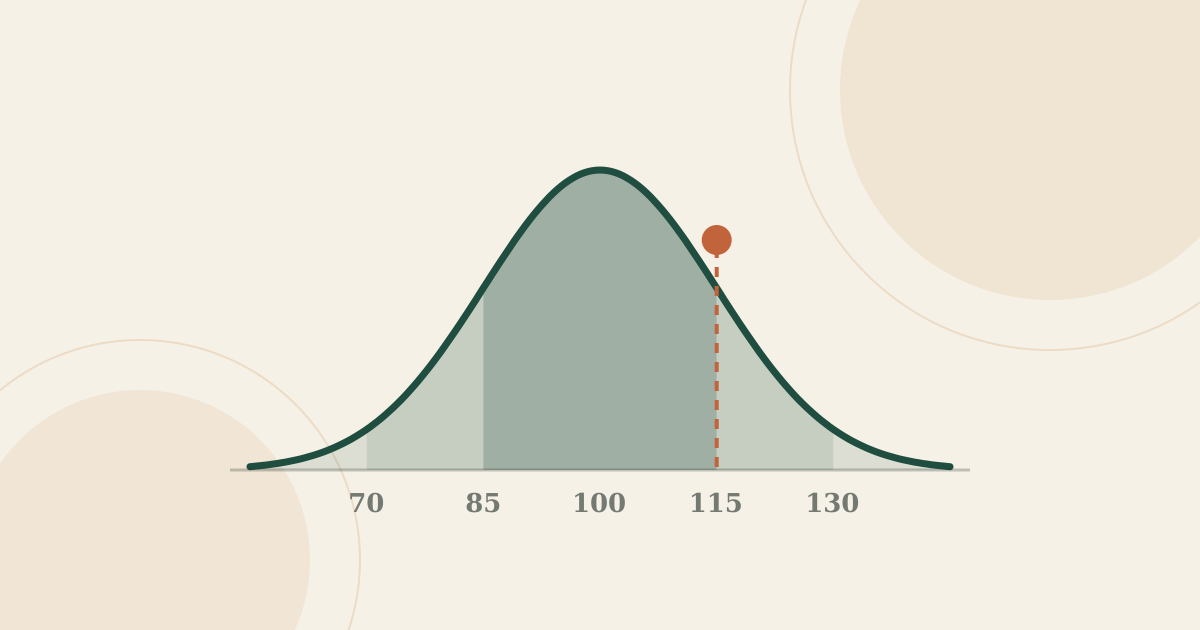
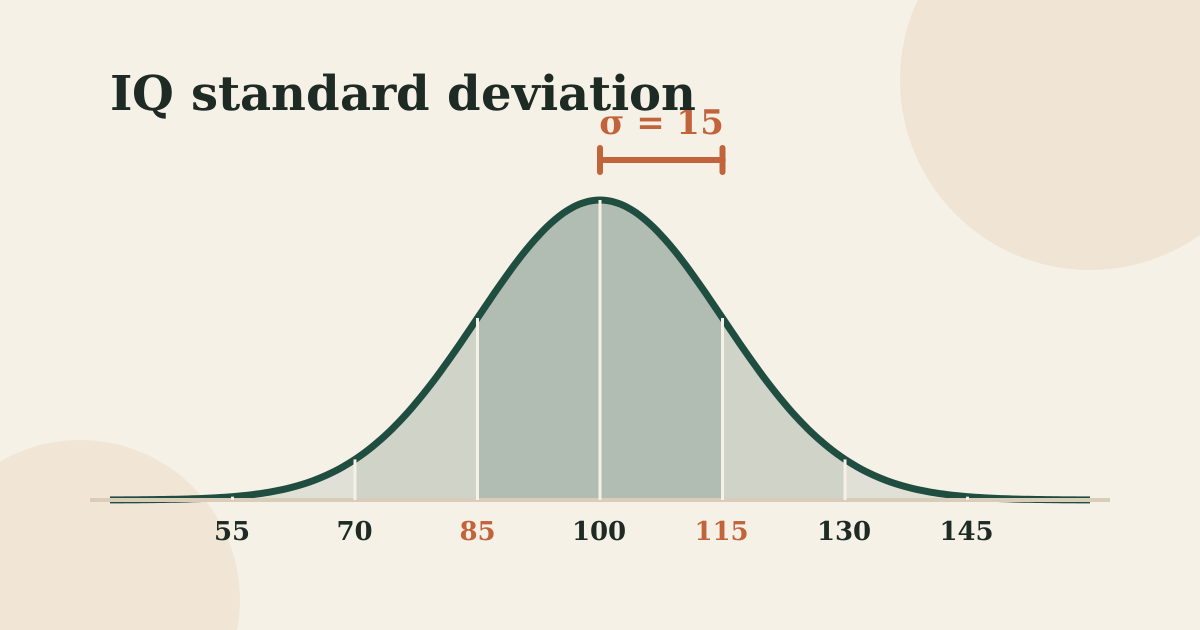
In short: the average IQ is 100. That isn't a discovery but a rule: IQ tests are scaled so that the middle of the population scores 100. Scores from about 90 to 109 count as average, and around two in three people score between 85 and 115.
Why the average IQ is always 100
An IQ score doesn't count how many questions you got right. It describes how your result compares with a large group of people who took the same test, known as the norm group. Test makers set the scale so that the average result in that group becomes 100, and the typical spread of scores becomes 15 points.
This is why you'll never read that "the average IQ is 103" for a professional test in current use. If people start doing better on a test over the years, the publisher re-norms it with a fresh group, and the middle is set back to 100. The number stays the same; what it takes to reach it changes.
What counts as a normal IQ?
"Normal" isn't a technical term, but people usually mean the average range. Psychologists most often label 90 to 109 as average, which covers about half the population. Scores of 80 to 89 are called low average and 110 to 119 high average, so a much wider band, roughly 80 to 120, describes the large majority of people.
In other words, there is a lot of room in "normal". Two people who score 96 and 104 could easily swap places on another day: the gap between them is within the margin of error of a professional test, which is about five points either way. Our IQ range chart shows every score range and how rare each one is.
How tests decide what "average" is
Before a professional IQ test is published, it is given to a large norm group, often a couple of thousand people, chosen to match the population by age, sex, education and region. Their results set the yardstick: whatever the middle of that group achieved becomes 100 for everyone who takes the test afterwards.
Because people's performance drifts over the years, the yardstick has to be renewed. The adult Wechsler test, for example, has been re-standardised roughly every 11 to 16 years since the 1980s: the WAIS-III appeared in 1997, the WAIS-IV in 2008 and the WAIS-5 in 2024, with norms collected in 2023 and 2024. Each new edition is normed on a fresh group so that 100 keeps meaning "typical for people today".
This has a practical consequence. A score from an old test edition, measured against out-of-date norms, can come out a few points higher than the same performance measured against current norms. Psychologists take the test edition into account when comparing results from different years.
Average IQ by age
The average IQ is 100 at every age. Professional tests compare you only with people of your own age: the Wechsler Intelligence Scale for Children covers ages 6 to 16, and the adult version, the WAIS-5, has separate norms for age groups from 16 to 90. So a typical 10-year-old, a typical 40-year-old and a typical 80-year-old all score 100.
| Age | Average IQ | Usual professional test | What to know |
|---|---|---|---|
| 2½ to 7 | 100 | WPPSI-IV (preschool and early school) | Scores move a lot between tests at this age |
| 6 to 16 | 100 | WISC-V (children) | Scores become steadily more stable through school |
| 16 to 24 | 100 | WAIS-5 (adults) | Fluid reasoning is at or near its peak |
| 25 to 64 | 100 | WAIS-5 | Knowledge and vocabulary keep growing |
| 65 to 90 | 100 | WAIS-5 | Speed slows, but you are compared with your own age group |
Each test is normed separately for narrow age bands, so the average at every age is 100. The WPPSI-IV covers ages 2 years 6 months to 7 years 7 months, the WISC-V 6 to 16 and the WAIS-5 16 to 90.
That doesn't mean abilities stay still. Raw performance changes a great deal through life, in two broad patterns:
- Fluid reasoning, solving new problems quickly, rises through childhood, tends to peak in early adulthood and then slowly declines.
- Crystallised knowledge, such as vocabulary and general knowledge, keeps growing for much longer and often holds steady well into later life.
Our guide to fluid vs crystallized intelligence shows when each kind of ability peaks. So an 80-year-old with an IQ of 100 is solving new puzzles more slowly than they did at 25, but just as well as the typical 80-year-old. The chart above works as an IQ score chart by age: the dashed line, the average, never moves.
Average IQ by age for males and females
The average is 100 for both, at every age. As the American Psychological Association's review of intelligence research put it, "most standard tests of intelligence have been constructed so that there are no overall score differences between females and males" (Neisser and others, 1996). Small differences show up on some individual kinds of task, but not in the overall IQ score.
Does IQ change with age?
It depends on what you mean by IQ. Your IQ score, your position compared with people your own age, becomes fairly settled from the teenage years. Your raw abilities, how fast and how much you can actually do, keep changing all your life.
- Scores settle in adolescence. A 2024 review of 205 studies found that scores in young children shift a lot. Stability good enough for decisions about one child can only be expected from about age 7, and then over short periods. From about age 14, scores stay reasonably stable for the rest of life (Breit and others, 2024).
- Different abilities peak at different ages. A 2015 study drawing on tens of thousands of people found that "some abilities peak and begin to decline around high school graduation; some abilities plateau in early adulthood, beginning to decline in the 30s; still others do not peak until the 40s or later". Vocabulary peaked around 65 in their online data (Hartshorne and Germine, 2015).
- Some decline starts early, some growth continues late. Timothy Salthouse concluded that "some aspects of age-related cognitive decline begin in healthy educated adults when they are in their 20s and 30s", while vocabulary and general knowledge keep increasing until at least 60 (Salthouse, 2009).
So does IQ increase or decrease with age? Raw ability rises fast through childhood, peaks for most reasoning skills in early adulthood and then slowly declines, while knowledge keeps growing. Your IQ score, measured against your own age group, usually changes far less.
Average IQ over time: the Flynn effect and its reversal
Through most of the 20th century, people around the world got steadily better at IQ tests. A 2015 analysis of studies covering nearly 4 million people in 31 countries, from 1909 to 2013, found average gains of about 3 IQ points per decade. In psychology, this rise is known as the Flynn effect, after the researcher James Flynn who made it widely known.
Because tests are re-normed, the average is always reset to 100. But it means that a person who scores 100 against today's norms would have scored well above 100 against norms from several decades ago. Researchers have linked the gains to environmental changes, such as better nutrition, health, economic conditions and longer schooling. The causes are still debated, and the gains don't simply mean people became more intelligent across the board.
In some countries the rise has slowed or reversed. A 2018 study of Norwegian military conscripts born between 1962 and 1991 found that scores rose and then fell for those born after the mid-1970s. Because the same pattern appeared when comparing brothers within the same families, the authors concluded that the causes are environmental, not genetic, although exactly which changes are responsible is still debated. For how averages compare between nations, and why those figures are disputed, see our guide to average IQ by country.
Average IQ for children and teenagers
The average IQ for a 10-year-old, a 12-year-old, a 13-year-old, a 14-year-old or a 16-year-old is 100, exactly as for adults, because each child is measured against others of the same age. A 9-year-old is never compared with adults. What differs is stability: scores for very young children can move noticeably between tests, because children develop at different speeds. Scores generally become more stable through the school years and into adulthood.
For that reason, psychologists are careful about drawing firm conclusions from a single test in early childhood, and they look at a child's everyday learning and development alongside any score.
Is an average score good enough?
For almost everything in life, yes. A score in the average range means you reason as well as most people around you. IQ scores are linked with how people tend to do at school, but many other things matter at least as much: motivation, persistence, interests, support, health and experience. Plenty of people with average scores do very well in demanding careers, and plenty with high scores don't.
It's also worth remembering what an IQ test leaves out. It doesn't measure creativity, practical skills, emotional understanding or expertise in a subject you love.
Common myths about what's average
An IQ of 100 means you got 100% right.
100 means you scored in the middle compared with others your age. It has nothing to do with percentages.
Adults have a higher average IQ than children.
Everyone is compared with their own age group, so the average is 100 at every age.
The average IQ is falling everywhere.
Scores rose for most of the last century. Recent declines have been found in some countries, not all, and researchers are still studying why.
Famous geniuses had IQs of 200.
Very high numbers like this usually come from old formulas designed for children, or are simply guesses. Modern professional tests rarely measure reliably beyond about 160.
Frequently asked questions
Is an IQ of 100 good?
Yes. 100 is exactly average, which means you scored higher than about half of people your age. It is a perfectly good score for school, work and everyday life.
What is the average IQ for a 12, 13 or 14-year-old?
It is 100, the same as for any other age. Professional tests compare each person with others of the same age, so a 13-year-old who scores 100 is right in the middle for 13-year-olds.
Why can a child's IQ score change between tests?
Scores for young children are less stable than for adults. Children develop at different speeds, so their position compared with others their age can shift, especially before the school years. Tiredness, mood and how familiar the tasks feel also play a part at any age.
Is the average IQ different in different countries?
Tables of average IQ by country are widely shared, but many of the figures rest on small or unrepresentative samples, and about a quarter are estimates copied from neighbouring countries. Our IQ by country page shows them side by side with World Bank test scores and explains how far each can be trusted.
Does IQ increase with age?
Raw reasoning ability grows quickly through childhood and peaks for most skills in early adulthood, while vocabulary and knowledge keep growing into later life. Your IQ score itself, which compares you with people your own age, tends to stay fairly stable from the teenage years.
What is the Flynn effect in psychology?
The usual definition of the Flynn effect in psychology is the rise in average IQ test scores seen across generations through most of the 20th century, about 3 points per decade in a 2015 analysis of studies covering nearly 4 million people. It is named after the researcher James Flynn. Tests are re-normed so the average stays at 100, and in some countries the rise has since slowed or reversed.
Can my IQ be below average and still go up?
Your measured score can change, especially with practice on the question types, better rest, or less stress on the day. Your underlying reasoning ability changes more slowly. A single result is best read as a rough guide, not a fixed label.
Sources
- Pietschnig, J. and Voracek, M. (2015). One century of global IQ gains: a formal meta-analysis of the Flynn effect (1909–2013). Perspectives on Psychological Science, 10(3), 282–306.
- Bratsberg, B. and Rogeberg, O. (2018). Flynn effect and its reversal are both environmentally caused. Proceedings of the National Academy of Sciences, 115(26), 6674–6678.
- Wechsler Adult Intelligence Scale, Fifth Edition, Pearson: age range and norms.
- Wechsler Preschool and Primary Scale of Intelligence, Fourth Edition, Pearson: the WPPSI-IV age range, 2 years 6 months to 7 years 7 months.
- What's new with the WAIS-5?, Pearson: the 2023–2024 norms.
- Intelligence test, Encyclopaedia Britannica: how IQ scores are scaled.
Above, below or right on average?
Take the free Assessivo IQ test: 36 questions, 25 minutes, and your estimated IQ score and percentile as soon as you finish.
Take the free IQ test