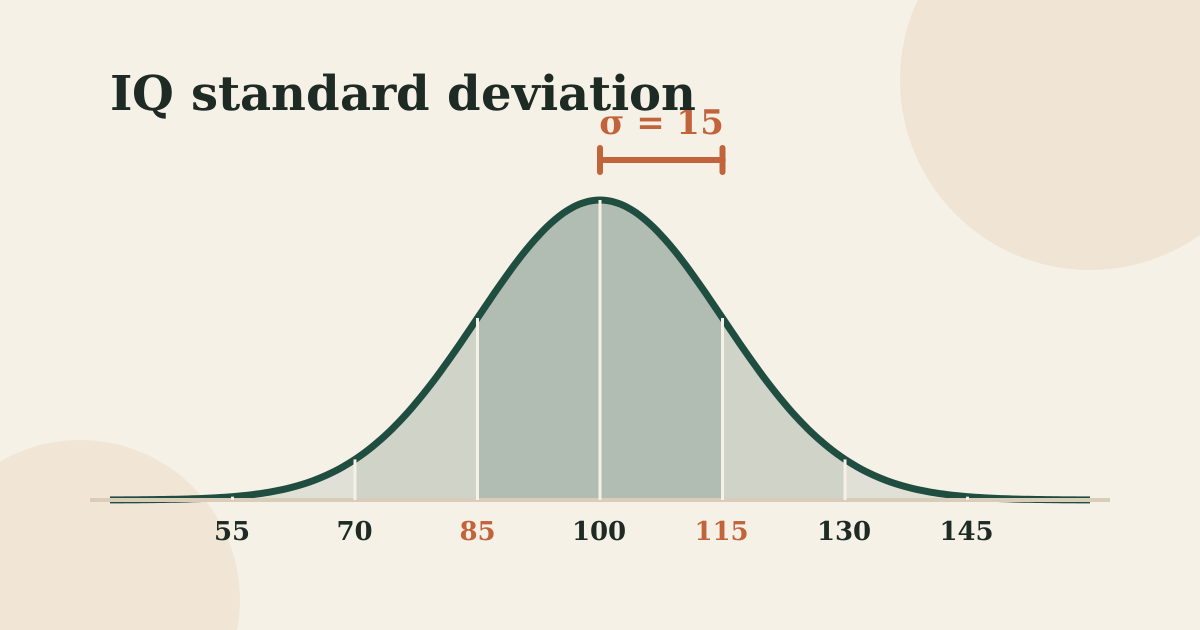
In short: the IQ scale is set so that the average score is 100, with a standard deviation of 15. Scores of 90 to 109 are the average range. About 68% of people score between 85 and 115, and about 95% score between 70 and 130. A score of 130 or more is higher than about 98% of people.
What is the IQ scale?
IQ stands for intelligence quotient. An IQ score is a way of describing how someone's reasoning ability compares with other people of the same age. It is not a count of how much you know. It shows where your test performance sits within a large reference group. Our guide What is IQ? explains what the tests measure and what they leave out.
Put simply, the IQ scale is the scale for IQ scores: a ruler that turns test performance into a number, so results from different people, and different tests, can be compared. Its score bands are what people mean by IQ levels or intelligence quotient ranges.
Most modern IQ tests, including the Wechsler and Stanford-Binet scales, use the same scale. The average score in the reference group is set to 100 and the standard deviation, a measure of how spread out the scores are, is set to 15. So a score of 115 is one standard deviation above average, and a score of 85 is one standard deviation below.
A few tests use a wider spread, such as 24 points on the Cattell scale, so the same ability can produce different numbers. Reaching the top 2% means a score of 130 on the Wechsler scale but about 148 on the Cattell scale. When comparing IQ scores, it helps to know which test they came from. Our guide to IQ standard deviation explains the difference and converts between scales.
Because scores are spread out in a predictable bell shape, any IQ score can be turned into a percentile: the share of people who score lower than you. The IQ charts on this page show both.
Where IQ scores come from
The first practical intelligence test was created in France in 1905 by Alfred Binet and Théodore Simon, to find schoolchildren who needed extra support. It described a child's performance as a "mental age". In 1912 the German psychologist William Stern suggested dividing mental age by actual age, and the American psychologist Lewis Terman multiplied the result by 100 for his Stanford-Binet test in 1916. A 10-year-old performing like a typical 12-year-old scored 120. This is where the word "quotient" comes from.
The formula worked poorly for adults, whose mental age stops rising. In 1939 David Wechsler introduced a better method: compare each person with others of the same age and place them on a scale with an average of 100. Almost all modern tests use this "deviation IQ", which is what the IQ scale on this page describes (Britannica).
IQ chart: score ranges, levels and classifications
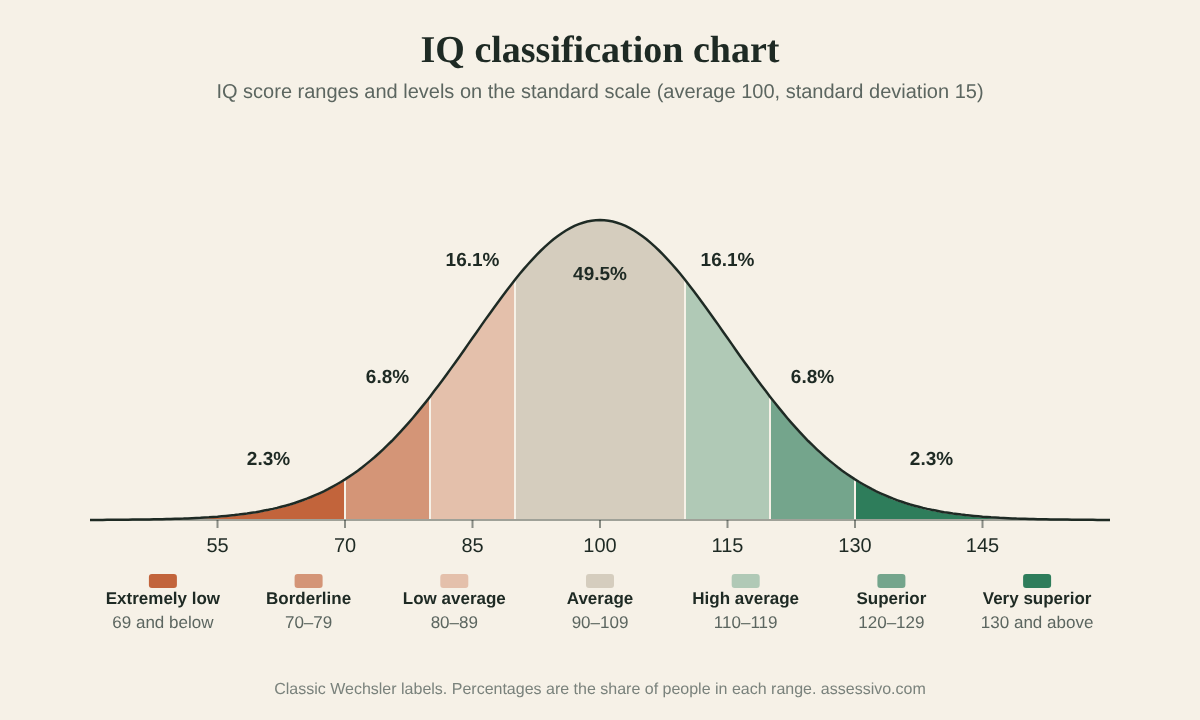
Psychologists group IQ scores into ranges, often called IQ levels, each with a descriptive label. The labels below are the ones used for many years by the Wechsler intelligence scales, the most widely used professional IQ tests. Newer editions use more neutral wording, such as "very high" instead of "superior".
| IQ score | Classification | Share of people | Newer label |
|---|---|---|---|
| 130 and above | Very superior | 2.3% | Extremely high |
| 120–129 | Superior | 6.8% | Very high |
| 110–119 | High average | 16.1% | High average |
| 90–109 | Average | 49.5% | Average |
| 80–89 | Low average | 16.1% | Low average |
| 70–79 | Borderline | 6.8% | Very low |
| 69 and below | Extremely low | 2.3% | Extremely low |
Shares are calculated from the standard IQ scale (average 100, standard deviation 15). Real test results vary slightly from test to test.
These labels describe where a score sits on the scale. They don't measure a person's worth, character or potential, and two people with the same score can have very different strengths.
IQ levels and their meaning
Here is what each of the seven IQ levels means in practice, with how common it is. The same intelligence quotient ranges are used for children and adults, because everyone is compared with people of their own age.
Different tests and countries use slightly different IQ test ranges and labels, and many professional reports now avoid words like "superior" altogether. The numbers matter more than the names: the classification only tells you where a score sits, not what a person can do.
What is the normal IQ range?
When people talk about a normal IQ range, they usually mean 90 to 109, the band labelled average in the chart above. About half of everyone scores in it. But "normal" isn't a formal category, and there is a second, statistical way to answer the question: count how far scores sit from 100 in standard deviations.
| IQ score range | Distance from 100 | Share of people |
|---|---|---|
| 85–115 | within 1 standard deviation | about 68%, roughly 2 in 3 |
| 70–130 | within 2 standard deviations | about 95%, roughly 19 in 20 |
| 55–145 | within 3 standard deviations | about 99.7%, all but 3 in 1,000 |
This is the 68–95–99.7 rule that holds for any bell curve.
By the first definition, a score of 112 is above the normal range. By the second, it sits comfortably inside the middle two thirds. Both are fair readings, which is why it helps to give the actual range rather than just saying "normal". A practical summary: about 82% of people, more than 4 in 5, score somewhere from 80 to 119. For what an ordinary score means in daily life and how average scores differ by age, see our guide to average IQ.
The IQ bell curve and range explorer
If you plot everyone's IQ scores, you get a bell curve, also called a normal distribution. Most people are near the middle, and fewer and fewer people score further out in either direction. The chart shows how the population divides across the score ranges. Use the explorer below it to shade any range you like and see what share of people falls inside it.
IQ range explorer
Pick a preset or drag the two sliders. The shaded part of the curve above is the range you chose. Set both sliders to the same number to look up a single score.
About 68.3% of people have an IQ between 85 and 115, about 68 in 100 people.
What is the average IQ?
The average IQ is 100, by design: test makers set the scale so the middle of their reference group scores 100, and scores from about 90 to 109 count as average. Because everyone is compared with people of their own age, the average is 100 for children and adults alike.
Our full guide to average IQ explains what counts as normal, how abilities change with age, and how average scores rose and in some countries fell over the last century.
What is a good IQ score?
Any score in the average range or above is a perfectly good result for everyday life, study and work. From 110 a score is clearly above average, 120 is higher than about 9 in 10 people, and 130 or more, the top 2%, is what most people mean by a high IQ. Our full guide to what counts as a good IQ score covers the Mensa and gifted-programme benchmarks, what higher scores do and don't predict, and a checker for your own score.
What IQ is considered genius level?
There is no official "genius" IQ score. Psychologists don't use the word as a category, and no professional test labels anyone a genius. In everyday use, a genius IQ usually means a score of 140 or more, which is higher than about 99.6% of people, or about 1 in 261.
Some other useful reference points:
- 130: the usual entry level for high-IQ societies such as Mensa, which accepts people in the top 2% on an approved, supervised test.
- 145: three standard deviations above average, about 1 in 741 people.
- 160: four standard deviations above average, about 1 in 31,560 people. Most tests can't measure reliably this far out.
You may have seen figures like "Einstein's IQ was 160". Albert Einstein never took an IQ test, so numbers like this are guesses, not measured scores. Claims of 200 and more get the same treatment in our look at the highest IQ in the world.
IQ percentile chart
A percentile tells you what share of people score below a given IQ. For example, an IQ of 115 is at about the 84th percentile, so it is higher than about 84% of people. Use this chart to read any score, or the IQ percentile calculator for exact figures and the reverse question: what IQ puts you in the top 5% or 1%.
| IQ score | Percentile | Higher than | How rare |
|---|---|---|---|
| 70 | 2.3 | about 2.3% of people | – |
| 80 | 9.1 | about 9.1% of people | – |
| 85 | 15.9 | about 15.9% of people | – |
| 90 | 25.2 | about 25.2% of people | – |
| 100 | 50 | about 50% of people | – |
| 110 | 74.8 | about 74.8% of people | 1 in 4 |
| 115 | 84.1 | about 84.1% of people | 1 in 6 |
| 120 | 90.9 | about 90.9% of people | 1 in 11 |
| 125 | 95.2 | about 95.2% of people | 1 in 21 |
| 130 | 97.7 | about 97.7% of people | 1 in 44 |
| 135 | 99.02 | about 99.02% of people | 1 in 102 |
| 140 | 99.62 | about 99.62% of people | 1 in 261 |
| 145 | 99.87 | about 99.87% of people | 1 in 741 |
| 150 | 99.957 | about 99.957% of people | 1 in 2,330 |
| 160 | 99.997 | about 99.997% of people | 1 in 31,560 |
"How rare" is the share of people who score at that level or higher.
Look up any IQ score from 55 to 180
Every score from 55 to 180 has its own page, with its percentile, how rare it is, its likely range on a professional test and how it compares with nearby scores. The pages below 85 also explain how professionals assess intellectual disability and borderline intellectual functioning, mental age and why an online result can come out low. The pages from 146 to 180, above the range of most online tests, cover high-IQ society entry, test ceilings and famous figures rated at each level.
Extremely low (55–69)
Borderline (70–79)
Low average (80–89)
Average (90–109)
- IQ 90
- IQ 91
- IQ 92
- IQ 93
- IQ 94
- IQ 95
- IQ 96
- IQ 97
- IQ 98
- IQ 99
- IQ 100
- IQ 101
- IQ 102
- IQ 103
- IQ 104
- IQ 105
- IQ 106
- IQ 107
- IQ 108
- IQ 109
High average (110–119)
Superior (120–129)
Very superior (130–145)
Highly and exceptionally gifted (146–180)
- IQ 146
- IQ 147
- IQ 148
- IQ 149
- IQ 150
- IQ 151
- IQ 152
- IQ 153
- IQ 154
- IQ 155
- IQ 156
- IQ 157
- IQ 158
- IQ 159
- IQ 160
- IQ 161
- IQ 162
- IQ 163
- IQ 164
- IQ 165
- IQ 166
- IQ 167
- IQ 168
- IQ 169
- IQ 170
- IQ 171
- IQ 172
- IQ 173
- IQ 174
- IQ 175
- IQ 176
- IQ 177
- IQ 178
- IQ 179
- IQ 180
What below-average scores mean
Scores from 80 to 89 are called low average, and scores from 70 to 79 are called borderline (or "very low" on newer tests). About 1 in 6 people score in the low average range, so it is a common result. Each of these scores has its own page, for example IQ 80 or IQ 75.
A score below 70 on a professional test is one of the things a psychologist considers when assessing an intellectual disability, but a diagnosis never rests on a number alone. It also looks at everyday skills and at how a person has developed over time. A low score on an online test is not a diagnosis of anything (see what an IQ of 70 means). Tiredness, distractions, unfamiliar question styles and the device you use can all pull a score down.
How IQ is calculated and measured
Professional IQ tests, such as the Wechsler Adult Intelligence Scale (WAIS) for adults and the Wechsler Intelligence Scale for Children, are given one to one by a trained psychologist. The current adult version, the WAIS-5, takes about 45 to 60 minutes for the core tasks, longer if extra tasks are added. They include a mix of tasks covering verbal understanding, visual and spatial reasoning, fluid reasoning, working memory and processing speed.
Each group of tasks produces an index score. A core set of the tasks also produces a full scale IQ, the single number most people mean when they talk about their IQ. Scores are worked out by comparing your answers with a large, carefully chosen reference group of people your age.
To calculate an IQ score, the test first counts your correct answers, then works out how far that result is from the reference group's average, measured in standard deviations. Each standard deviation is worth 15 points, so a result one standard deviation above average becomes an IQ of 115, and two below becomes 70. Our guide to the IQ standard deviation explains why most tests use 15.
Every test score has some uncertainty. Professional reports usually give a confidence interval, such as "112, with a likely range of 107 to 117", rather than treating the score as exact.
IQ scores and age
Because each person is compared with others of their own age, IQ scores tend to be fairly stable through adult life. Two kinds of ability change differently with age, though. Fluid reasoning, solving new problems you haven't seen before, tends to peak in early adulthood and slowly decline. Crystallised knowledge, such as vocabulary and general knowledge, often holds steady or keeps growing well into later life. Our guide to fluid vs crystallized intelligence explains the difference, with the ages at which each ability peaks.
Scores can also move a few points between test sessions because of practice, sleep, stress and health. That is normal and one reason a single result is best read as a range.
Can an online IQ test tell you your IQ?
An online test can't give you an official IQ score, but a well-designed one can give you a useful estimate of where you sit on the IQ scale and which kinds of reasoning are your strongest. Our guide Are online IQ tests accurate? explains what separates a real test from a quiz.
To check your IQ level for free, try the Assessivo IQ test. It has 36 questions across four areas: fluid, logical, spatial and numerical reasoning. Each attempt draws fresh questions from a pool of 960. Your score is placed on the IQ scale described on this page, and you see your estimated IQ score and percentile as soon as you finish. You can read more about how the test works, or warm up first with some sample IQ test questions with answers.
For an official score, for example for school, work or a medical question, speak to a qualified psychologist.
Frequently asked questions
Can you increase your IQ?
To a degree. Practising puzzles like the ones on IQ tests usually raises scores on those tests by a few points, mostly because the question styles become familiar. Research also links extra years of education with modestly higher IQ scores. Brain-training games, on the other hand, tend to improve only the games themselves. Good sleep and not testing when tired or stressed help you show your real ability. What the evidence says about increasing your IQ →
What is the highest IQ score possible?
In theory the IQ scale has no top or bottom, because it only describes how far a result is from the average. In practice, most professional IQ tests cannot measure reliably much beyond about 160, because so few people score that high that there is little data to compare them with. The same problem applies at the very low end. Claims of IQs of 200 or more usually come from old formulas designed for children or from unsupervised online tests, not from modern professional tests.
What is the difference between an IQ score and a percentile?
An IQ score is your position on the IQ scale, where 100 is average. A percentile is the share of people who score below you. For example, an IQ of 130 is at about the 98th percentile. A percentile is not the percentage of questions you got right.
Is an IQ of 110 or 115 good?
Yes. Both are above average. An IQ of 110 is higher than about 75% of people, and an IQ of 115, one standard deviation above average, is higher than about 84% of people.
What are the IQ levels?
Psychologists usually describe seven IQ levels: 130 and above (very superior), 120 to 129 (superior), 110 to 119 (high average), 90 to 109 (average), 80 to 89 (low average), 70 to 79 (borderline) and 69 and below (extremely low). Newer tests use more neutral words such as very high and very low.
What is the range of IQ scores?
Most people score between 70 and 130, and about two in three score between 85 and 115. In theory the scale has no fixed ends, but professional tests rarely measure reliably below about 40 or above about 160.
Do online IQ test scores count for Mensa?
No. Mensa only accepts scores from approved intelligence tests taken under supervision. An online test is still a good way to get a feel for where you might stand before booking a supervised test.
Sources
- Intelligence test, Encyclopaedia Britannica: history of IQ testing and the IQ formula.
- Wechsler Adult Intelligence Scale, Fifth Edition, Pearson: the WAIS-5 and how long it takes.
- Getting your IQ tested: FAQs, Mensa International: the top 2% entry rule and approved tests.
Find your place on the IQ scale
Take the free Assessivo IQ test: 36 questions, 25 minutes, instant results. No sign-up or email needed.
Take the free IQ test