In short: there is no verified "highest IQ in the world". The most famous figure, Marilyn vos Savant's 228, came from a childhood test scored with an outdated formula, and Guinness World Records retired the category in 1990 as unreliable. Modern IQ tests can't measure reliably above about 160, and the statistics of the IQ scale suggest the highest IQ among 8 billion people would be around 195.
Who has the highest IQ in the world?
If you search for the highest IQ in the world, you will see the same names again and again: Marilyn vos Savant, William James Sidis, Terence Tao, Kim Ung-yong and Christopher Langan, with numbers from 195 to 300. Each list presents them as facts.
The honest answer is that no one holds a verified record. For several years Guinness World Records did list a "Highest IQ", but it retired the category in 1990, concluding that IQ tests are not reliable enough at the extreme top to crown a single winner. Nothing has replaced it. To see why, it helps to look at where each famous number actually came from.
The highest IQ ever recorded: the claims, checked
We traced each claim back as far as the sources go and gave it a verdict, using the same evidence-first approach as our guide to the IQ of famous people.
| Person | Claimed IQ | Where the number comes from | Verdict |
|---|---|---|---|
| Marilyn vos Savant | 228 | A 1937 Stanford-Binet test at age 10, scored with the old childhood formula | Tested, outdated method |
| William James Sidis | 250–300 | Family hearsay published in 1946, two years after his death | Myth |
| Terence Tao | 220–230 | A children's intelligence test at age 6 (mental age 14), scored with the old childhood formula | Tested, outdated method |
| Kim Ung-yong | 210 | A childhood test, usually said to be the Stanford-Binet, once listed by Guinness | Unverified test |
| Christopher Langan | 195–210 | A figure of 195 quoted on TV, plus an unsupervised mail-in test he took twice | Unverified test |
Marilyn vos Savant: 228
Vos Savant took the 1937 edition of the Stanford-Binet test as a 10-year-old. She has said it put her mental age at 22 years and 10 months, which, divided by her age and multiplied by 100, gives 228. Guinness listed her under "Highest IQ" from 1985 to 1989, and also cited her adult result on the Mega Test, an unsupervised test for very high scorers, which its designer scored as 186.
The 228 has been heavily criticised. The psychologist Alan Kaufman, an author of IQ tests himself, argued in his book IQ Testing 101 that there is no valid way anyone could have scored that high on the test, which used the antiquated ratio formula. Her childhood results have been reported as anything from 167 to 230: a school record gives a lower mental age from a later sitting, recalculations with different ages give 218, and 228 is often rounded up to 230. Vos Savant herself has said that even professional IQ tests are primitive measures of intelligence. She went on to write the long-running "Ask Marilyn" column, famous for her answer to the Monty Hall probability puzzle.
William James Sidis: 250–300
Sidis was a genuine prodigy. He entered Harvard in 1909 at the age of 11 and in January 1910 lectured the Harvard Mathematical Club on four-dimensional bodies. But nothing shows he ever sat an IQ test. The 250–300 figure first appeared in a 1946 book, two years after his death, repeating what a psychologist had heard from his family. It is hearsay, not a score.
Terence Tao: 220–230
Tao is one of the most gifted mathematicians alive. He scored 760 on the maths section of the SAT at the age of 8, won a gold medal at the International Mathematical Olympiad at 13, still the youngest gold medallist in its history, and received the Fields Medal, mathematics' highest honour, in 2006. Those achievements are documented, and so is the source of his IQ figure: at 6 years 4 months a psychologist found his mental age to be 14, which the old ratio formula turns into about 221. Tao himself says the test is "extremely noisy at these scales" and that "greater than 175" is a more realistic estimate. Our article on Terence Tao's IQ covers the full story.
Kim Ung-yong: 210
A South Korean child prodigy who reportedly attended university physics classes as a young child, Kim was listed by Guinness with an IQ of 210, reportedly from a Stanford-Binet test in early childhood, though when and how it was scored have never been documented, and the listing disappeared when Guinness retired the category.
Christopher Langan: 195–210
Langan became known in the media as "the smartest man in America" through magazine and TV features in the late 1990s. On the ABC programme 20/20 in 1999 his IQ was said to have been "measured at 195", without saying on what test; figures of up to 210 are his own estimates. The only scores ever published come from the Mega Test, an unsupervised, untimed test taken by post, which he took twice, and whose scoring has been disputed. The Mega Test is not among the tests Mensa accepts for membership.
Why a 228 isn't a modern IQ
Most record-breaking numbers come from children, and that is no coincidence. Early IQ tests used a different formula from today's, and it produces enormous numbers for exceptional children.
22.8 ÷ 10 × 100 = 228A 10-year-old who answers like a typical 22-year-old scores 228. The number depends on how far ahead of their age a child is, so it can climb almost without limit.100 = average, 15 points = 1 standard deviationModern tests compare you with a large group of people your age. A score shows how rare your result is, so it is limited by how rare a score can be.The old ratio method was abandoned for adults in 1939, when David Wechsler introduced the deviation IQ, and later for children too. Our guide to the IQ scale explains how the modern scale works, and What is IQ? covers what it measures.
How high can IQ go? The statistics ceiling
On the modern scale, an IQ is a statement about rarity. That lets us ask a simple question: how high would the top score be if we could test everyone? The bell curve gives the answer.
Our calculations, on the standard IQ scale (average 100, standard deviation 15), using population figures from the Population Reference Bureau.
In other words, even if a perfect test existed and every person on Earth took it, the top score would most likely be in the mid-190s. A genuine 228 on today's scale would be expected in about 1 person in 141 quadrillion, far more people than have ever lived. That is why record numbers above 200 can't be modern IQ scores. One caveat: the bell curve is a model, and nobody knows exactly how well it fits at such extremes.
How rare is that IQ?
Drag the slider or pick a famous claim to see how many people alive today would be expected to score that high, and whether any real test could measure it.
IQ rarity calculator
On the standard IQ scale, with today's world population of about 8 billion.
Right at the limit of professional IQ tests, which can't reliably measure much higher.
The highest IQ score a real test can give
Every IQ test has a ceiling, the highest score it can report, because a score only means something if enough people were tested to compare with:
- Adult tests such as the Wechsler scales top out around 160 (see what an IQ of 160 means). Above that, so few people score so high that there is almost nothing to compare with. Our guide to the Wechsler IQ test (WAIS) explains how it is scored.
- The Stanford-Binet Fifth Edition offers "extended" scores that can reach 225, designed for assessing exceptionally gifted children. They exist precisely because ordinary scores run out, but numbers that far out rest on very little data.
- "High-range" tests, such as the Mega Test, were built to rank people at the very top. They are usually unsupervised and untimed, their scoring is disputed, and mainstream organisations don't accept them.
High-IQ societies: the real ladder
High-IQ societies are a useful reality check, because they set their entry bars by rarity rather than by eye-catching numbers:
| Society | Entry level | Rarity |
|---|---|---|
| Mensa | Top 2% | 1 in 50 |
| Triple Nine Society | Top 0.1% | 1 in 1,000 |
| Prometheus Society | Top 0.003% | 1 in 30,000 |
| Mega Society | Top 0.0001% | 1 in 1,000,000 |
On the standard scale, Mensa's top 2% corresponds to an IQ of about 130 and the Prometheus Society's 1 in 30,000 to about 160. Beyond that point, the levels can't be measured reliably with any current test, which is why the most selective societies rely on high-range tests.
Famous names and their IQs
Many people search for the highest IQs of famous scientists and celebrities. Most of those numbers are guesses too. We have checked several in detail:
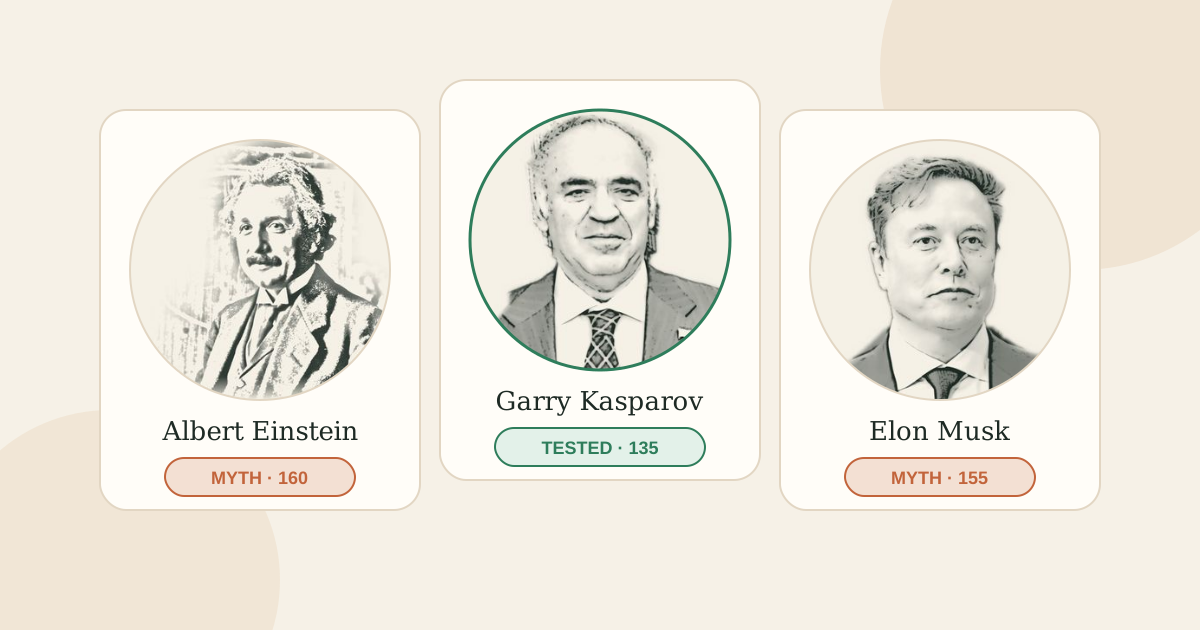
- Albert Einstein: never tested; the 160 is a guess.
- Stephen Hawking: never tested; he said he had no idea of his IQ.
- Garry Kasparov: actually tested in 1987, scoring 135 and 123.
- Elon Musk: the 155 has no known source.
- Nikola Tesla: claims run from 160 to 310, but he never took a test.
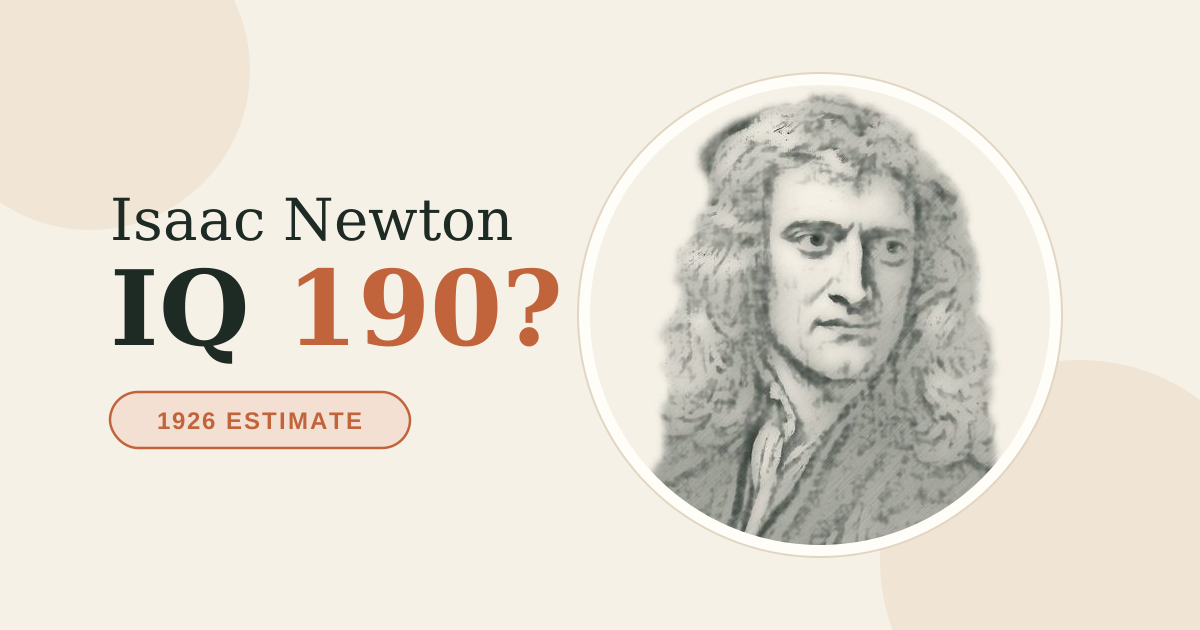
Historical figures such as Goethe and Isaac Newton have also been given very high IQs, based on a 1926 study that estimated scores from biographies. Our guide to the IQ of famous people explains those estimates and how to spot a made-up celebrity IQ.
Does the highest IQ matter?
The stories behind the record numbers point to something more interesting than the numbers themselves. Sidis, the boy credited with the highest figure of all, did not go on to the career many predicted and spent much of his adult life avoiding public attention. Tao, whose famous number comes from a test at age 6, became one of the leading mathematicians of his generation and has said himself that IQ plays no real role in academic work.
Above a certain level, an IQ score says less and less about what a person will achieve. Interests, persistence, opportunity, health and luck all play a large part, as our guide What is IQ? explains. A very high IQ is rare and real, but the records attached to it are mostly myths.
Frequently asked questions
Who has the highest IQ in the world?
Nobody holds a verified record. Guinness World Records stopped listing a "highest IQ" in 1990 because tests are not reliable enough at the extreme top. The most quoted figure, Marilyn vos Savant's 228, came from a childhood test scored with an old formula and is not comparable to a modern IQ.
What is the highest IQ ever recorded?
The highest figure ever printed in a record book is 228, for Marilyn vos Savant, listed by Guinness from 1985 to 1989. It came from the 1937 Stanford-Binet test she took at age 10, which used the old "mental age divided by age" method. On today's scale, a genuine 228 would be expected in about 1 person in 141 quadrillion.
Is an IQ of 200 possible?
Not as a measured score. On the modern IQ scale, 200 is about 1 person in 76 billion, more people than are alive today. Professional tests can't measure reliably above about 160, so any "200" comes from an old childhood formula, an estimate or an unsupervised test.
What is the highest IQ score a real test can give?
Most adult tests, such as the Wechsler scales, top out around 160. The Stanford-Binet Fifth Edition has special extended scores that can go up to 225, intended for assessing exceptionally gifted children, but scores that far out rest on very little comparison data.
What IQ do you need for Mensa?
Mensa's entry bar is a score in the top 2% on one of its approved tests, taken under supervision. On tests with a standard deviation of 15, such as the Wechsler scales, that means about 130 or higher.
What was Einstein's IQ?
Nobody knows. Einstein never sat an IQ test of any kind, so the popular figure of 160 is a guess. Our article on Einstein's IQ traces where the number came from.
Sources
- Marilyn vos Savant, Wikipedia: her Stanford-Binet result, the Guinness listing (1985–1989) and the retirement of the category in 1990.
- What is the highest IQ ever recorded?, Mental Floss: Guinness and the 228 figure.
- Kaufman, A. S. (2009). IQ Testing 101. Springer: criticism of the 228 figure.
- William James Sidis, Wikipedia: Harvard entry at 11, the 1910 lecture and the origin of the 250–300 claim.
- Terence Tao, Wikipedia: SAT score at age 8, International Mathematical Olympiad medals and the 2006 Fields Medal.
- Tao, T. Advice on gifted education (addendum on IQ): the age-6 test and his "greater than 175" estimate.
- Christopher Langan, Wikipedia: the 20/20 programme (1999) and Mega Test scores.
- Use of the SB5 in the assessment of high abilities, Riverside / HMH: extended IQ scores up to 225.
- How many people have ever lived on Earth?, Population Reference Bureau: about 117 billion.
- High-IQ society, Wikipedia: entry level of the Triple Nine Society.
- Prometheus Society: entry at the 99.997th percentile.
- Mega Society: entry at the one-in-a-million level.
- Getting your IQ tested: FAQs, Mensa International: the top 2% entry rule.
Find your own place on the scale
Records aside, the real question is where you stand. Take the free Assessivo IQ test: 36 questions, 25 minutes, with your estimated score and percentile when you finish.
Take the free IQ test