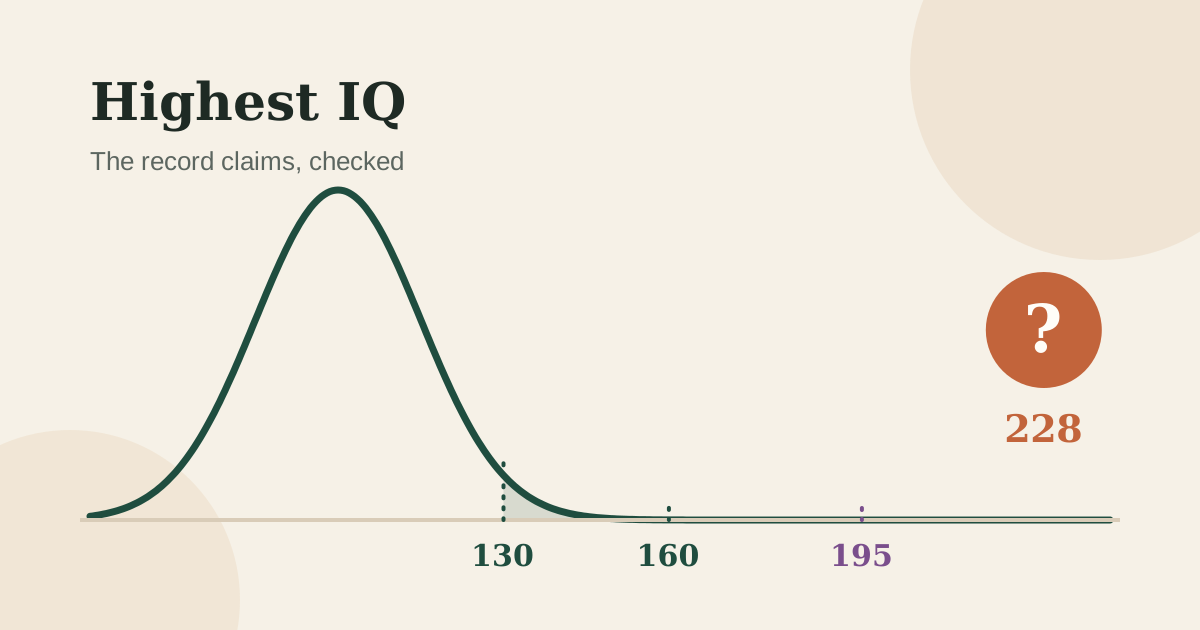
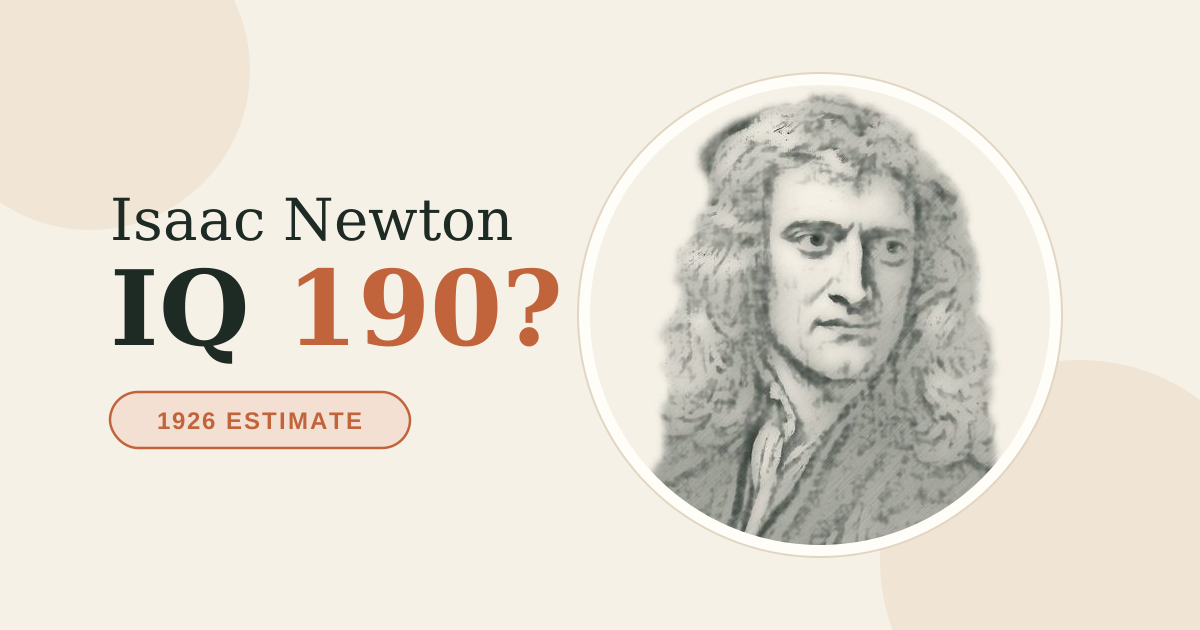
In short: very few famous people have a real IQ score. Chess champion Garry Kasparov is a rare documented case, with 135 on one test and 123 on another. Most figures for historical geniuses are estimates made from biographies in 1926, and many celebrity IQ numbers online have no source at all.
One world champion, two IQ scores, 12 points apart
In 1987 the German news magazine Der Spiegel did something no celebrity IQ list has done since: it actually tested a famous mind. In Baku, Garry Kasparov, then the reigning world chess champion, spent three days taking psychological tests, including three major intelligence tests.
On a test compiled by Hans Eysenck he scored 135. On Raven's Advanced Progressive Matrices he scored 123. Same man, same week, two respectable results that sit 12 points apart. The magazine treated the gap as nothing unusual for intelligence testing and was blunt about what the numbers meant: an IQ, it wrote, is no more than a vague indication.

That one documented case tells you more about famous people and IQ than a hundred viral rankings:
- A real score names who tested, which test and when. Kasparov's does.
- A real score comes with uncertainty. Two good tests can disagree by 10 points or more.
- A real score for an exceptional person can look surprisingly ordinary. Kasparov's results are well above average, but nowhere near the 190 that circulates online.
Keep those three points in mind, because almost every other claim below fails at least one of them. For the full story of his tests, including why the two results differ, read Garry Kasparov's IQ.
The four kinds of IQ claim about famous people
Before comparing numbers, it helps to sort them. Following our editorial policy, every claim on this page carries one of four labels, from the strongest kind of evidence to the weakest.
The evidence ladder: the fewer bars a claim has, the less it can tell you.
Most "IQ of famous people" lists mix all four kinds together and present them in the same confident format. That is the main reason readers end up believing that Newton was measured at 190 or that a pop star scored 160.
Celebrity IQ scores: claimed online vs the evidence
Here are seven names that top almost every celebrity IQ ranking. For each one, the dashed marker shows the figure most often repeated online, and the green bar shows what the evidence actually supports.
Tested score: 123 and 135 on two tests, 1987
Published estimate: Cox: 130 as a child, 170 at 17–26 (190 after her correction)
Published estimate: Cox: 135 as a child, 150 at 17–26 (180 after her correction)
Published estimate: Cox: 185 as a child, 200 at 17–26 (210 after her correction)
Published estimate: Cox: 145 at both ages (160 after her correction)
Published estimate: Cox: 135 as a child, 140 at 17–26 (145 after her correction)
No evidence: Never tested, and not in Cox's study
A pattern jumps out. The popular number is almost always the highest figure available. For Kasparov it has no source at all. For the historical names it is usually Cox's corrected estimate, quoted without the word "corrected" and without her lower ratings beside it. The bigger number wins the click, then gets copied.
Einstein is the odd one out: there is no evidence at all, which we explain in detail in our article on Einstein's IQ. The same pattern drives figures like Nikola Tesla's supposed IQ of 310 and modern celebrity claims such as Elon Musk's supposed IQ of 155, or Bill Gates' 160, which is really a converted SAT score. For a sense of scale, an IQ of 190 would be expected in about 1 person in a billion, and most professional tests can't reliably measure much above 160. You can see how rare each level is on our IQ scale and score chart. For the record claims of 200 and more, see who really has the highest IQ in the world.
Celebrity IQ list: where the numbers really come from
Search for celebrities with high IQs and you'll find the same list everywhere: actors at 160, singers at 140, a TV host at 160. We traced each famous person's IQ score back to its earliest source. The result is striking: not one of the actor or singer figures comes from a documented IQ test. The only reliable IQ scores of famous people belong to a handful of scientists, chess players and child prodigies.
| Name | IQ claimed online | Where the number comes from | Verdict |
|---|---|---|---|
| Garry KasparovChess champion | 190 | 135 and 123 on two tests for Der Spiegel in 1987. The 190 has no source. | Documented test |
| Terence TaoMathematician | 230 | A real childhood test. The 220+ comes from an old formula; Tao himself puts it at "greater than 175". | Documented test |
| Richard FeynmanPhysicist | 125 | A school IQ test, "a merely respectable 125", according to James Gleick's biography Genius (1992). | Documented test |
| William ShockleyPhysicist | – | Tested as a child for Lewis Terman's gifted study and missed the cut-off. He later won a Nobel Prize. | Documented test |
| Marilyn vos SavantColumnist | 228 | A Stanford-Binet test at age 10, scored with the old childhood formula. Listed by Guinness 1985 to 1989. | Documented test |
| Kim Ung-yongFormer child prodigy | 210 | A childhood test, usually said to be the Stanford-Binet, once listed by Guinness. Details are undocumented. | Reported, no test shown |
| Christopher LanganWriter | 195 | Described as "measured at 195" on ABC's 20/20 in 1999, with no test named. | Reported, no test shown |
| Sharon StoneActor | 154 | Printed in a 1992 Playboy interview introduction, not in her own words. Mensa said in 2002 she had never been a member. | Reported, no test shown |
| Quentin TarantinoFilm director | 160 | Stated in two 1995 biographies, one calling it "estimated". No test is named. | Reported, no test shown |
| ShakiraSinger | 140 | Reported in the press since 2006. A 2013 "Mensa list" repeating it was denied by Mensa. | Reported, no test shown |
| MadonnaSinger | 140 | Repeated in a 2011 CBS News gallery ("claims to have") and the same denied 2013 list. | Reported, no test shown |
| James WoodsActor | 180 | Widely repeated, often credited to him, but no interview or test record could be found. | No traceable source |
| Steve MartinActor and comedian | 142 | A 2011 CBS News gallery said "estimated to be about 142", with no source. | No traceable source |
| Jodie FosterActor | 132 | Listed as "reportedly" 132 in the same 2011 CBS gallery. No test record. | No traceable source |
| Nicole KidmanActor | 132 | Listed as "reportedly" 132 in the same 2011 CBS gallery. No test record. | No traceable source |
| Arnold SchwarzeneggerActor and politician | 135 | The 2011 CBS gallery said 132; the 135 seen elsewhere has no source at all. | No traceable source |
| Natalie PortmanActor | 140 | No traceable source. | No traceable source |
| Ashton KutcherActor | 160 | No traceable source. | No traceable source |
| Matt DamonActor | 160 | No traceable source. | No traceable source |
| Conan O'BrienTV host | 160 | No traceable source. | No traceable source |
| Rowan AtkinsonActor | 178 | No traceable source. | No traceable source |
| Lisa KudrowActor | 154 | Traced only to online discussion threads. | No traceable source |
| Mark ZuckerbergTech founder | 152 | No traceable source. | No traceable source |
| Judit PolgárChess grandmaster | 170 | No record of any IQ test. | No traceable source |
| Dolph LundgrenActor | 160 | Contradicted: Maxim reported in 2008 that "He does not have an I.Q. of 160", quoting him: "I'm not that smart." | Contradicted |
Sources are listed at the end of this page. "No traceable source" means we couldn't find any interview, test record or published estimate behind the figure, not that the person isn't clever.
So which celebrity has the highest IQ? On the evidence, nobody can say. The famous person with the highest recorded IQ score is Marilyn vos Savant, from a childhood test scored with an outdated formula; among actors there is no documented score at all. A few celebrities do have verifiable academic records instead: Mayim Bialik holds a PhD in neuroscience from UCLA, and Queen guitarist Brian May completed a PhD in astrophysics at Imperial College London. Those are real achievements; the IQ numbers attached to them online are not.
Where the historical genius IQ estimates came from
Nearly every IQ figure for a historical figure traces back to one book: Catharine Cox's Genetic Studies of Genius, Volume II, published by Stanford University Press in 1926. Working with Lewis Terman, whose 1916 Stanford-Binet became the standard American version of the first intelligence test, Cox set out to estimate the IQs of 301 eminent people born between 1450 and 1850.
Nobody in her sample could be tested, of course. Instead, Cox and her fellow raters read detailed records of each person's early life, such as the age they learned to read, their schoolwork, letters and early achievements, and compared them with what children of known IQ could do at the same ages. Each person received two ratings:
Cox was unusually honest about the limits of her method. She stressed that the estimates depend on how much was written down. As she put it:
"The IQ of Newton or of Lincoln recorded in these pages is the IQ of the Newton or of the Lincoln of whom we have record."
Catharine Cox, Genetic Studies of Genius, Vol. II (1926)In other words, a genius with a thin paper trail gets a lower estimate. Newton's childhood rating of 130 is not a claim that he was ordinary; it reflects how little survives about his early years. Cox suggested his true level was higher than the surviving record let her show.
Because she knew sparse records pulled estimates down, Cox also calculated corrected group averages, which raised the typical childhood figure from about 135 to 155 and the young-adult figure from about 145 to 165. She also reported that one rater put Goethe's IQ for ages 17 to 26 at 225, against the agreed estimate of 200. Many of the dramatic numbers on today's lists appear to come from corrections and outlier ratings like these, with the caution stripped away.
Used properly, Cox's figures are interesting historical estimates. Used carelessly, they become fake test scores. If you see a historical figure's IQ quoted without the words "estimated" and "1926", treat it with suspicion. For fifteen of these people, our IQ score pages show the estimate with its label and a portrait, for example IQ 140, IQ 150, IQ 155 and IQ 160.
Chess players' IQ: does it take a genius to win?
Chess is the field where the "genius IQ" myth runs strongest, and it is also one of the few where researchers have checked. The results are humbling for the myth.
The same 1987 Der Spiegel report compared Kasparov with around 30 players from the German chess Bundesliga. Among these strong players, the magazine found no correlation between IQ and playing strength. Being a better player did not go with a higher score.
A much larger picture came in 2016, when Alexander Burgoyne and colleagues combined 19 studies with about 1,800 participants in the journal Intelligence. They found a real but modest link between chess skill and cognitive ability, a correlation of about 0.24. The details are more revealing than the headline:
- The link was stronger in young players. For fluid reasoning it was about 0.32 among youth samples, but only 0.11 among adults.
- It was weaker among ranked players. For fluid reasoning, about 0.32 for unranked players, but 0.14 among ranked ones. Once everyone is good, other things decide who wins.
- Visual-spatial ability mattered least. Despite chess looking like a spatial game, numerical ability showed the strongest link (about 0.35), verbal ability came next (0.19) and visuospatial ability was weakest (0.13).
The likely explanation is that reasoning ability helps a beginner learn faster, but at a high level, thousands of hours of study and pattern memory take over. That fits Kasparov's own results: very able, clearly above average, and still nowhere near the scores fans like to give him. So a high chess rating is not a hidden IQ score, and a world champion's IQ is not a reliable guide to how good they are at chess.
The great scientists who shrugged at IQ
Some of the most celebrated thinkers of the last century either had unremarkable recorded scores or simply refused to play the game.
- Richard Feynman. The Nobel Prize-winning physicist reportedly scored 125 on an IQ test at school, according to his biographer James Gleick, who called it "merely respectable". The original record has never been published, but the story is often told as a warning against reading too much into a single score.
- William Shockley and Luis Alvarez. Both were tested as boys for Lewis Terman's famous long-term study of gifted children in California and were not selected because their scores fell short of the cut-off. Both later won the Nobel Prize in Physics, while none of the children who were selected did.
- Stephen Hawking. Asked by The New York Times Magazine in 2004 what his IQ was, he answered that he had no idea, and added a line that has been quoted ever since:
"People who boast about their I.Q. are losers."
Stephen Hawking, The New York Times Magazine, December 2004Hawking's IQ is still listed as 160 on countless websites. The only thing he ever said about it was that he didn't know, which makes the number a myth by any standard.
Real or myth? Test yourself
Here are eight claims you might meet online. Choose the label you think each one deserves, then check the answer.
True, and he also scored 123 on a second test during the same three-day session. Both were given for Der Spiegel in 1987.
Never measured. It is Cox's 1926 corrected estimate for his young adulthood; her raw ratings were 130 (childhood) and 170 (age 17 to 26).
Cox rated Goethe 185 for his childhood and 200 for ages 17 to 26, from biographical records, not a test.
Asked his IQ in 2004, Hawking said he had no idea, and that people who boast about their IQ are losers.
His biographer James Gleick reports a school test result of 125. The original record hasn't been published, so treat it with some caution.
Cox rated him 135 for his childhood and 140 for ages 17 to 26, from records of his early life.
No NBA player has a published IQ score. Figures like this are invented.
That study covered people born between 1450 and 1850. Einstein, born in 1879, isn't in it.
Your score: 0 of 8 answered
Athletes' IQ, NBA players and "sports IQ"
Searches for NBA players' IQ, footballers' IQ and athletes' IQ are hugely popular, so here is the plain answer: there is no published IQ score for any current NBA star, and the same is true for nearly every famous athlete. Lists that give exact numbers for basketball or football players are inventing them.
Part of the confusion comes from the phrase sports IQ, or "basketball IQ". Coaches and commentators use it to describe how well a player reads the game: seeing a pass before it opens up, anticipating where the ball will go, and making fast, smart decisions under pressure. It is a real and valuable skill, but it has nothing to do with an IQ test and has no number attached. A player with "a high basketball IQ" hasn't scored anything.
The closest thing to IQ testing in professional sport was the Wonderlic, a 50-question, 12-minute test of general problem solving that American football prospects took at the NFL Scouting Combine for decades. It is not a full IQ test, and its scores are on a different scale. In 2022 the league stopped giving it at the Combine, as CBS Sports reported, after years of criticism that it said little about performance on the field and that leaked scores were used to embarrass players. Teams may still use their own assessments, but those results are private.
The research on chess points the same way. In any field built on years of practice, the people at the top are separated far more by skill, training and experience than by a test score.
How to spot a fake celebrity IQ in seconds
Celebrity IQ figures tend to share the same warning signs. If a claim shows two or more of these, you can safely treat it as a myth:
- It is suspiciously round160, 180 and 200 are favourites. Real results are as likely to be 123 as 120.
- It is above what tests can measureMost professional tests top out around 160. A "tested" 190 is almost impossible.
- The person lived before IQ testsThe first practical test appeared in 1905. Anyone earlier can only have an estimate.
- No test, date or tester is named"Experts say" or "reportedly" usually means nobody measured anything.
- Every site gives the same numberIdentical figures across many sites, with no original source, are copies of copies.
- It flatters perfectlyA celebrity whose IQ "matches Einstein's" is a headline, not a result.
Run the most popular celebrity IQ lists through these six checks and very few names survive. That isn't a reason to stop being curious about how famous minds compare. It is a reason to compare them honestly, using real tests where they exist and labelled estimates where they don't.
Frequently asked questions
Which famous people have a real, tested IQ score?
Very few. Chess champion Garry Kasparov is one of the best documented: he scored 135 and 123 on two different tests given for Der Spiegel in 1987. Physicist Richard Feynman's school score of 125 is reported by his biographer. Most other celebrity IQ figures have no test behind them.
Where do the IQ scores of historical figures come from?
Mostly from Catharine Cox's 1926 study, which estimated IQs for 301 eminent people from records of their childhood and youth. These are educated estimates, not test results, and Cox gave two figures for each person: one for childhood and one for ages 17 to 26.
Which celebrity has the highest IQ?
No actor or singer has a documented IQ score, so nobody can say. Figures such as 160 for Quentin Tarantino or 140 for Shakira circulate without a test record. The famous person with the highest recorded score is Marilyn vos Savant, at 228 from a childhood test using an outdated formula.
What celebrities have a high IQ?
Many lists name actors such as Sharon Stone, Natalie Portman and Matt Damon, but we found no documented IQ test behind any of their figures. Famous people with real tested scores include chess champion Garry Kasparov (135 and 123), physicist Richard Feynman (125 at school) and mathematician Terence Tao.
Do celebrities take IQ tests?
Some may have, but almost none have published a verified result. Many celebrity IQ numbers online are copied from site to site without a source, so the safest assumption is that a number without a named test, date and source is a guess.
What is sports IQ or basketball IQ?
Sports IQ is a coaching term for how well a player reads the game, anticipates what will happen and makes quick decisions. It is not measured with an IQ test and has no number attached, so a claim that a player has a "high basketball IQ" says nothing about their IQ score.
Are chess players smarter than average?
Research finds a modest link. A 2016 analysis of 19 studies found a correlation of about 0.24 between chess skill and measured cognitive ability, For reasoning ability the link was stronger in young players than in adults, and stronger in unranked than in ranked players. Practice explains much more of the difference between strong and weak players.
What IQ do you need to be a genius?
There is no official genius score. In everyday use the word usually means 140 or more, which about 1 in 260 people reach. But Cox's study and the lives of famous scientists show that achievement depends on far more than a test result.
Sources
- Gleick, J. (1992). Genius: The Life and Science of Richard Feynman. Pantheon: Feynman's school IQ test of 125.
- Leslie, M. (2000). The vexing legacy of Lewis Terman, Stanford Magazine: Shockley and Alvarez tested but not selected.
- Sheff, D. (1992). Playboy interview: Sharon Stone: the source of the 154 figure.
- Reiter, A. (2002). Salon: Mensa on Sharon Stone's membership claim.
- Moreno, C. (2013). HuffPost: the "Mensa list" and Mensa's denial.
- Dawson, J. (1995). Tarantino: Inside Story, and Brode, D. (1995), Money, Women, and Guns: the earliest print sources of the 160 figure.
- Stars with high IQs, CBS News (2011): the gallery behind many repeated celebrity figures.
- Freedman, L. (2008). 8 things you need to know about Dolph Lundgren, Maxim.
- Der Spiegel (1987). Genieblitze und Blackouts: Kasparov's two intelligence test results and the comparison with Bundesliga players.
- Cox, C. M. (1926). Genetic Studies of Genius, Vol. II: The Early Mental Traits of Three Hundred Geniuses. Stanford University Press.
- Burgoyne, A. P. et al. (2016). The relationship between cognitive ability and chess skill: a comprehensive meta-analysis. Intelligence, 59, 72–83.
- Gleick, J. (1992). Genius: The Life and Science of Richard Feynman. Pantheon Books.
- Shurkin, J. N. (1992). Terman's Kids: The Groundbreaking Study of How the Gifted Grow Up. Little, Brown.
- Solomon, D. (2004, December 12). Questions for Stephen Hawking. The New York Times Magazine.
- NFL pre-draft changes: Wonderlic test being dropped, CBS Sports (2022).
- Article image: Elon Musk sketch adapted from a photo by Gage Skidmore, CC BY-SA 4.0; Einstein sketch based on a public-domain photograph by Ferdinand Schmutzer; garry Kasparov sketch based on a photo © European Union, 2026, CC BY 4.0.
Get a real score of your own
Most famous people never published an IQ score. You can find out yours in 25 minutes: 36 questions across four kinds of reasoning, with your estimated IQ as soon as you finish.
Take the free IQ test