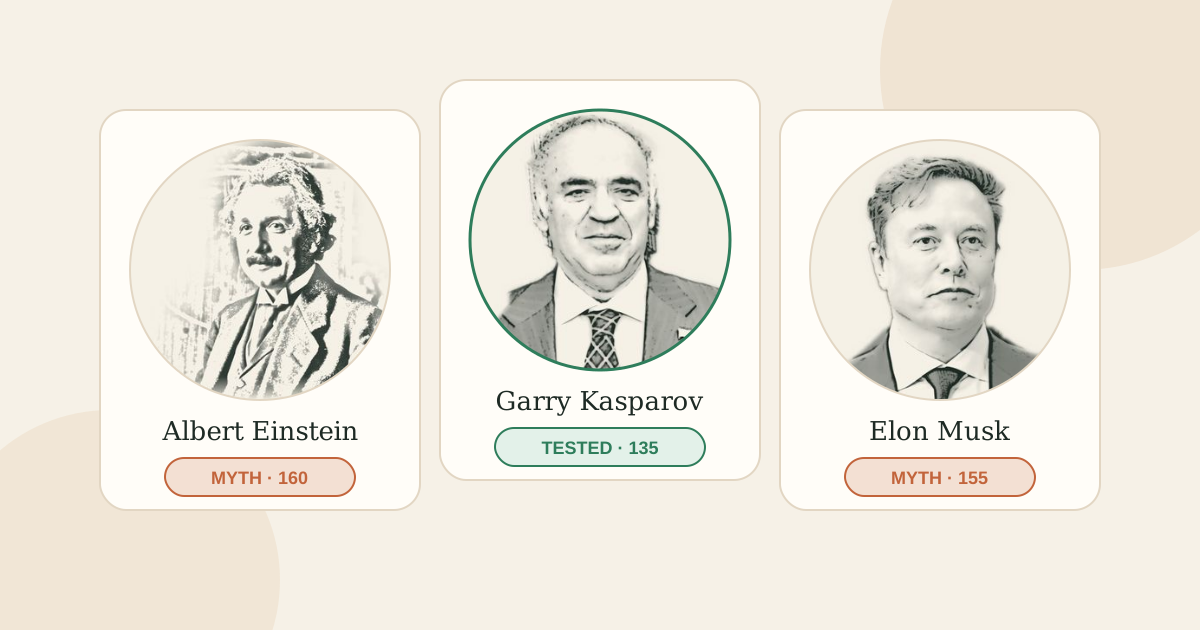
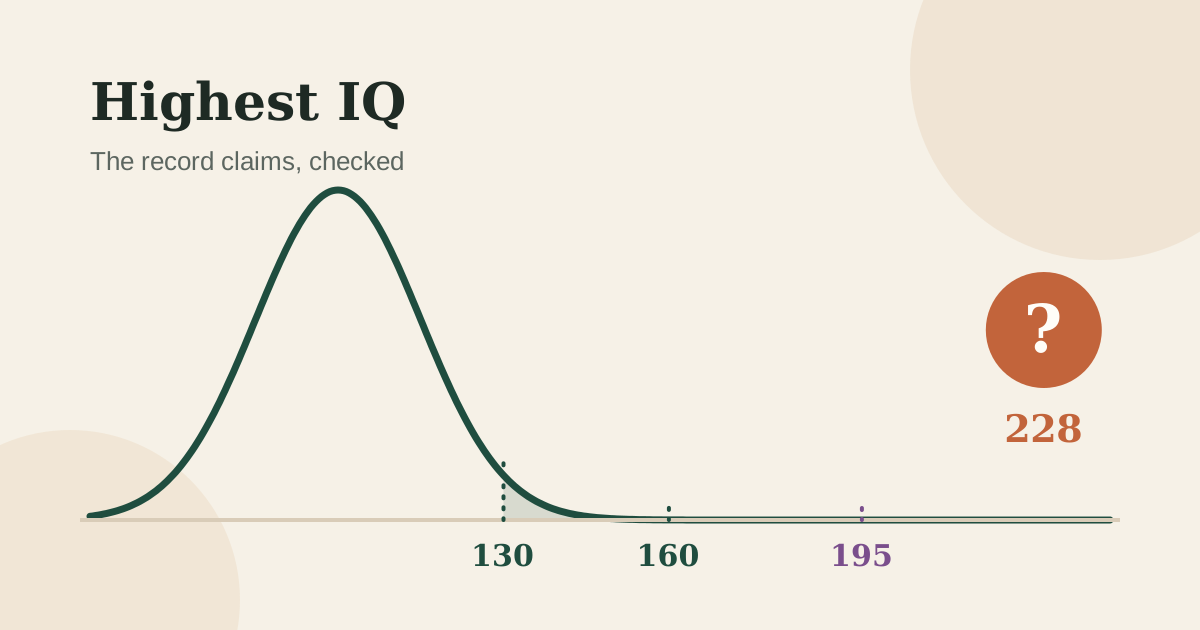
In short: Einstein's IQ is unknown. He never took an IQ test, and the figure of 160 you see everywhere has no traceable source. Even the 180 and 200 sometimes quoted are guesses made after his death, without a published method.
Myth or fact? Test what you know
Before the details, try these six claims about Einstein's intelligence. Tap a card to see the answer.
Cards revealed: 0 of 6

Why Einstein was never given an IQ test
Albert Einstein was born in 1879. The first practical intelligence test, created by Alfred Binet and Théodore Simon in France, appeared in 1905, and it was built to identify schoolchildren who needed extra support, not to rank adults. By then Einstein was 26.
There is a striking coincidence in that date. 1905 is also Einstein's "miracle year", when he published the papers on the photoelectric effect, Brownian motion, special relativity and E = mc². Modern IQ testing and Einstein's greatest work were born in the same year, and the two never met.
The first widely used individual IQ test for adults, David Wechsler's, only arrived in 1939, when Einstein was 60 and world famous. Nothing in his letters, biographies or archives suggests he ever sat one. So the honest answer to "what was Einstein's IQ score?" is that no score exists.
Where the famous Einstein IQ numbers came from
If Einstein never took a test, why does almost every website give him a number? The figures fall into three groups, and none of them is a measurement.
The 1987 example is revealing. While reporting on chess champion Garry Kasparov's own IQ tests, the German magazine Der Spiegel wrote that the IQs of "geniuses of the century" such as Goethe and Einstein had been estimated after their deaths "by some psychologists at 200, by others at 180". No psychologist was named and no study was cited. Repeated in a respected magazine, numbers like these take on a life of their own.
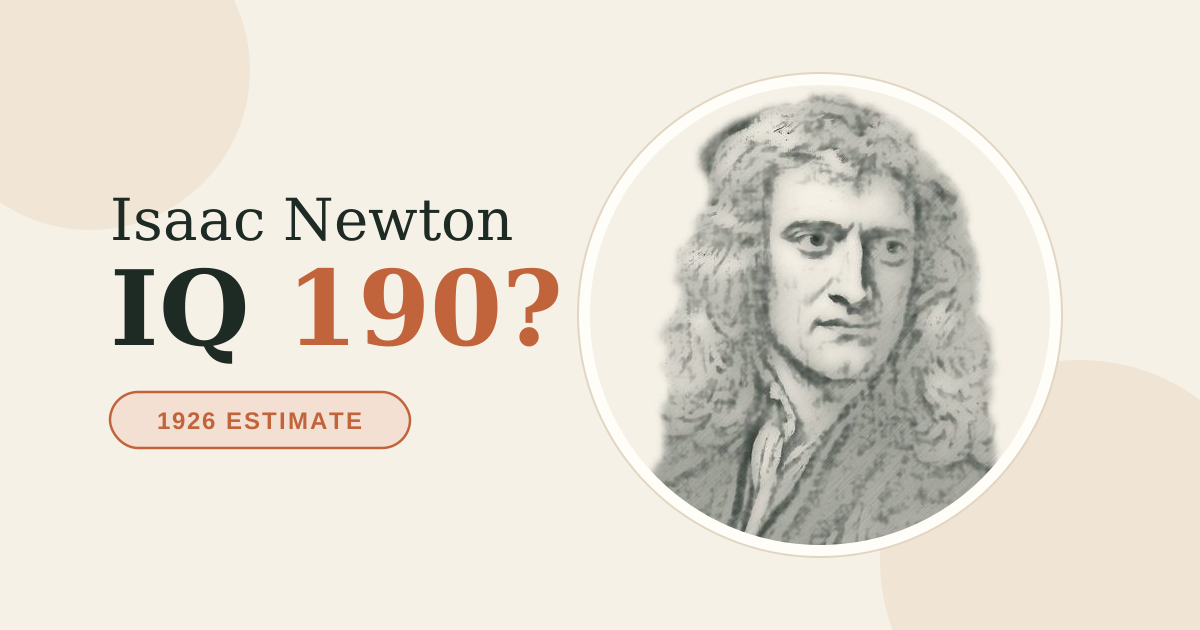
Many sites also claim that Einstein's IQ was estimated in the best-known study of historical geniuses, Catharine Cox's 1926 Genetic Studies of Genius. We checked the original book. It covers 301 people born between 1450 and 1850, and Einstein, born in 1879, does not appear in it at all.
The likely story behind "Einstein IQ 160" is simpler: 160 sounds impressive, sits near the top of what professional tests can measure, and was easy to repeat. Each copy made it look more official.
A timeline of a score that was never measured
Albert Einstein is born in Ulm, Germany.
Aged 16, he takes the entrance exam for the Zurich Polytechnic. He does very well in maths and physics but not well enough in other subjects.
He finishes secondary school in Aarau, Switzerland, with top marks in mathematics.
The first practical intelligence test is published, and Einstein, now 26, has his "miracle year" in physics.
He wins the 1921 Nobel Prize in Physics (presented in 1922), cited especially for his discovery of the law of the photoelectric effect.
Cox publishes her famous estimates for 301 historical geniuses. Einstein is not among them.
A newspaper feature claims he failed maths. He laughs it off.
Einstein dies. His brain is removed and preserved for study.
Der Spiegel repeats unnamed posthumous estimates of 180 and 200.
"Einstein IQ 160" appears on countless websites, still without a source.
Did Einstein fail maths? The myth he corrected himself
One of the most popular Einstein stories is that he was a poor student who failed mathematics. It is false, and Einstein said so himself. In 1935 a rabbi in Princeton showed him a newspaper feature, from the popular "Believe It or Not!" series, claiming he had failed maths. Einstein laughed and replied that he had never failed in mathematics, and that before he was 15 he had mastered differential and integral calculus, as TIME later recounted.
His school record backs him up. His Swiss school-leaving certificate from 1896 shows the top grade, 6 out of 6, in algebra, geometry and physics. The story may have grown from two real events: he did not pass the Zurich Polytechnic entrance exam at 16, because of weaker results in non-science subjects, and the Swiss grading scale, where 6 is best, is the reverse of some other systems, which makes his grades easy to misread.
The lesson for anyone thinking about intelligence is a useful one. Uneven results across subjects are normal, even for exceptional minds, which is why good IQ tests report different abilities separately rather than one number alone.
What Einstein's brain actually showed
When Einstein died in 1955, the pathologist Thomas Harvey removed and preserved his brain, and photographed it from many angles. Decades later, researchers studied those photographs and samples.
- 1999: a study in The Lancet by Sandra Witelson and colleagues compared Einstein's brain with 91 others. His brain was not heavier than average, but his parietal lobes, areas linked with visual and spatial reasoning and mathematical thinking, were about 15% wider than those of the comparison group.
- 2012: a team led by Dean Falk examined 14 rediscovered photographs and, in the journal Brain, described unusual folding patterns in several regions. The authors were careful to call their interpretations preliminary.
These findings are fascinating, but they don't give Einstein an IQ. A single brain cannot show which features caused his abilities and which came from a lifetime of thinking about physics, and brain shape says nothing direct about how someone would perform on a test.
What would Einstein score on an IQ test today?
It is tempting to imagine sitting Einstein down with a modern test. Even then, the result might surprise people:
- Tests reward speed. Many tasks are timed, while Einstein was known for working slowly and deeply on a single problem for years.
- Tests have ceilings. Most professional tests can't measure reliably much above about 160, so an exceptional mind might simply hit the top of the scale.
- Tests measure broad reasoning, not discovery. They sample many short problems with known answers. Einstein's gift was asking new questions that nobody had thought to ask.
- Language and culture matter. A test given in a second language, or built around unfamiliar material, can lower a score without reflecting ability.
So even a real score would have told us less about Einstein than his work does. For a sense of how rare different scores are, our IQ scale and score chart shows that an IQ of 160 would be reached by roughly 1 person in 30,000, and our page on an IQ of 140 explains the level usually called "genius" in everyday speech.
What an IQ score couldn't capture about Einstein
Einstein's own descriptions of how he thought point to qualities that IQ tests barely touch. Asked by the mathematician Jacques Hadamard in the 1940s how he worked, he replied that words did not seem to play any role in his thinking. Instead, he worked with images and signs that he could combine at will, and only later searched for words to explain them.
"I am enough of the artist to draw freely upon my imagination. Imagination is more important than knowledge."
Albert Einstein, interviewed in The Saturday Evening Post, 1929His most famous ideas began as thought experiments: imagining riding alongside a beam of light, or a person falling freely who feels no weight. Add extraordinary persistence, a willingness to question accepted ideas and a lifelong curiosity, and you have the ingredients of his genius. None of them fits neatly into a number.
That is the real answer to "how smart was Einstein?" He was clearly exceptionally able, but the evidence for it is in his physics, not in an IQ score that was never measured.
How to judge any claim about Einstein's IQ
You will keep meeting confident statements about Einstein's IQ in articles, videos and quizzes. Four quick questions will tell you how much weight any of them deserves:
- Who measured it? A real score names the person or organisation that gave the test. "Experts estimate" or "it is said" means nobody did.
- Which test, and when? A genuine result can be tied to a specific test and date. For Einstein, no claim passes this step, because no test was ever given.
- Is it a score or an estimate? Estimates made from someone's life story are a different thing from test results, and honest sources say which one they are giving.
- Can you follow the source? If a number only links to other websites repeating the same number, it is an echo, not evidence.
Apply these to "Einstein IQ 160" and the claim falls at the first step. That doesn't make the question pointless. It simply means the interesting answer is not a number but the story of why a number was never needed to recognise his genius.
Frequently asked questions
Did Einstein ever take an IQ test?
There is no record that he did. The first practical intelligence test was published in 1905, when Einstein was 26 and already working on the ideas that made him famous. Group tests for adult army recruits appeared in 1917 and the first widely used individual adult test in 1939, and nothing suggests he ever sat one.
What IQ is considered genius level?
No professional test uses the word genius. In everyday use it usually means a score of about 140 or more, which roughly 1 in 260 people reach. Einstein's fame comes from his work in physics, not from any test score.
What was Stephen Hawking's IQ compared with Einstein's?
Neither has a known score. When a New York Times interviewer asked Hawking about his IQ in 2004, he said he had no idea and added that people who boast about their IQ are losers.
Was Einstein a member of Mensa?
There is no record that he was. Mensa was founded in England in 1946, when Einstein was in his late sixties and living in the United States, and membership requires a qualifying test score that he never had.
Could anyone measure Einstein's IQ today?
No. An IQ score comes from a person taking a test. Estimates made from someone's life story are educated guesses, and for Einstein not even a published estimate of that kind exists.
Sources
- Der Spiegel (1987). Genieblitze und Blackouts: Kasparov's tests and the posthumous estimates for Goethe and Einstein.
- Cox, C. M. (1926). Genetic Studies of Genius, Vol. II: The Early Mental Traits of Three Hundred Geniuses. Stanford University Press.
- Did Einstein flunk math?, TIME: the 1935 exchange and his early record in mathematics.
- Witelson, S. F., Kigar, D. L. and Harvey, T. (1999). The exceptional brain of Albert Einstein. The Lancet, 353(9170), 2149–2153.
- Falk, D., Lepore, F. E. and Noe, A. (2013). The cerebral cortex of Albert Einstein: a description and preliminary analysis of unpublished photographs. Brain, 136(4), 1304–1327.
- Imagination is more important than knowledge, Quote Investigator: the 1929 Saturday Evening Post interview.
- Hadamard, J. (1945). The Psychology of Invention in the Mathematical Field. Princeton University Press: Einstein's account of how he thought.
- Intelligence test, Encyclopaedia Britannica: Binet and Simon (1905) and the history of IQ testing.
Curious about your own score?
Einstein never took an IQ test, but you can. 36 questions across four kinds of reasoning, 25 minutes, and your estimated IQ score as soon as you finish.
Take the free IQ test