In short: Isaac Newton's IQ was never measured. The famous 190 is a 1926 estimate by the psychologist Catharine Cox, made from biographies: her corrected figure for Newton aged 17 to 26. Her raw estimates were 130 for his childhood and 170 for his young adulthood. Treat 190 as an educated guess about a genius, not as a score.
Where Isaac Newton's IQ of 190 comes from
In 1926 the Stanford psychologist Catharine Cox published The Early Mental Traits of Three Hundred Geniuses, the second volume of Lewis Terman's Genetic Studies of Genius. Terman had built the Stanford-Binet test a decade earlier. Cox's question was whether history's most eminent people had shown exceptional intelligence when they were young, and since none of them could be tested, she tried to estimate their IQs from what they had done at each age.
She and her raters worked through biographies, letters and school records for 301 people born between 1450 and 1850, and gave each person two estimates. For Newton, those were:
The third number is the one that spread. Cox knew that a person with few surviving records would get a lower estimate than they deserved, so for each person she also calculated a "corrected" estimate, pushing the raw figure up according to how reliable the evidence was. In the corrected column of her table, Newton's young-adult estimate is 190. When "Newton's IQ was 190" appears online, it is this number, usually without the words "estimated", "corrected" or "1926". Cox herself was careful about what the correction meant:
"The final correction is thus no more than an approximation to a true score."
Catharine Cox, The Early Mental Traits of Three Hundred Geniuses (1926), p. 83So the figure is not invented, which already sets it apart from claims like Einstein's 160 or Tesla's 310. But it is not a test score either. Cox's study is used, and misused, across hundreds of celebrity IQ lists; our guide to the IQ of famous people sorts the tested scores from the estimates and the myths.
How Cox estimated an IQ from a biography
Cox's raters used the logic of the early Stanford-Binet: compare what a child could do with the age at which a typical child does the same thing. A 10-year-old doing what most 15-year-olds do has a "mental age" of 15, and a ratio IQ of 15 ÷ 10 × 100 = 150. Try it with a few made-up examples:
Mental age calculator
Illustrative examples, not real records. Pick one or set your own ages.
This shows both the appeal and the weakness of the method. It needs only a few dated achievements, which is why it could be applied to people who died centuries ago. But everything depends on what was written down, on the raters' judgement of what typical children could do, and on the assumption that someone who became famous was the same person as a child. Modern IQ tests no longer use mental age at all. They compare people with others of the same age on a bell curve, as our guide to what IQ is explains.
Why Newton's childhood estimate is "only" 130
A childhood estimate of 130 surprises many people, but it says more about the records than about Newton. He was born prematurely in Woolsthorpe, Lincolnshire, on Christmas Day 1642 by the calendar England then used (4 January 1643 by today's). His father had died three months earlier, and when Isaac was three his mother remarried and left him with his grandmother. Few written records of his early years survive.
Most of the stories about young Newton were collected decades later by his friend William Stukeley from people who had known him. They describe a solitary boy at the King's School in Grantham who built working models, including a windmill and a water clock, made sundials, and rose from near the bottom of his class to the top. The stories are charming but hard to date, and Cox could only rate what was documented. She wrote that her estimates were probably, in most cases, still too low, because the surviving record rarely shows everything a child could do.
Newton's school career was also interrupted. His mother took him out of school to run the family farm, which he did badly, before his uncle and his schoolmaster persuaded her to let him prepare for Cambridge. He entered Trinity College in June 1661, aged 18.
The miracle years: why the second estimate is so high
Cox's second period, ages 17 to 26, covers the most extraordinary stretch of Newton's life. In 1665 Cambridge closed because of the plague, and Newton, then 22, returned home to Woolsthorpe. Over roughly the next two years, working largely alone, he:
- developed his "method of fluxions", the core of what we now call calculus;
- used prisms to show that white light is a mixture of colours, overturning the accepted view that colours were changes to white light;
- began working out the idea that the force holding the Moon in its orbit is the same one that makes objects fall to the ground.
Historians call 1665 to 1666 Newton's annus mirabilis, his year of wonders. Much of this work stayed in his notebooks for years, but it was documented, and documented achievement is exactly what Cox's method rewards. In 1669, at 26, he was appointed Lucasian Professor of Mathematics at Cambridge, one of the most prestigious posts in the country. That is the age at which Cox's second estimate ends.
Newton's record in numbers
- Born in Woolsthorpe4 January (25 December 1642 on the old calendar), premature and fatherless.
- Trinity College, CambridgeEnters at 18, paying his way partly by working as a servant to other students.
- The plague years beginCalculus, light and colour, and the first ideas about gravity, all by age 24.
- Lucasian Professor at 26Where Cox's estimates stop.
- Royal SocietyElected a Fellow after presenting his reflecting telescope.
- The PrincipiaSets out his laws of motion and universal gravitation.
- The Royal MintBecomes Warden, then Master, and hunts down counterfeiters.
- President of the Royal SocietyA post he holds until his death. Knighted in 1705.
- Dies in LondonAged 84, and is buried in Westminster Abbey.
The Principia is the work on which his reputation rests. Its laws of motion and law of universal gravitation explained, with the same mathematics, the fall of an apple, the orbit of the Moon, the paths of comets and the tides. Its framework remained the foundation of physics until Einstein's relativity, more than two centuries later, and it is still what engineers use to send spacecraft to other planets.
The other Newton: alchemy, theology and a breakdown
Newton spent at least as much time on alchemy and on reading the Bible as on physics, and wrote a vast amount on both that he never published. When the economist John Maynard Keynes bought a large collection of Newton's private papers at auction in 1936 and read them, he concluded that Newton was "not the first of the age of reason" but "the last of the magicians". In theology, Newton privately rejected the doctrine of the Trinity, a view that could have cost him his Cambridge post had it become known.
In 1693 he suffered a period of severe distress, with sleeplessness and suspicious letters to friends. Its cause is debated. A 1979 analysis of surviving locks of his hair found high levels of mercury, suggesting his alchemical experiments may have poisoned him; other historians point to exhaustion, stress and the end of a close friendship. Either way, it is a reminder that a brilliant mind is not a protected one, and that exceptional ability says nothing about a person's wellbeing.
Myths and facts about Newton's intelligence
Newton was tested and scored 190.
No IQ test existed in his lifetime. 190 is Catharine Cox's 1926 corrected estimate for his young adulthood, made from biographies.
An apple hit Newton on the head and gave him the idea of gravity.
Newton told William Stukeley in 1726 that the thought had come to him when he saw an apple fall in his garden, about 60 years earlier. Nothing in the account says it hit him.
Newton said: "I can calculate the motion of heavenly bodies, but not the madness of people."
The line comes from a secondhand anecdote about the 1720 South Sea Bubble, attributed to a Lord Radnor and not published until 1820. Newton did lose money in the bubble, but there is no record of him writing those words.
Newton wrote "If I have seen further, it is by standing on the shoulders of giants."
True. It is in a letter to Robert Hooke dated 5 February 1675 (1676 by today's calendar). The image was not his own, though: versions of it go back to the 12th century.
Newton vs Einstein: who had the higher IQ?
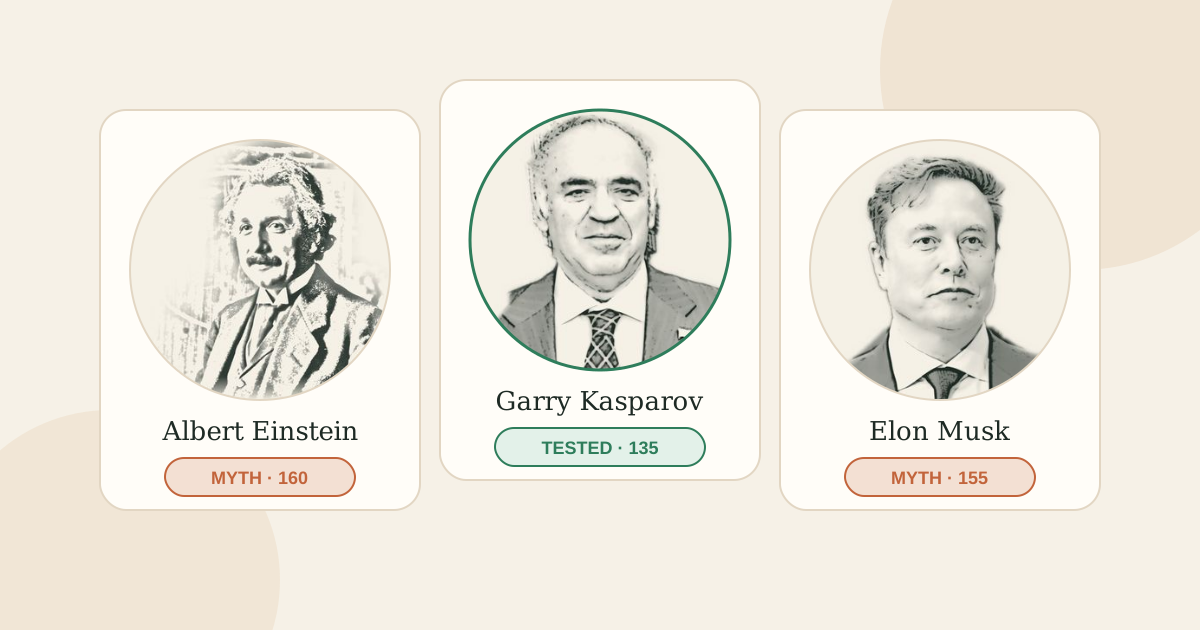
It is the most common question about Newton's IQ, and it can't be answered with numbers. Neither man took an IQ test. Cox's study ended with people born in 1850, so Einstein, born in 1879, was never rated, and the widely quoted 160 for Einstein has no source at all, as we explain in our article on Einstein's IQ. Comparing Newton's 190 with Einstein's 160 means comparing a 1926 estimate with an invented number.
What the two have in common is more interesting than any ranking: each produced a theory of gravity that reshaped physics, and each did much of his most original work in his mid-twenties.
How rare would an IQ of 190 be?
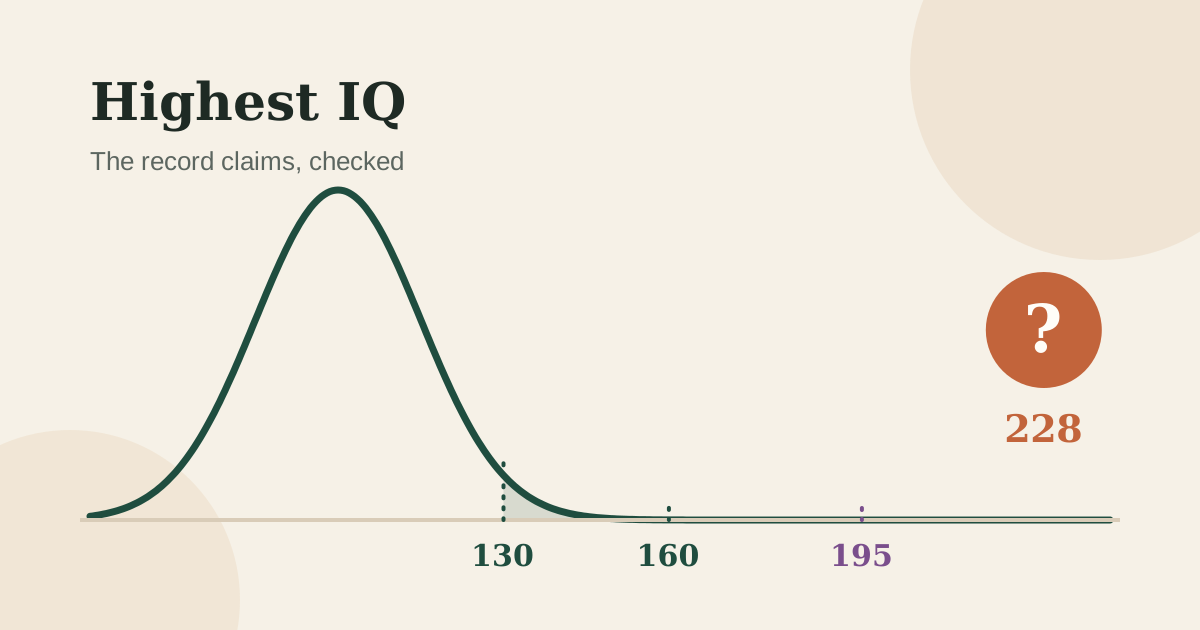
Read literally on a modern scale (mean 100, standard deviation 15), 190 sits six standard deviations above average. Only about one person in a billion would score that high, so among the world's 8 billion people you would expect fewer than ten. That is far beyond what any modern test can measure reliably; most professional tests stop around 160.
That is another reason not to read Cox's corrected estimates as precise numbers. Her ratings were on the old ratio scale, built for children, which behaves differently from today's bell-curve scores at the extremes. Our page on the highest IQ in the world lets you try any score in a rarity calculator, and our IQ scale explains what each level means.
Frequently asked questions
What was Isaac Newton's IQ?
Nobody knows his real IQ, because he lived more than 200 years before IQ tests existed. The figure of 190 comes from a 1926 study by the psychologist Catharine Cox, who estimated IQs from biographies. Her raw estimates for Newton were 130 for his childhood and 170 for ages 17 to 26; 190 is her statistically corrected version of the second figure.
Did Isaac Newton ever take an IQ test?
No. Newton died in 1727, and the first practical intelligence test was published in France in 1905, 178 years later. Every IQ figure for Newton is an estimate made from historical records.
Who estimated Newton's IQ at 190?
Catharine Cox, a psychologist working with Lewis Terman at Stanford, in volume II of Genetic Studies of Genius (1926). She and her raters estimated IQs for 301 eminent people born between 1450 and 1850. The 190 is the "corrected" estimate for Newton aged 17 to 26, adjusted upwards because thin records tend to pull estimates down.
Was Newton smarter than Einstein?
Numbers can't settle it. Neither took an IQ test, and Einstein, born in 1879, was outside Cox's study, so no comparable estimate exists for him. The popular figure of 160 for Einstein has no source at all. Both changed physics, and historians rank them together rather than one above the other.
Did an apple really fall on Newton's head?
There is no evidence that it hit him. Newton himself told the story of seeing an apple fall in his garden, and of wondering why apples always fall straight down, to his friend William Stukeley in 1726, about 60 years after it happened. Stukeley published the account in 1752. The bump on the head was added later.
How old was Newton when he discovered calculus?
About 22 to 24. Newton developed his "method of fluxions", his version of calculus, during 1665 and 1666, while Cambridge was closed by plague. He did not publish it for decades, and Gottfried Leibniz developed calculus independently, which led to a bitter dispute over who came first.
Sources
- Cox, C. M. (1926). Genetic Studies of Genius, Vol. II: The Early Mental Traits of Three Hundred Geniuses. Stanford University Press.
- Cox's IQ estimates of 301 eminent geniuses, IQ Comparison Site: the "corrected IQ estimate" (AII) column of Cox's Table 12A.
- Simonton, D. K. (2020). Galton, Terman, Cox: the distinctive Volume II in Genetic Studies of Genius. Gifted Child Quarterly: Cox's raters, reliability coefficients and corrected estimates.
- Stukeley, W. (1752). Memoirs of Sir Isaac Newton's Life, The Newton Project: childhood stories and the apple.
- Newton's apple tree, The Royal Society.
- Isaac Newton letter to Robert Hooke, 1675, Historical Society of Pennsylvania: "standing on the shoulders of giants".
- "I can calculate the motions of the heavenly bodies…", WIST Quotations: origin of the South Sea Bubble quote.
- Spargo, P. E. and Pounds, C. A. (1979). Newton's "derangement of the intellect": new light on an old problem. Notes and Records of the Royal Society, 34(1), 11–32.
- Newton, the man, John Maynard Keynes, MacTutor History of Mathematics.
- Isaac Newton, Encyclopaedia Britannica: life, the plague years, the Principia and the Royal Mint.
Find out your own score
Newton could only ever be estimated from his biography. You can do better: 36 puzzles on patterns, logic, shapes and numbers, with your estimated IQ, percentile and four-area profile at the end.
Take the free IQ test