In short: unlike most celebrity IQs, Tao's number does come from a real test. At 6 he scored like a typical 14-year-old, and 14 divided by his age gives "just over 220". But that childhood formula exaggerates at the extremes, and Tao himself says a realistic estimate is "greater than 175". He has not taken an IQ test as an adult.
Where the Terence Tao IQ figure comes from
Tao was born in Adelaide, South Australia, on 17 July 1975, the eldest of three sons of Billy Tao, a paediatrician, and Grace Leong, who had taught mathematics and physics in Hong Kong. His abilities showed so early that his parents had him assessed by a clinical psychologist three times before he was seven: at 4 years 7 months, at 5 years 9 months and at 6 years 4 months.
According to the educational researcher Ken Clements, who described the reports in a 1984 article, the third assessment found that Tao gained maximum or near-maximum scores on a standard children's intelligence test, with no difference between his verbal and non-verbal ability, and an overall mental age of 14. That is the source of the famous number:
Rounded down to 6, the same division gives 233, which is how figures around 230 appear online. The two sources disagree on which test it was: Tao recalls it as the Stanford-Binet, while Clements's account of the psychologist's report names the Wechsler children's scale. Either way, the result was documented at the time, and it was later included in the psychologist Miraca Gross's 1993 book Exceptionally Gifted Children, a long-term study of Australian children with IQs above 160, where Tao appears under the pseudonym "Adrian Seng".
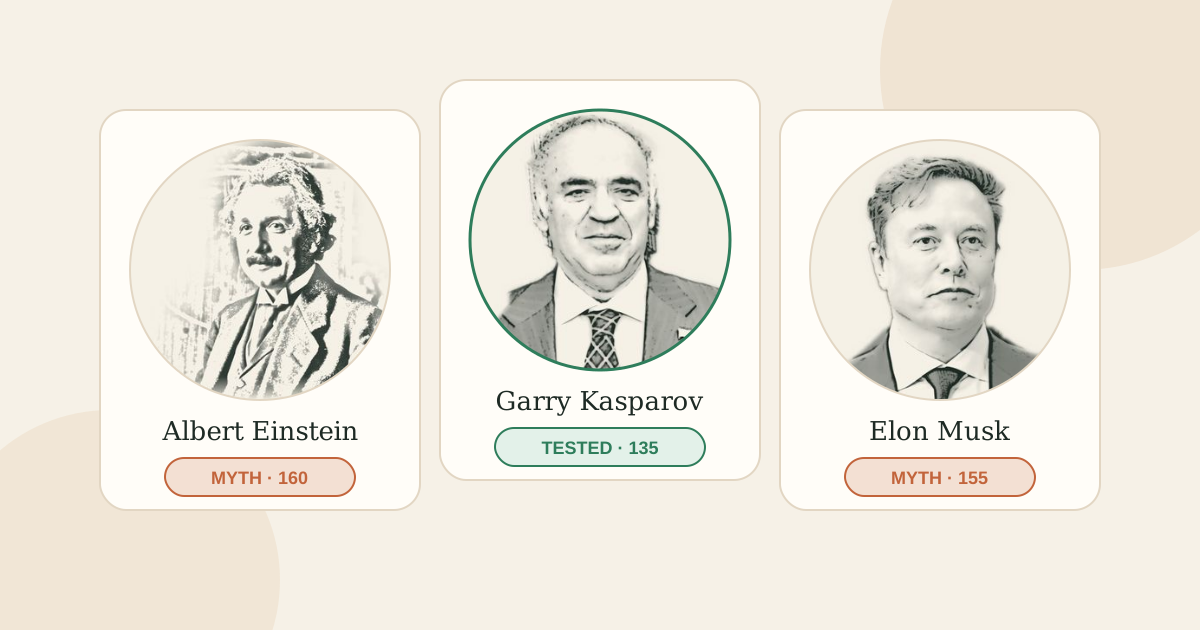
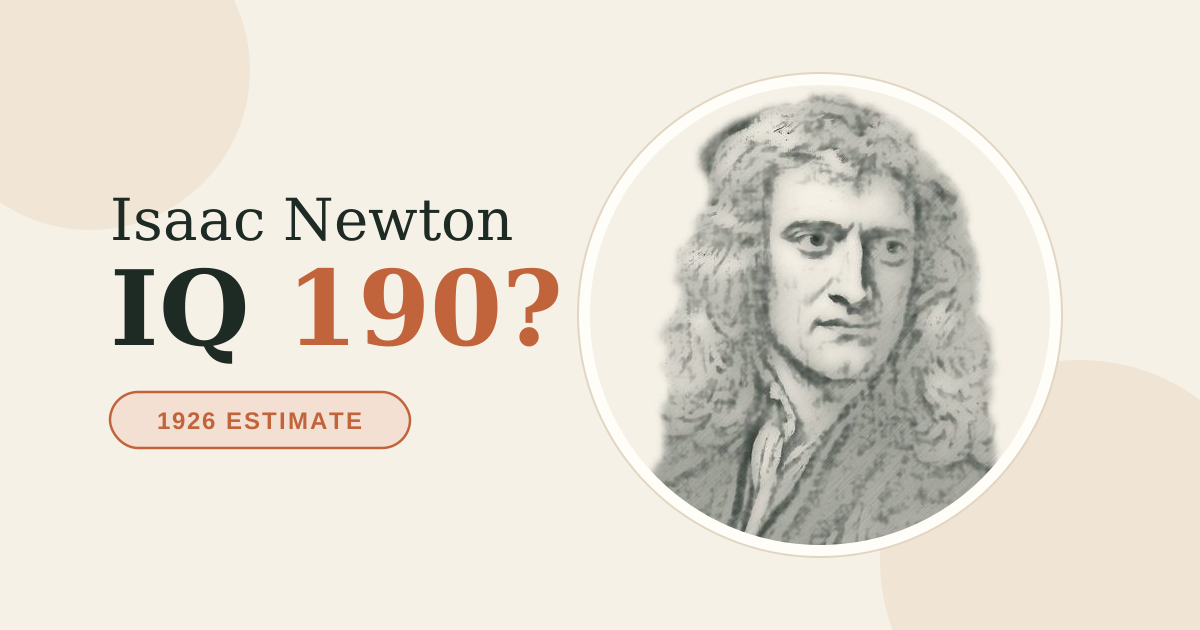
So, unlike Einstein's 160, Tao's figure isn't invented, and unlike Newton's 190, it isn't an estimate from a biography. It is a real childhood test result, converted into an IQ with a formula that is no longer used.
What Terence Tao says about his IQ
Tao has addressed the number directly in an addendum to his blog page on gifted education, because, as he puts it, he is "asked from time to time as to the source of this number". He explains the age-6 test and the division, then adds:
"The test is extremely noisy at these scales, and with realistic error bars a more accurate estimate would be 'greater than 175'."
Terence Tao, "Advice on gifted education", terrytao.wordpress.comHe also points out that "there is no reason to expect that this ratio would continue in my later years", that he took some other cognitive tests at eight but none since, and that IQ "plays no actual role in academia" outside specialist fields such as psychometrics. It isn't used for university admissions or job applications.
Why the childhood formula inflates the number
Early tests expressed intelligence as mental age divided by real age. The problem is that the same head start produces very different numbers depending on how young the child is. Try it: choose how many years ahead of their age a child is, and see the ratio IQ at different ages.
Same head start, different IQ
Ratio IQ = (real age + years ahead) ÷ real age × 100
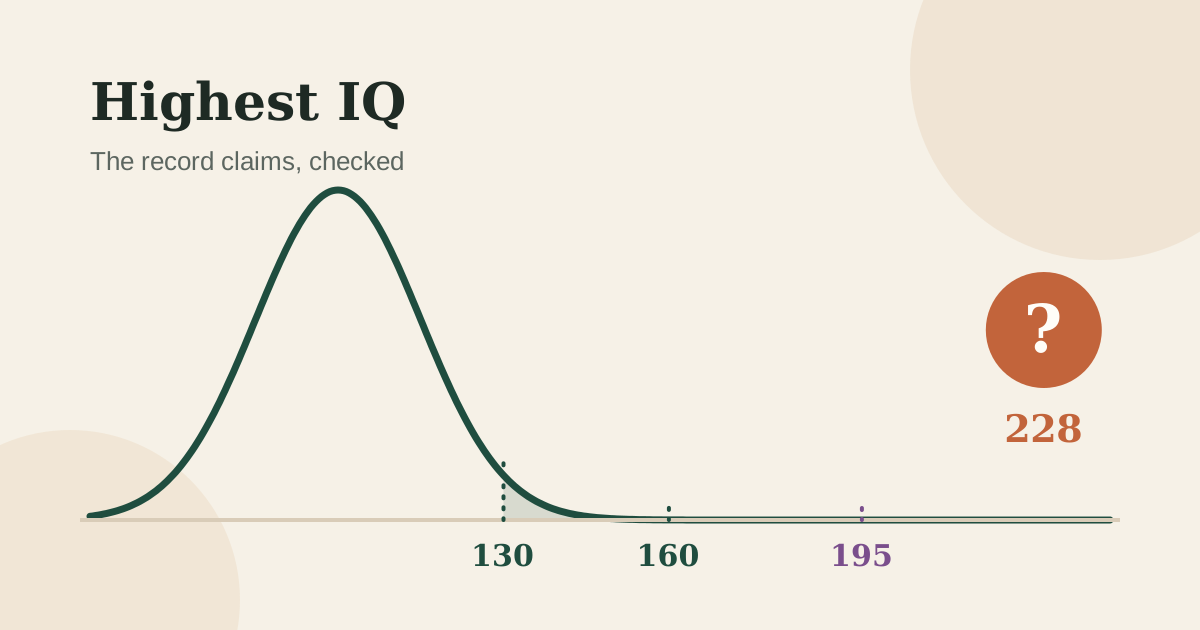
An eight-year head start, which is roughly what Tao showed at six, gives about 233 for a 6-year-old but only 150 for a 16-year-old. That is why the most extreme IQs ever reported almost all come from young children, and why modern tests abandoned the formula in favour of comparing people with others their own age. On today's scale, a genuine 220 would be about one in 1.6 quadrillion, more people than have ever lived. Our page on the highest IQ in the world compares the two methods in more detail, including the similar story behind Marilyn vos Savant's 228.
None of this makes Tao's childhood result less remarkable. It means the right way to describe it is "far ahead of his age on every test he was given", not "IQ 230".
Tao's childhood, test by test
The early record is unusually well documented, by psychologists, by Clements, and later by Julian Stanley, founder of the Study of Mathematically Precocious Youth at Johns Hopkins University:
- Teaching himself to readLearned before 2 by watching Sesame Street, and soon after copied a page of a children's book on a typewriter, one finger at a time.
- First psychologist's reportAt 4 years 7 months, judged to be functioning intellectually like an 8- to 10-year-old. Gross recalled him multiplying two-digit numbers in his head just before he turned 4.
- Second reportAt 5 years 9 months, in the 95th percentile range for 11-year-olds on Raven's Matrices, a non-verbal reasoning test.
- Third reportAt 6 years 4 months, maximum or near-maximum scores on a children's intelligence test; mental age 14.
- High school mathsAfter covering primary school material from grades 1 to 7 in under three years, he joins an 11th-grade maths class.
- Clements's tests60 out of 60 on an Australian Operations Test where the average final-year student scores 53, and 27 out of 30 on a spatial test where final-year students average 24.
- SAT maths: 760Out of 800, on a college admissions test taken mostly by students in their last years of high school. His verbal score was much lower at first but rose into the 700s within a few years.
- Part-time universityStarts taking courses at Flinders University in Adelaide.
Clements also noted something that is easy to miss in the legend: the tests didn't capture everything. On the spatial test Tao preferred to reason through problems analytically rather than picture them, and his verbal scores trailed his maths for several years. Even an extraordinary child had an uneven profile.
Three Olympiad medals before 14
The International Mathematical Olympiad is the world championship of school mathematics, for students up to the end of secondary school. Tao competed for Australia three times:
He remains the youngest person to have won each colour of medal, and his gold at 13 is still the youngest in the competition's history. These results say more about his ability than a childhood IQ: they are timed, supervised, marked by expert judges and compared with the best young mathematicians in the world.
The decision to slow down
Tao's story is also a story about restraint. His parents first enrolled him in school at 3½, but withdrew him after a few weeks: he was far ahead of his classmates intellectually but not ready socially. When the family visited Julian Stanley at Johns Hopkins, Stanley and his wife advised them to monitor his progress carefully and give his verbal, social and emotional development time to catch up. As a result, Tao took university courses part-time from 9 but did not enrol full-time until 14.
He completed his bachelor's and master's degrees at Flinders, then a PhD at Princeton under Elias Stein in 1996. He joined UCLA and became a full professor at 24, the youngest in the university's history. In a 2006 article he co-wrote with Stanley and Gross, his father credited three things: his intellectual capacity, his friendly personality and "chance meetings with many kind and helpful people". Our parent's guide to IQ testing for children covers how gifted children are assessed today.
What Terence Tao went on to do
Tao has worked across an unusually wide range of mathematics. A few highlights:
- The Green-Tao theorem (2004). With Ben Green, he proved that the prime numbers contain arithmetic progressions of any length: evenly spaced runs of primes, like 3, 5, 7, as long as you like.
- Compressed sensing. With Emmanuel Candès and Justin Romberg, he showed in 2006 that signals with simple structure can be reconstructed exactly from far fewer measurements than expected, ideas now used in fields from medical imaging to astronomy.
- The Fields Medal (2006). Mathematics' highest honour, for contributions to partial differential equations, combinatorics, harmonic analysis and additive number theory. The same year he received a MacArthur Fellowship.
- The Breakthrough Prize (2014). One of the five winners of the first Breakthrough Prize in Mathematics, worth $3 million.
- The Erdős discrepancy problem (2015). He solved a question posed by Paul Erdős in the 1930s about how unbalanced long sequences of +1s and −1s must be.
- The Collatz conjecture (2019). The full problem is still unsolved, but he proved that, in a precise statistical sense, almost all starting numbers eventually fall to very small values, one of the strongest partial results so far.
"Does one have to be a genius to do maths?"
That is the title of one of Tao's best-known blog posts, written in 2007 as advice for graduate students, and later reprinted by the American Mathematical Society. Coming from the person most often described as the world's smartest, his answer surprises people:
"The answer is an emphatic NO."
Terence Tao, "Does one have to be a genius to do maths?" (2007)He argues that good mathematics comes from hard work, learning your field and others, asking questions and talking to other mathematicians, together with "a reasonable amount of intelligence, patience, and maturity", rather than from a "genius gene" that produces insights out of nowhere. It is a useful counterweight to the attention his IQ gets, and fits what our guide What is IQ? says about what IQ does and doesn't predict.
Myths and facts about Terence Tao's intelligence
Terence Tao has a confirmed IQ of 230, the highest ever recorded.
The 220 to 230 comes from a test at age 6, converted with the old ratio formula. Tao says a realistic estimate is "greater than 175", and no record-keeping body lists him as the highest.
Tao never took an IQ test; the number was made up.
He did, as a young child. Psychologists' reports from ages 4 to 6 are described in Clements's 1984 article, and Tao explains the result himself.
Tao went to university full-time at 9.
He took university courses part-time from 9, but on Stanley's advice did not enrol full-time until 14.
Tao is the youngest gold medallist in the history of the International Mathematical Olympiad.
True. He won gold in 1988 at 13 years and 4 days, after bronze at 10 and silver at 11.
Frequently asked questions
What is Terence Tao's IQ?
The number usually quoted, 220 to 230, comes from an intelligence test he took at the age of 6, when his mental age was assessed at 14. Dividing 14 by his age gives "an IQ of just over 220", in Tao's own words, but he says the test is extremely noisy at that level and that "greater than 175" is a more realistic estimate. He has not taken an IQ test as an adult.
Did Terence Tao take an IQ test?
Yes, as a young child. A clinical psychologist assessed him at 4, 5 and 6, and at 6 years 4 months he scored at or near the maximum of a standard children's intelligence test, with a mental age of 14. Tao recalls the test as the Stanford-Binet; a 1984 article describing the psychologist's reports names the Wechsler children's scale.
Does Terence Tao have the highest IQ in the world?
There is no way to say that. His childhood figure was calculated with the old "mental age" formula, which produces huge numbers for very young children and can't be compared with a modern adult IQ score. Tao himself says the number plays no role in academia and puts a realistic estimate at above 175.
What did Terence Tao score on the SAT?
He scored 760 out of 800 on the maths section at the age of 8, after Julian Stanley of the Study of Mathematically Precocious Youth sent his parents a copy of the test. His verbal score was much lower at first but rose into the 700s over the next few years.
How old was Terence Tao when he went to university?
He began taking university courses part-time at Flinders University in Adelaide at 9, but did not enrol full-time until 14. He finished his bachelor's and master's degrees there, earned a PhD from Princeton in 1996, and became a full professor at UCLA at 24.
What is Terence Tao known for?
Among much else, the Green-Tao theorem (with Ben Green, 2004), showing that prime numbers contain arithmetic progressions of any length; work with Emmanuel Candès and Justin Romberg that helped found compressed sensing; and solving the Erdős discrepancy problem in 2015. He received the Fields Medal in 2006.
Sources
- Tao, T. Advice on gifted education (with addendum on IQ), What's new blog.
- Clements, M. A. (1984). Terence Tao. Educational Studies in Mathematics, 15(3), 213–238: the psychologist's reports and Clements's own tests.
- Muratori, M. C., Stanley, J. C., Ng, L., Ng, J., Gross, M. U. M., Tao, T. and Tao, B. (2006). Insights from SMPY's greatest former child prodigies. Gifted Child Quarterly, 50(4), 307–324.
- Gross, M. U. M. (1986). Radical acceleration in Australia: Terence Tao. G/C/T, 9(4), 2–11.
- List of International Mathematical Olympiad participants, Wikipedia: medal years and ages.
- Terence Chi-Shen Tao, MacTutor History of Mathematics: family background and career.
- Terence Tao, Clay Mathematics Institute Annual Report 2006: the Fields Medal and the Green-Tao theorem.
- Five chosen for inaugural Breakthrough Prize in Mathematics, Physics Today (2014).
- Tao, T. (2016). The Erdős discrepancy problem. Discrete Analysis.
- Terence Chi-Shen Tao, Engineering and Technology History Wiki: compressed sensing with Candès and Romberg.
- Tao, T. Does one have to be a genius to do maths? Notices of the American Mathematical Society (2024 reprint of the 2007 blog post).
Try a test on today's scale
Tao's famous number comes from a formula built for children in the early twentieth century. Our free test compares you with others on the modern scale: four kinds of reasoning, 36 questions, and your result in about 25 minutes.
Take the free IQ test