In short: IQ stands for intelligence quotient. It is a score from a standardised test that shows how well you reason and solve problems compared with other people your age, on a scale where 100 is average. It is a good guide to some things, such as how people tend to do at school, and a poor guide to others, such as creativity, character or how happy someone will be.
IQ meaning: what does IQ stand for?
The meaning of IQ is in its name: it is short for intelligence quotient. A quotient is the result of a division, and the first IQ scores really were one: a child's "mental age", worked out from a test, divided by their actual age and multiplied by 100. A 10-year-old who performed like a typical 10-year-old scored 100.
That formula made no sense for adults, whose mental age stops climbing, so it was replaced decades ago. Today an IQ score simply shows where your result falls compared with a large group of people your age, so a high or low intelligence quotient is high or low only in comparison with them. The name is a leftover from the old method. Our guide to the IQ scale covers that history and what each score range means.
What is intelligence?
Psychologists have argued about the exact definition for over a century, but most definitions describe the same core: the ability to understand new things, reason through problems and learn from experience. Two well-known versions:
"The aggregate or global capacity of the individual to act purposefully, to think rationally, and to deal effectively with his environment."
"Individuals differ from one another in their ability to understand complex ideas, to adapt effectively to the environment, to learn from experience, to engage in various forms of reasoning, to overcome obstacles by taking thought."
Notice what these definitions leave out: they say nothing about how much you know about a particular subject, how hard you work or how kind you are. An IQ test is built around this narrower idea of intelligence, which is why it is useful for some questions and silent on others.
What an IQ test actually measures
In 1904 the British psychologist Charles Spearman noticed something that has been confirmed in hundreds of studies since: people who do well on one kind of mental test tend to do well on others, even when the tests look completely different. Vocabulary, number puzzles and shape problems all correlate positively. Spearman called the shared factor behind this general intelligence, or g.
The overall IQ score is the best available estimate of g. But modern tests also look at more specific abilities that sit underneath it. Most professional tests measure some version of these five:
These abilities are related, but not identical. One person may have a strong vocabulary and only average speed, while another is the reverse, which is why a professional report shows a profile and not just one number. The two best-known groupings are fluid reasoning and crystallized knowledge, compared in our guide to fluid vs crystallized intelligence. Separate guides cover verbal reasoning, spatial reasoning, abstract reasoning and processing speed. Memory has its own myths too: our guides ask whether photographic memory is real and what hyperthymesia is, and you can try a photographic memory test.
Quiz: which ability is it?
Each task below is written in the style of the questions used in IQ tests (these are our own examples, not real test items). Pick the ability you think each one mainly measures.
Which ability is it?
What IQ predicts, and how strongly
IQ scores are among the most studied measurements in psychology, largely because they are linked to things people care about. The strength of a link is usually given as a correlation, from 0 (no link) to 1 (a perfect one). For how average scores differ between jobs, see IQ by profession.
School: Deary and colleagues (2007), a link between underlying traits rather than raw scores. Jobs: Schmidt and Hunter (1998) and the revised estimate by Sackett and colleagues (2022).
- School results. In a study of more than 70,000 English children, intelligence measured at age 11 was strongly linked to exam results at 16, with a correlation of 0.81 between the two underlying traits. Few predictors in psychology are this strong.
- Job performance. For decades, the standard figure was 0.51 (Schmidt and Hunter, 1998), which made general ability look like one of the best and most widely usable predictors of how well people do at work. In 2022 a team led by Paul Sackett showed that earlier corrections had been too generous and revised it to about 0.31. That is still a real, useful link, but structured interviews (about 0.42) and several other methods, such as job knowledge tests and work samples, came out ahead.
- Health and lifespan. A 2011 review of 16 studies, covering more than a million people, found that people who scored one standard deviation higher (15 IQ points) in youth had a 24% lower risk of dying during follow-up periods of 17 to 69 years. Taking education and adult social class into account weakened the link by about a half and a third respectively, though the authors note it is unclear how far these explain the link rather than form part of it.
Correlations describe patterns across thousands of people. They don't tell you what will happen to any one person. Plenty of people with modest scores do brilliantly at work, and plenty with high scores don't.
What IQ leaves out
An IQ test is a sample of reasoning tasks done in about an hour. By design it doesn't try to measure everything that makes someone capable.
- Reasoning with new problems
- Vocabulary and knowledge
- Visual and spatial thinking
- Working memory
- Speed on simple tasks
- Creativity and original ideas
- Understanding people and emotions
- Motivation, persistence and self-control
- Practical skills and experience
- Judgement, values and wisdom
You may have heard of Howard Gardner's theory of multiple intelligences, such as musical, interpersonal and bodily intelligence. It is popular in schools, but researchers who reviewed the evidence, including Lynn Waterhouse, found little support for the idea that these are separate, independent intelligences. Many of them are better described as talents or skills, which matter a great deal but aren't what an IQ test sets out to measure.
Can IQ change?
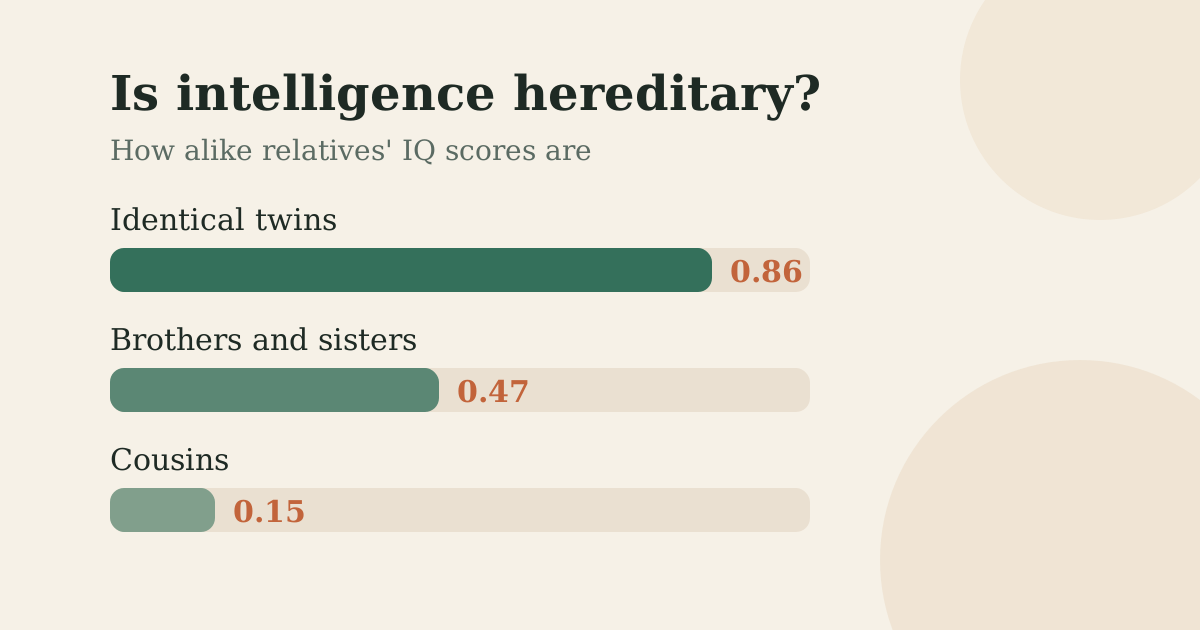
Intelligence is shaped by both genes and environment. Studies of twins suggest that genetic differences account for about 20% of the differences between people in infancy, rising to perhaps 80% in later adulthood (Plomin and Deary, 2015). That figure describes variation across a population. It doesn't mean any one person's IQ is fixed or that environment doesn't matter. Our guide to whether intelligence is hereditary explains what that heritability figure does and doesn't mean.
Source: Ritchie and Tucker-Drob (2018), Psychological Science.
Education is the clearest example: staying in school longer raises measured IQ, and the gains were still visible in people tested in their 70s and 80s. Scores also rise when someone retakes a test, simply because the tasks are familiar. A large 2018 analysis of retesting found clear gains that levelled off after the third attempt, which is one reason professionals avoid giving the same test too often. Average scores across whole countries have also changed over time, which our guide to average IQ explains. For what else has and hasn't been shown to work, from adoption to brain training, see can you increase your IQ?
How IQ is measured today
An official IQ score comes from a professional test given one to one by a qualified psychologist, using strict instructions and timing. The most widely used is the Wechsler Adult Intelligence Scale; our guide to the Wechsler IQ test (WAIS) explains what happens during it and how it is scored.
Online tests can't give you an official score, but a well-built one can give a useful estimate. Our article Are online IQ tests accurate? shows how to tell a careful test from a quiz, and our free IQ test measures four kinds of reasoning in 36 questions.
Frequently asked questions
What does IQ stand for?
IQ stands for intelligence quotient. The name comes from early tests for children, where a "mental age" was divided by the child's real age and multiplied by 100. Modern tests no longer use that division, but the name stuck.
Is IQ the same thing as intelligence?
Not quite. Intelligence is the broad ability to reason, learn and solve problems. An IQ score is one measurement of it, taken with a particular test on a particular day. It captures reasoning well, but it leaves out things many people would call intelligent, such as creativity and practical know-how.
Does more education raise IQ?
Yes, modestly. A 2018 analysis of studies with more than 600,000 people found that each extra year of education was linked to a gain of roughly 1 to 5 IQ points, about 3.4 points on average. It is still unclear exactly which abilities improve.
Is emotional intelligence part of IQ?
No. IQ tests measure reasoning, knowledge, memory and speed. Emotional intelligence, the ability to understand and manage emotions in yourself and others, is measured separately, and researchers still debate how best to define and test it.
Does a high IQ guarantee success?
No. IQ is linked to school results and, more weakly, to job performance, but these are patterns across large groups. Effort, interests, health, opportunity and luck all shape how an individual life turns out, and many people with average scores do very well.
Sources
- Neisser, U. et al. (1996). Intelligence: knowns and unknowns. American Psychologist, 51(2), 77–101.
- Schmidt, F. L. and Hunter, J. E. (1998). The validity and utility of selection methods in personnel psychology. Psychological Bulletin, 124(2), 262–274.
- Spearman, C. (1904). General intelligence, objectively determined and measured. American Journal of Psychology, 15(2), 201–292. Background: g factor.
- Deary, I. J., Strand, S., Smith, P. and Fernandes, C. (2007). Intelligence and educational achievement. Intelligence, 35(1), 13–21.
- Sackett, P. R., Zhang, C., Berry, C. M. and Lievens, F. (2022). Revisiting meta-analytic estimates of validity in personnel selection. Journal of Applied Psychology, 107(11), 2040–2068. Summary: SIOP.
- Calvin, C. M. et al. (2011). Intelligence in youth and all-cause-mortality: systematic review with meta-analysis. International Journal of Epidemiology, 40(3), 626–644.
- Plomin, R. and Deary, I. J. (2015). Genetics and intelligence differences: five special findings. Molecular Psychiatry, 20, 98–108.
- Ritchie, S. J. and Tucker-Drob, E. M. (2018). How much does education improve intelligence? A meta-analysis. Psychological Science, 29(8), 1358–1369.
- Scharfen, J., Peters, J. M. and Holling, H. (2018). Retest effects in cognitive ability tests: a meta-analysis. Intelligence, 67, 44–66.
- Waterhouse, L. (2006). Multiple intelligences, the Mozart effect, and emotional intelligence: a critical review. Educational Psychologist, 41(4), 207–225. Update: Waterhouse (2023).
Put the theory to the test
Try the free Assessivo IQ test: fluid, logical, spatial and numerical reasoning, with your estimated score and percentile when you finish.
Take the free IQ test