In short: yes, IQ can change, but not in the way most "boost your IQ" adverts promise. The strongest evidence that the environment can raise IQ comes from big, slow forces: more years of schooling, being adopted into a better-resourced home in childhood, and avoiding harm such as iodine deficiency or lead. Gains from intensive preschool programmes usually fade within a few years. Brain-training apps, Mozart, supplements and courses that promise dozens of extra points have no good evidence behind them. Practice usually lifts scores on a familiar test, but that isn't a promise to change your IQ.
Can you increase your IQ? The short answer
IQ is not a fixed number stamped on you at birth. Measured intelligence responds to the world a person grows up in, and researchers have watched it move, in both directions, across individuals, families and whole countries. So the honest answer to "can you increase your IQ?" is yes, in principle.
The catch is in the detail. The things with solid evidence behind them mostly act on children, take years rather than weeks, and are hard to buy: a longer education, a stable and stimulating home, enough iodine, no lead in the water. The things that are easy to buy, such as apps, pills and online courses, are exactly the ones that have failed when tested properly. And many apparent gains turn out to be gains on one test, not in the underlying ability the test is trying to measure.
Our guide sets out what the research actually shows, where the evidence is strong, where it is mixed, and where it is marketing. It doesn't promise a higher number, because nobody honest can.
What "increasing your IQ" really means
An IQ score is not a raw count of right answers. It tells you how you did compared with a large sample of people your own age, with the average set at 100. Three things follow from that, and they matter for any claim that something can boost your IQ.
- No score is exact. No test measures perfectly, so a professional report gives a likely range of a few points either side of your score. A rise of 3 or 4 points between two sittings can be nothing more than noise. Our page on an IQ of 89 shows how publishers calculate this range.
- Scores are relative. If everyone your age improves, your IQ stays put. A real increase means you have moved up compared with your peers, not just that you know more than you did last year.
- A test is a sample of ability, not the ability itself. Getting better at one kind of puzzle can lift a score without making you any better at reasoning in general. Psychologists call that a gain that doesn't "transfer", and it is the main reason so many headline results have shrunk on closer inspection.
So when we ask whether something can raise IQ, the useful question is narrower: does it produce a gain that shows up on different tests, lasts after the activity stops, and survives a fair comparison with people who didn't do it? Very few things pass all three.
What has raised IQ scores
The clearest evidence comes not from lab experiments but from natural experiments: situations where life itself changed people's surroundings, and researchers could measure what happened.
More years of education
Staying in school longer is the best-supported route. Studies that exploited changes to school-leaving ages and school-entry cut-offs put the gain at roughly 1 to 5 IQ points for each extra year, and the authors called education "the most consistent, robust, and durable method yet to be identified for raising intelligence" (Ritchie and Tucker-Drob, 2018). Our guide to what IQ is covers this study in more detail.
Adoption: the strongest natural experiment
Adoption separates the family a child is born into from the family that raises them, which makes it one of the few ways to see the effect of upbringing on its own. Three studies stand out.
- Swedish brothers raised apart. Researchers searched Swedish national records for 436 sets of full brothers in which one was raised by his birth parent or parents and another by adoptive parents. IQ was measured at 18 to 20 at military conscription. The adopted brothers scored on average 4.41 points higher than their brothers who stayed at home, and each step up in the adoptive parents' education went with about 1.7 more points. A second sample of 2,341 sets of half-brothers showed a gain of 3.18 points (Kendler and others, 2015). Because the brothers share many of their genes, this is unusually direct evidence that the home makes a difference.
- Late adoption in France. From 5,003 adoption files, a French team selected 65 children who had been abused or neglected as infants, had an IQ below 86 (average 77) and were adopted between the ages of 4 and 6. Retested at about 13, they had gained an average of 7.7 points if placed with lower-status families and 19.5 points if placed with higher-status families (Duyme, Dumaret and Tomkiewicz, 1999). These were children rescued from severe deprivation, so the result tells us how much a poor start can hold IQ down, not how much an ordinary child can gain.
- A meta-analysis of 62 studies. Pooling results for 17,767 adopted children, a 2005 review found that adopted children outscored the brothers, sisters and peers they left behind, and did not differ in IQ from the children they grew up alongside, although their school performance lagged a little (van IJzendoorn, Juffer and Klein Poelhuis, 2005).
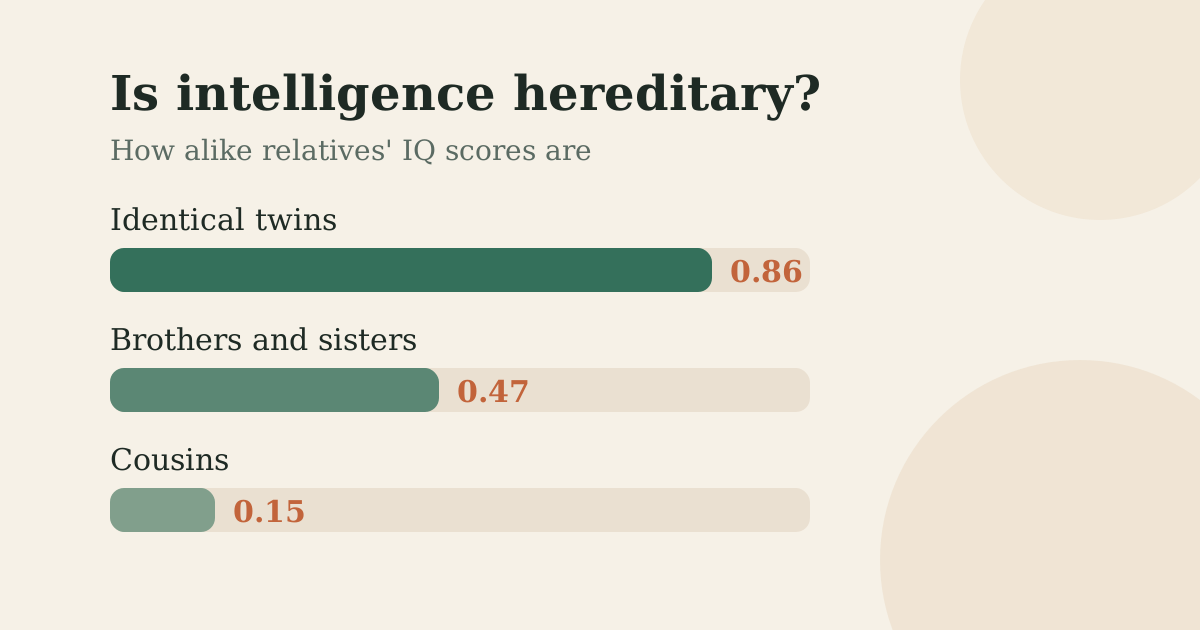
What adoption does and doesn't show: a better environment in childhood can lift IQ, sometimes a lot when the starting point is deprivation. It doesn't show that adults can add the same points by changing their surroundings, and genes still matter: the French children's later IQs were linked to their IQs before adoption. Our page on genes, home and family income looks at how the two interact. For the genetic side of the story, see is intelligence hereditary?
Removing things that hold IQ down
Some of the largest effects come from preventing harm rather than adding a boost. Severe iodine deficiency in childhood is linked to lower IQ (see iodine and IQ), and even low levels of lead in a child's blood are tied to lost points (see lead and IQ). For a well-fed adult in a country without these problems, there is nothing extra to gain here, but for millions of children worldwide it remains the most practical way to protect IQ.
Whole populations
Average scores rose for most of the 20th century, the Flynn effect, which our average IQ guide explains, and in some countries the rise has since stalled or reversed, as in Norway. Rising averages are a reminder that IQ responds to schooling, health and the demands of daily life, even if nobody can yet say exactly which changes did the work.
Early childhood programmes and fade-out
If home and schooling matter, the obvious next step is to help young children directly. Many programmes have tried, and the story they tell is more complicated than the headlines.
The common pattern is called fade-out. A 2015 meta-analysis of 39 randomised trials with 7,584 participants confirmed that "after an intervention raises intelligence the effects fade away", and showed that this happens because the children who received the programme lose their advantage, not because the comparison group catches up (Protzko, 2015).
The best-known example is the Perry Preschool program, a randomised trial run in the mid-1960s in Ypsilanti, Michigan, for disadvantaged 3- and 4-year-olds, who were then followed to age 40. The programme boosted children's IQs at first, but a few years after it ended there was no significant difference for boys and only a borderline one for girls. Even so, participants did better as adults, and economists traced much of that to lasting improvements in behaviour, such as fewer aggressive and rule-breaking behaviours, rather than to IQ (Heckman, Pinto and Savelyev, 2013).
There are exceptions. The Abecedarian Project in North Carolina gave children from low-income families full-time, high-quality educational care from infancy to age 5. Treated children still had higher scores on cognitive and academic tests at 21, with moderate to large effects (Campbell and others, 2001), and at 30 they had completed more years of education (Campbell and others, 2012). It was a small trial of 111 infants and an unusually intensive programme, so it shows what may be possible rather than what a typical nursery can deliver.
Why fade-out isn't failure. A programme that leaves IQ unchanged by age 10 can still change lives. Perry's graduates did better in adulthood despite their IQ advantage disappearing, which suggests that skills such as self-control and persistence matter as much as the number on a test.
Raising a test score vs raising intelligence
Most quick IQ gains are gains in a score. Take the same or a similar test again and you will usually do better, because the instructions, timing and types of question are familiar; our page on the retest effect shows how big that effect is and when it levels off.
The key question is whether such gains reflect a rise in general intelligence, often called g, or something narrower. A meta-analysis of 64 test-retest studies with 26,990 people found that score gains were concentrated on the parts of tests that measure g least, a correlation of −1.00 between how strongly a subtest measures g and how much it improved. In plain terms, practice made people better at the particular tests, not more intelligent, which is why the gains didn't carry over to other tests or to real-world outcomes (te Nijenhuis, van Vianen and van der Flier, 2007).
Motivation, sleep and nerves can also move a score on the day. Paying people to try harder was once thought to lift scores dramatically, until the best-known study on it was retracted, a story told on our IQ 88 page. None of this is cheating, but none of it changes the ability underneath.
A useful rule: if a method raises your score on the test you practised for, but not on a different, well-made test, you have learned the test. If it raises scores on many different tests and the gain lasts, you may have learned something more general.
What does not work (or not yet)
Plenty of products and habits are sold as ways to improve IQ. Here is where the evidence stands on the most common ones.
- Brain-training apps and dual n-back. Players improve at whatever they rehearse, but large reviews find little sign that the improvement spreads to intelligence. Our fluid intelligence guide covers the dual n-back story and the reviews that followed.
- The Mozart effect and "sonic" audio. Pooled studies of listening to Mozart found no real gain, and audio tracks sold as adding 40 IQ points have no study behind them. US regulators have penalised a brain-training firm for unsupported claims; our pattern recognition article has the details.
- Music lessons. An early experiment found a small IQ advantage for children given lessons, but a 2020 review of 54 studies found the benefit disappeared in the better-designed trials (see music lessons and IQ).
- Learning a second language. Being bilingual has real benefits, but a sharper mind across the board is not a reliable one (see bilingualism and IQ).
- A growth mindset. Believing ability can grow has small effects on school grades, mainly for struggling students, and no shown effect on IQ (see growth mindset).
- Creatine. A 2018 systematic review found only 6 randomised trials, with 281 people in total. There was some evidence that short-term memory and reasoning may improve, especially in older or stressed people and in vegetarians on memory tasks, but performance "stayed unchanged in young individuals" and the authors called for larger studies (Avgerinos and others, 2018). Promising, not proven.
- Omega-3 capsules. A Cochrane review of trials in more than 3,000 cognitively healthy people aged 60 and over found no benefit of omega-3 supplements on cognitive function compared with placebo (Sydenham, Dangour and Lim, 2012).
- Speed training, exercise and sleep. These can make you faster or sharper on the day, which our processing speed guide describes, but faster is not the same as a higher IQ. Fitter teenagers do score higher, though that link is observational and can't show cause and effect.
Two more childhood factors often come up. Reading well early is linked to higher later intelligence in a clever twin study (see reading and IQ), and the link between breastfeeding and IQ largely disappears once the mother's own IQ is taken into account (see breastfeeding and IQ).
Works, mixed or myth?
Test your instincts. For each claim, decide whether the evidence says it works, is mixed, or is a myth, then check the verdict.
Can adults increase their IQ?
Not reliably, as far as current evidence goes. Nearly all the strong results above involve children: years of schooling, adoption, early care, nutrition. By adulthood, people's rank compared with others of the same age is fairly stable, and Scottish research that retested people at 90 on a test they first sat at 11 found a clear link between the two scores, though far from a perfect one (see IQ stability over a lifetime).
That doesn't mean adults are stuck. The education studies found gains that persisted across the life span, so further study may still help. Knowledge and vocabulary, which psychologists call crystallized intelligence, keep growing as long as you keep learning. And staying mentally and physically active is linked to keeping the abilities you have for longer; our page on childhood ability and dementia touches on why people with more mental reserve may cope better with ageing.
What adults should be wary of is any product that promises a specific number of extra points. The best-designed tests of brain training, supplements and short courses have not found them.
Does IQ increase with age?
Your abilities do; your IQ score is built not to. A 10-year-old solves far more puzzles than a 5-year-old, and most adults keep adding words and knowledge for decades, while quicker, puzzle-style reasoning starts to slip earlier. But an IQ score compares you only with people born around the same time as you, so if you develop at the same pace as your peers, the number holds steady even as you grow.
That is why a child whose score is 100 at 8 and again at 14 has not stood still: they have kept up. Scores wobble more in early childhood and settle in the teenage years. Our average IQ guide sets out when scores become stable and when different abilities peak, and fluid vs crystallized intelligence charts which abilities climb and which decline.
A realistic plan
If you want to think more clearly and get the best out of the ability you have, these steps are backed by evidence, even if none can promise a higher IQ.
- Keep learning in a structured way. Formal education has the strongest record of any method. A course, a qualification or serious self-study all build knowledge that a test can draw on.
- Read widely. It builds vocabulary and general knowledge, the parts of intelligence that keep growing.
- Look after the basics. Sleep, exercise and not testing yourself while ill or exhausted help you perform at your real level, as our processing speed guide explains.
- For children, think about the long run. A safe, stimulating home, good schooling, enough iodine and no lead exposure matter far more than any app or supplement.
- Be sceptical of products. If something promises a set number of IQ points, ask whether it has been tested against a control group, on a different test, months later. Usually it hasn't.
- Measure fairly. If you want to see where you stand, take a well-built test once, rested, and read the result as a band of likely scores, not a verdict. Our free IQ test scores fluid, logical, spatial and numerical reasoning, and our look at online test accuracy sets out what a web-based result can and can't show.
Retaking a test after practice will probably give you a higher number. That is worth knowing, so you can read the result honestly: a better score on a familiar test is not the same as a bigger mind.
Frequently asked questions
Can you increase your IQ?
IQ can change, but the reliable influences are slow and mostly act in childhood: more years of education, a better home environment, and avoiding harms such as iodine deficiency and lead. Quick fixes like brain-training apps, supplements and short courses have not held up when tested properly. Practice will usually lift your score on a familiar test, but that isn't a promise to change your IQ.
How much can IQ increase?
It depends on the cause. Each extra year of schooling is linked to roughly 1 to 5 IQ points. Swedish brothers adopted into other families scored about 4.4 points higher than brothers raised at home, and neglected French children adopted at 4 to 6 gained about 8 to 20 points depending on the adoptive family. For an adult starting from a typical background, no tested method reliably adds large gains.
Can adults increase their IQ?
Not reliably, on current evidence. Most strong findings come from children. Adults can keep adding knowledge and vocabulary for life, further education seems to help, and retaking tests raises scores through familiarity. But research that retested the same people at 90 on a test they took at 11 found scores clearly linked across the decades, and no adult programme has shown lasting, general IQ gains.
Does reading increase IQ?
Reading builds vocabulary and general knowledge, which feed into the verbal parts of IQ tests. When identical twins differ in early reading skill, the stronger reader usually goes on to do better on later intelligence tests too. Those were children in an observational study, not a trial, so nothing here guarantees points for adults, but reading remains one of the best ways to keep learning.
Do brain games increase IQ?
There is no convincing evidence that they do. People get much better at the specific games they practise, but large reviews of working memory and brain-training studies found little or no improvement on intelligence tests or everyday thinking. In 2016 the US Federal Trade Commission settled with the brain-training company Lumosity over advertising claims it said were not backed by science.
Can you increase your IQ by 20 points?
Not by any method tested in ordinary adults. Gains of around 20 points have been recorded, but in special cases: in one French study, neglected children whose IQs averaged 77 before adoption gained 19.5 points on average if they were placed with higher-status families, measured years later. Courses or audio tracks promising 20 or 40 points in weeks have no scientific evidence behind them.
Does IQ increase with age?
Your abilities change with age, but your IQ score is designed to stay roughly level, because it compares you only with people of your own age. Children solve far more problems each year, and adults keep adding knowledge, yet the score stays the same if you develop at the same pace as your peers. Scores move more in early childhood and become fairly stable from the teenage years.
What foods increase IQ?
No food has been shown to raise IQ in people who already eat a reasonable diet. Severe iodine deficiency in childhood is linked to lower IQ, so getting enough iodine protects children's development. A Cochrane review of omega-3 trials in more than 3,000 healthy people aged 60 and over found no benefit for cognitive function. Eat well for your health, not for extra IQ points.
Does creatine increase IQ?
The evidence is too thin to say. A 2018 systematic review found only 6 randomised trials with 281 people in total. There were hints that short-term memory and reasoning may improve in some groups, such as older adults, but performance stayed unchanged in young people and the authors called for larger studies. Creatine is not a proven way to raise IQ.
Do early childhood programmes raise IQ?
Often at first, but the gains usually fade. A meta-analysis of 39 randomised trials found that IQ advantages from early interventions faded after the programmes ended. The Perry Preschool program lost its IQ effect within a few years yet still improved adult outcomes, while the more intensive Abecedarian Project kept a cognitive advantage to age 21. Their value lies as much in later life as in IQ.
Sources
- Ritchie, S. J. and Tucker-Drob, E. M. (2018). How much does education improve intelligence? A meta-analysis. Psychological Science, 29(8), 1358–1369.
- Kendler, K. S., Turkheimer, E., Ohlsson, H., Sundquist, J. and Sundquist, K. (2015). Family environment and the malleability of cognitive ability: a Swedish national home-reared and adopted-away cosibling control study. Proceedings of the National Academy of Sciences, 112(15), 4612–4617.
- Duyme, M., Dumaret, A.-C. and Tomkiewicz, S. (1999). How can we boost IQs of "dull children"? A late adoption study. Proceedings of the National Academy of Sciences, 96(15), 8790–8794.
- van IJzendoorn, M. H., Juffer, F. and Klein Poelhuis, C. W. (2005). Adoption and cognitive development: a meta-analytic comparison of adopted and nonadopted children's IQ and school performance. Psychological Bulletin, 131(2), 301–316.
- Protzko, J. (2015). The environment in raising early intelligence: a meta-analysis of the fadeout effect. Intelligence, 53, 202–210.
- Heckman, J., Pinto, R. and Savelyev, P. (2013). Understanding the mechanisms through which an influential early childhood program boosted adult outcomes. American Economic Review, 103(6), 2052–2086.
- Campbell, F. A., Pungello, E. P., Miller-Johnson, S., Burchinal, M. and Ramey, C. T. (2001). The development of cognitive and academic abilities: growth curves from an early childhood educational experiment. Developmental Psychology, 37(2), 231–242.
- Campbell, F. A. and others (2012). Adult outcomes as a function of an early childhood educational program: an Abecedarian Project follow-up. Developmental Psychology, 48(4), 1033–1043.
- te Nijenhuis, J., van Vianen, A. E. M. and van der Flier, H. (2007). Score gains on g-loaded tests: no g. Intelligence, 35(3), 283–300.
- Avgerinos, K. I., Spyrou, N., Bougioukas, K. I. and Kapogiannis, D. (2018). Effects of creatine supplementation on cognitive function of healthy individuals: a systematic review of randomized controlled trials. Experimental Gerontology, 108, 166–173.
- Sydenham, E., Dangour, A. D. and Lim, W.-S. (2012). Omega 3 fatty acid for the prevention of cognitive decline and dementia. Cochrane Database of Systematic Reviews, 2012(6), CD005379.
- Sala, G. and Gobet, F. (2020). Cognitive and academic benefits of music training with children: a multilevel meta-analysis. Memory & Cognition, 48(8), 1429–1441.
- Pietschnig, J., Voracek, M. and Formann, A. K. (2010). Mozart effect–Shmozart effect: a meta-analysis. Intelligence, 38(3), 314–323.
- Ritchie, S. J., Bates, T. C. and Plomin, R. (2015). Does learning to read improve intelligence? A longitudinal multivariate analysis in identical twins from age 7 to 16. Child Development, 86(1), 23–36.
- Deary, I. J., Pattie, A. and Starr, J. M. (2013). The stability of intelligence from age 11 to age 90 years: the Lothian birth cohort of 1921. Psychological Science, 24(12), 2361–2368.
- US Federal Trade Commission (2016). Lumosity to pay $2 million to settle FTC deceptive advertising charges for its "brain training" program.
See where you stand today
Take the free Assessivo IQ test once, rested, and read the result as a range: 36 questions on fluid, logical, spatial and numerical reasoning, with your estimated IQ and percentile.
Take the free IQ test