In short: nobody knows Nikola Tesla's IQ. No test was ever given to him, the first widely used adult IQ test appeared when he was 83, and no claimed figure has a traceable source. What survives is his record: more than 300 patents and the alternating-current system that powers the modern world.
Where the Nikola Tesla IQ numbers come from
Search for Tesla's IQ and you will find a wide spread of confident answers:
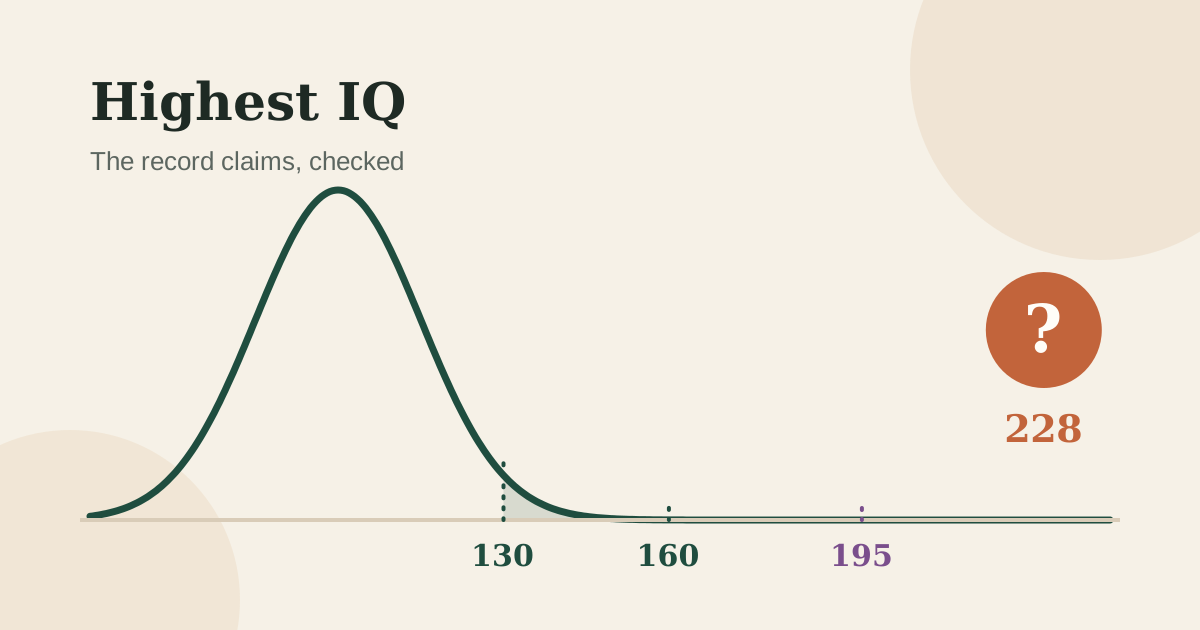
None of these numbers can be traced to a test, a study or a biography. They are passed from site to site without a source, and the size of the range is itself the giveaway: real measurements of the same person don't differ by 150 points. A figure like 310 isn't even possible on the IQ scale, as our page on the highest IQ in the world explains with a rarity calculator.
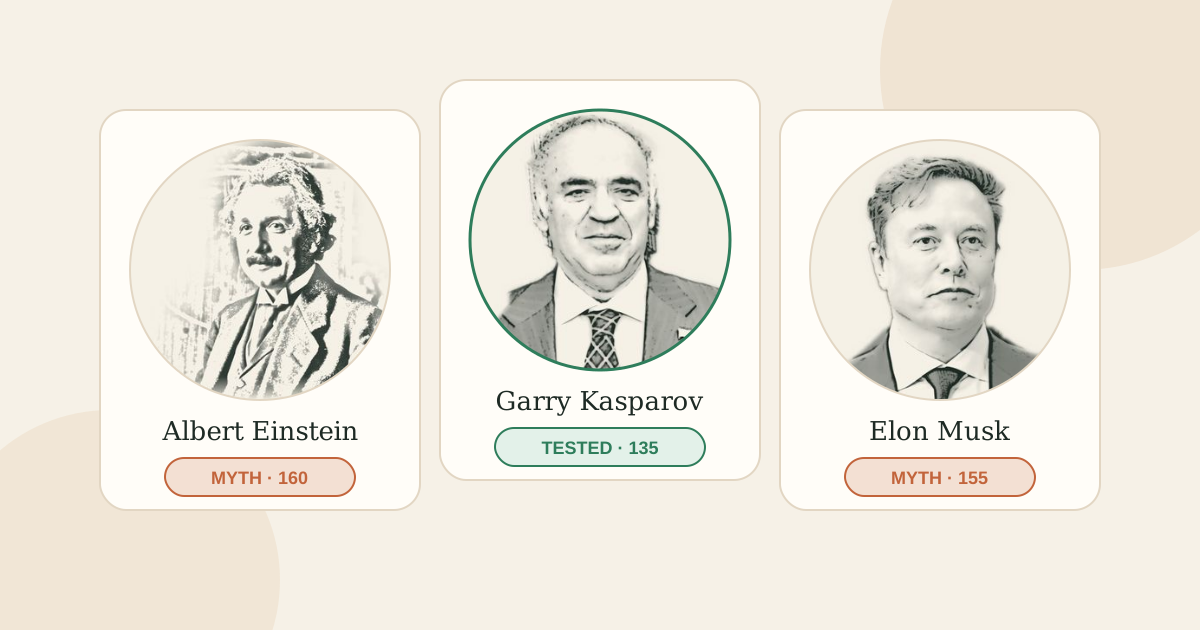
The pattern is the same one we found for Einstein's IQ and Stephen Hawking's IQ: a famous genius, a round number, and no evidence behind it. Our guide to the IQ of famous people explains how to spot these claims.
Could Tesla have taken an IQ test?
Tesla was born on 10 July 1856 in Smiljan, then part of the Austrian Empire and now in Croatia, and died in New York on 7 January 1943. For most of his life, IQ tests simply didn't exist. Move through the timeline to see which tests were available at each point in his life, and who they were designed for.
Tesla's life vs the history of IQ tests
Each orange mark is a new IQ test. Drag to any year from his birth to his death.
The first practical intelligence test, by Alfred Binet and Théodore Simon, appeared in France in 1905, the year Tesla turned 49, when he was already famous. It and its American revision, the Stanford-Binet, were built to compare children of the same age. The first widely used test for adults, David Wechsler's, arrived in 1939, when Tesla was 83 and living quietly in a New York hotel. There is no record that he took any of them. Our guide to the Wechsler IQ test (WAIS) covers its modern version.
Tesla at school: brilliant, then gone
The closest thing we have to test scores for Tesla is his university record. In 1875 he enrolled at the Polytechnic in Graz, Austria, on a military scholarship. According to the records of what is now Graz University of Technology, he was graded "excellent" in every exam he took except his last, which was marked "good". Tesla later recalled passing nine exams in his first year, and that his professors thought he "deserved more than the highest qualifications".
It didn't last. At the end of his second year his scholarship was withdrawn, he was removed from the student list for unpaid fees, and late in 1878 he left Graz without a degree. In 1880 he went to Prague, where he could not enrol at the university, and he never completed a degree. One of the greatest engineers in history had no engineering diploma, a useful reminder that grades and qualifications, like IQ scores, capture only part of a person.
How Tesla described his own mind
Tesla's 1919 autobiography, My Inventions, first published as a series in the magazine Electrical Experimenter, is the main source for stories about his mind. Two themes stand out.
Vivid images. He wrote that as a boy he suffered from images, often with flashes of light, that appeared so vividly he sometimes couldn't tell whether they were real, and that they were images of things he had actually seen. He learned to control them by deliberately "travelling" in his imagination.
Inventing in his head. As an adult he described building and testing machines entirely in his imagination:
"When I get an idea I start at once building it up in my imagination. I change the construction, make improvements and operate the device in my mind."
Nikola Tesla, My Inventions (1919)The best-known example came in 1882, during a walk with a friend in Budapest's City Park. Reciting lines from Goethe's Faust from memory as the sun set, he suddenly saw how a rotating magnetic field could drive a motor, the idea behind the alternating-current induction motor. These are Tesla's own accounts, written decades later, so they can't be checked. But they describe an unusually powerful visual imagination, the kind of ability that IQ tests measure only partly, through their spatial reasoning tasks.
Tesla's record in numbers
If there is no IQ score, the fairest way to judge Tesla's mind is by what he did with it:
- Graz PolytechnicTop grades in his first year; leaves without a degree in 1878.
- The rotating magnetic fieldThe idea for the induction motor comes to him in Budapest.
- Arrives in New YorkWorks briefly for Thomas Edison's company before leaving to set up on his own.
- Westinghouse licenses his AC patentsHis alternating-current motor and system patents are licensed to George Westinghouse.
- The Tesla coilHe patents the high-voltage transformer still named after him.
- Chicago World's FairWestinghouse lights the fair with alternating current.
- Niagara FallsPower from the Westinghouse plant at Niagara, built on AC, reaches Buffalo.
- 75th birthdayOn the cover of Time; letters of congratulation from scientists, including Albert Einstein.
- Dies in New YorkIn room 3327 of the Hotel New Yorker, aged 86.
Over his career Tesla was granted at least 308 patents in 27 countries, 112 of them in the United States, according to the Tesla Science Foundation, though many cover the same inventions. In 1960 the international unit of magnetic flux density was named the tesla in his honour. Accounts also say he spoke seven or eight languages, though the exact number isn't documented.
His later decades were less successful. His wireless power project at Wardenclyffe on Long Island was abandoned, he made bold claims about inventions that never appeared, and he died with little money. A record like this shows extraordinary ability, but also how much success depends on things an IQ score can't capture, such as business judgement, funding and focus.
Tesla vs Edison: two kinds of intelligence
Tesla's most famous rivalry, with Thomas Edison, is often told as a contest of intelligence. It is better seen as a clash of methods:
Tesla was blunt about the difference. When Edison died in 1931, Tesla told The New York Times that Edison was an empiricist, and that a little theory and calculation would have saved him most of his labour. Neither man ever took an IQ test, so any claim that one had the higher IQ is a guess. What history shows is that both styles of thinking changed the world.
The war of the currents
The rivalry came to a head in the late 1880s in what became known as the "war of the currents". Edison's companies had built their electric lighting systems on direct current (DC), which in those days could only be supplied economically over short distances, so power stations had to be close to their customers. Tesla's alternating-current (AC) system, backed by Westinghouse, could raise the voltage with transformers, send power over long lines and lower it again for use.
Edison's side campaigned hard against AC, arguing that its high voltages were dangerous, and the first execution by electric chair, in New York in 1890, was carried out with alternating current. But AC won on engineering. Westinghouse's lighting of the 1893 Chicago World's Fair and the Niagara Falls power project showed that it could serve whole cities, and alternating current became the standard for power grids around the world, as it still is today.
For understanding Tesla's mind, the lesson is that his greatest success came from seeing a whole system, generators, transformers, lines and motors, working together before it existed. That is the kind of thinking his own accounts describe, and it is easier to see in his work than in any test score.
Myths about Tesla's mind
Tesla had an IQ of 310.
He never took a test, and 310 is far beyond anything the IQ scale can measure.
Einstein, asked how it felt to be the smartest man alive, said "ask Nikola Tesla".
No source from Einstein's lifetime has been found for this quote, and a short 2022 paper on Tesla myths judged it "probably a myth". What is documented is that Einstein sent Tesla birthday congratulations in 1931, while Tesla publicly rejected Einstein's theory of relativity.
Tesla had a photographic memory.
Tesla described a vivid visual imagination, but that is not the same thing. A true photographic memory has never been reliably shown in anyone, as our guide to photographic memory explains.
The Supreme Court declared Tesla the inventor of radio.
In 1943, months after his death, the Supreme Court ruled that key Marconi patent claims had been anticipated by earlier work. The ruling is often retold as naming Tesla the inventor of radio, but it did not formally do that.
Could we estimate Tesla's IQ?
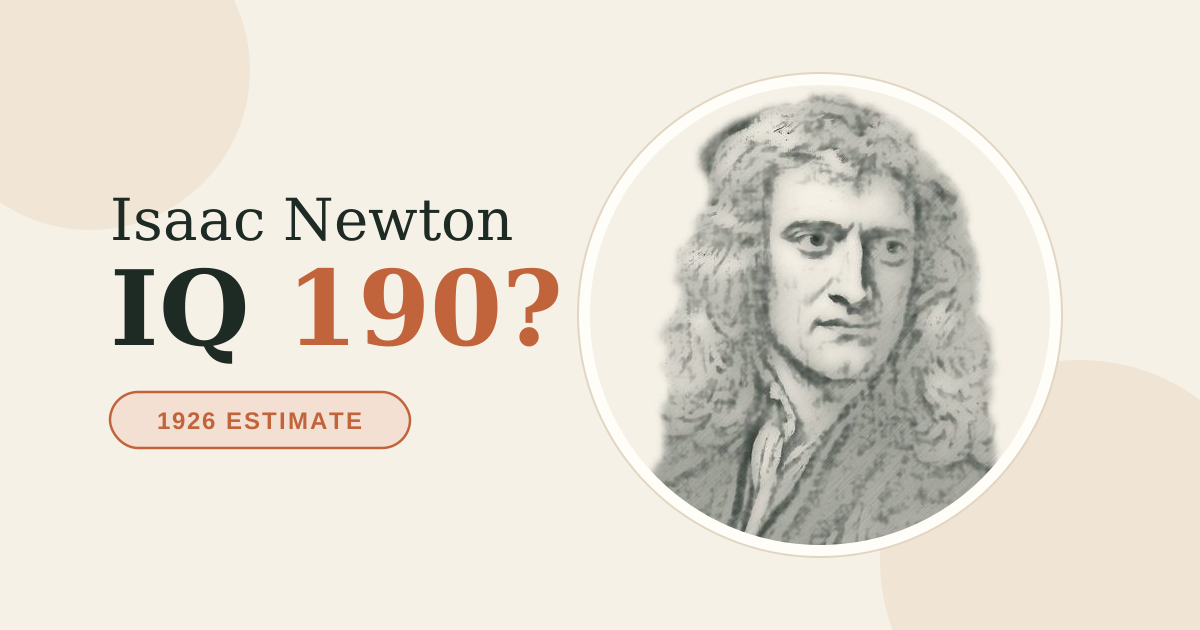
In 1926 the psychologist Catharine Cox estimated the IQs of 301 eminent people from the years 1450 to 1850, working from records of their early lives. Tesla, born in 1856, falls just outside her study, so no estimate of that kind exists for him. Any modern estimate would rest on the same thing Cox used: his achievements. That makes it circular. An IQ estimate based on someone being a genius can't tell you anything new about whether they were one.
What we can say is that Tesla's documented strengths, visualising complex machines, mathematics and languages, overlap with abilities that IQ tests measure, such as spatial and fluid reasoning. Our guide What is IQ? explains these abilities. An unusually high score would be plausible. A specific number would be invented.
How rare would an IQ of 160, or 310, be?
The claimed numbers become clearer when you translate them into rarity. On the standard IQ scale, where the average is 100 and the standard deviation 15:
- 160 is reached by about 1 person in 31,600, roughly 250,000 people among the 8 billion alive today. Very rare, but not unique, and right at the limit of what professional tests can measure.
- 230, the middle of the popular "range", would be about 1 in 450 quadrillion, far more people than have ever lived.
- 310 would be rarer than one in a number with more than 40 zeros. It is not a score any test could produce or any population could contain.
You can try any of these numbers in the rarity calculator on our page about the highest IQ in the world, and see what each level means on our IQ scale.
Frequently asked questions
What was Nikola Tesla's IQ?
Nobody knows. Tesla never took an IQ test: the first tests were designed for children in 1905, the year he turned 49, and the first widely used adult IQ test appeared in 1939, when he was 83. Figures such as 160, 230 or 310 have no traceable source.
Is it true that Tesla had an IQ of 310?
No. There is no record of any test, and 310 is far beyond what any IQ test can measure. On the standard IQ scale, a score of 310 would be rarer than one person in a number with more than 40 zeros.
Did Tesla have a photographic memory?
He described an exceptionally vivid visual imagination, and said he could picture and test machines in his mind. He also claimed that as a young man he knew entire books, such as Goethe's Faust, by heart, but that is his own account and was never tested. No one has been shown to have a true photographic memory.
Was Tesla smarter than Einstein?
There is no way to compare them with numbers, because neither man ever took an IQ test. They worked in different fields: Tesla was an inventor and engineer, Einstein a theoretical physicist. The popular quote in which Einstein supposedly says "ask Nikola Tesla" has no known source.
How many patents did Tesla have?
About 300 worldwide. The Tesla Science Foundation counts 112 in the United States and 196 more across 26 other countries, many of them covering the same inventions.
How many languages did Tesla speak?
Accounts usually say seven or eight, depending on whether his native Serbian is counted. Lists commonly include English, German, French, Italian, Czech, Hungarian and Latin. The exact number is not documented.
Sources
- Tesla, N. (1919). My Inventions. Electrical Experimenter, February–June and October 1919 (Wikisource): childhood images, inventing in his mind and the 1882 Budapest walk.
- Nikola Tesla's time at TU Graz, Graz University of Technology: exam grades, the withdrawn scholarship and his removal from the student list.
- Tesla patents, Tesla Science Foundation: 112 US patents and 196 in 26 other countries.
- Nikola Tesla, Wikipedia: life, Westinghouse, Niagara and the SI unit.
- Tesla says Edison was an empiricist, The New York Times, 19 October 1931 (reprinted by Tesla Universe).
- Letter from Albert Einstein to Nikola Tesla, June 1931, Tesla Universe.
- arXiv:2212.04440 (2022): a short note on Tesla myths that calls the "ask Nikola Tesla" quote "probably a myth".
- Marconi Wireless Telegraph Co. of America v. United States, 320 U.S. 1 (1943), Legal Information Institute, Cornell.
- Death of Nikola Tesla, History Today.
- Intelligence test, Encyclopaedia Britannica: the dates of early IQ tests.
Find out where you would score
Tesla never had the chance. You do: our free test covers fluid, logical, spatial and numerical reasoning, and shows your estimated IQ and percentile the moment you're done.
Take the free IQ test