In short: Stephen Hawking's IQ is unknown. He never published a score, said he didn't know it, and the popular 160 has no traceable source.
Hawking's own answer to the IQ question
In December 2004, The New York Times Magazine ran a short interview with Hawking in its "Questions for" series. One of the questions was simply: what is your IQ? His reply has been quoted ever since:
"I have no idea. People who boast about their I.Q. are losers."
Stephen Hawking, The New York Times Magazine, December 2004That answer is the most important fact on this page. One of the most celebrated scientists of the last century didn't know his IQ, didn't care, and thought that putting weight on the number missed the point. Every figure attached to his name since then has been added by someone else.
His reply also hints at why. Hawking's fame came from ideas about black holes and the origin of the universe, built over decades of work. A single test score taken on one afternoon could not capture that, and he seemed to know it.
Where the "Stephen Hawking IQ 160" number comes from
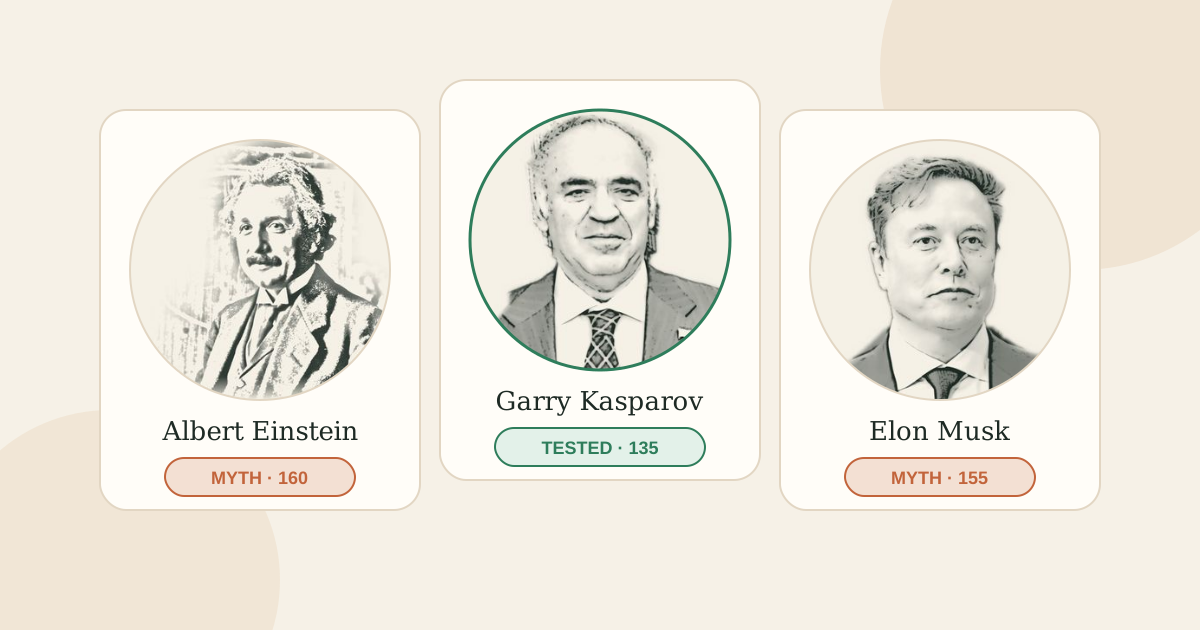
We could find no test, date or psychologist behind the 160 that appears on almost every celebrity IQ list. Some articles say that unnamed "academics" estimated it; none says who they were or how they did it. In the terms of our guide to famous people's IQ scores, that makes it a myth: widely repeated, with no traceable origin.
The likely reason it is 160 in particular is the company Hawking keeps in people's minds. The same unsourced number is attached to Albert Einstein, as we explain in our article on Einstein's IQ, and Hawking's life was full of links to the great names of physics:
- He was born on 8 January 1942, 300 years to the day after Galileo died.
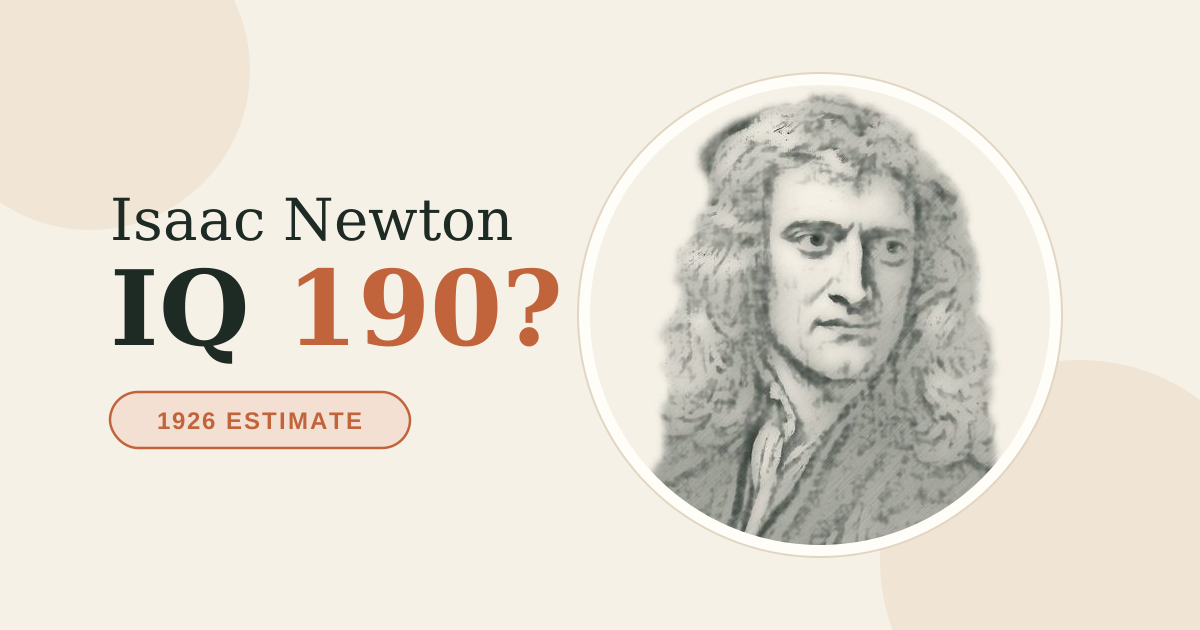
- For 30 years he held the Lucasian chair of mathematics at Cambridge, the post Isaac Newton once held.
- He died on 14 March 2018, Albert Einstein's birthday.
With a story like that, it was almost inevitable that the internet would give him Einstein's number too. But a coincidence of dates is not a test result. The question "what was Stephen Hawking's IQ?" has the same honest answer as Einstein's: nobody knows.
What Hawking's school record shows
If you expect a future genius to top every class, Hawking's schooldays are a surprise. He passed the eleven-plus exam and went to St Albans School, but by his own account he was not at the top of his class, and his early results were ordinary.
His classmates saw something else. They nicknamed him "Einstein", and with friends and the mathematics teacher Dikran Tahta he helped build a working computer from salvaged parts, including old telephone switchboard components. Curiosity and a talent for building and understanding things showed up long before good marks did.
This is a common pattern in the lives of exceptional scientists: school grades measure diligence and fitting into a syllabus as much as raw ability. It is one reason a single number, from a test or an exam, so often misses what makes someone remarkable.
A thousand hours at Oxford
Hawking went to Oxford at 17 to study natural sciences, focusing on physics. In his memoir My Brief History he later estimated, only half joking, that he did about a thousand hours of work in three years, roughly an hour a day. Physics, he found, came easily to him, and he spent much of his time coxing a college rowing crew and socialising.
The light approach nearly cost him. His final exam marks fell on the borderline between a first-class and a second-class degree, so the examiners called him in for an oral exam. Hawking told them that if they gave him a first he would go to Cambridge to do research, and if he got a second he would stay at Oxford, so he expected they would give him a first. They did.
It is a good story, and a revealing one. It shows a quick mind that could reach the top grade with little effort, but it also shows that his exam result depended on a borderline and a conversation. Even formal measures of ability are less precise than they look, which is just as true of IQ scores.
Stephen Hawking's life in ten dates
Born in Oxford on 8 January, 300 years to the day after the death of Galileo.
At St Albans School, where classmates nickname him "Einstein" even though he is not top of the class.
Goes to University College, Oxford, at 17 to study natural sciences, specialising in physics.
Graduates with a first-class degree after an oral exam decides between a first and a second.
Diagnosed with motor neurone disease around his 21st birthday, and given about two years to live.
Shows that black holes should give off radiation, and is elected to the Royal Society at 32.
Becomes Lucasian Professor of Mathematics at Cambridge, the chair once held by Isaac Newton.
Publishes A Brief History of Time, which spends a record 237 weeks on the Sunday Times bestseller list.
Asked his IQ by The New York Times Magazine, he says he has no idea.
Dies on 14 March, Albert Einstein's birthday, aged 76.
The turning point came in 1963. Around his 21st birthday, Hawking was diagnosed with motor neurone disease and told he might have only two years to live. He went on to live for another 55 years, and did nearly all of his famous work after the diagnosis.
Could Stephen Hawking even have taken an IQ test?
Here is a question most articles about Hawking's IQ never ask. Even if he had wanted to know his score, could a standard IQ test have measured it fairly? For most of his adult life, the answer is almost certainly no.
Professional IQ tests are mostly timed, and many tasks require speaking answers, drawing, or arranging blocks and pictures by hand. As his illness progressed, Hawking lost most of the use of his hands and, in 1985, his natural voice. He communicated through a computer, choosing words with a hand clicker and later with a sensor that detected movements of his cheek.
A 20-word answer would take him about 1 minute 20 seconds at 15 words per minute, but 10 to 20 minutes at 1 to 2 words per minute.
According to a 2015 Wired report on the system Intel built for him, he could write about 15 words a minute with a hand clicker before 2008, but by 2011 he managed only one or two words a minute as the disease progressed. At that speed, a timed test would have measured his disability, not his reasoning. Psychologists use adapted, untimed tests for people with severe motor impairments for exactly this reason.
Hawking's case is a powerful reminder of what IQ tests assume: that the person taking them can see, hear, speak and move freely and quickly. When those assumptions don't hold, the score stops meaning what it is supposed to mean.
What Hawking's work shows about his mind
Without a test score, the evidence of Hawking's intelligence is his work, and it speaks clearly.
His best-known discovery, published in Nature in 1974, was that black holes are not completely black: quantum effects should make them slowly emit radiation, now called Hawking radiation. It brought together two great theories of physics, general relativity and quantum mechanics, in a striking new way.
He then did something many brilliant scientists never manage: he explained his ideas to millions of people. A Brief History of Time, published in 1988, made cosmology a bestseller. Deep reasoning, imagination, persistence through extraordinary physical difficulty and a gift for explanation are all part of what made Hawking exceptional. An IQ score would have captured only a small slice of that.
How rare would an IQ of 160 be?
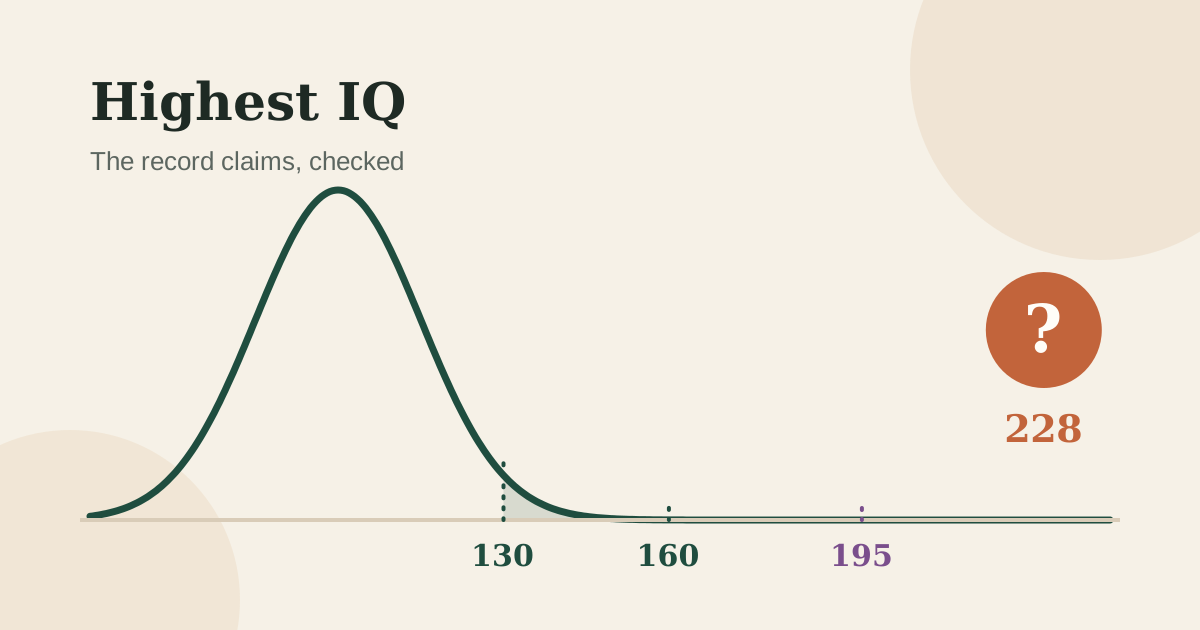
Suppose the internet's figure were right. IQ scores are set so that the average is 100 and most people fall within 15 points of it, which puts 160 a full four steps of 15 above the middle. Statistically, just 1 person in about 31,600 scores that high: around 30 people in a city of a million.
That is also close to the ceiling of most professional IQ tests, which can't reliably tell apart scores much higher than this. For a sense of the levels below it, see our IQ scale and score chart, or read what an IQ of 145 means, the level usually described as "highly gifted". And for the famous claims of IQs above 200, see who really has the highest IQ in the world.
Whatever Hawking's IQ really was, he would have been the first to say it didn't matter. In his own words, people who boast about it are losers. What mattered to him was what you do with your mind.
Frequently asked questions
What was Stephen Hawking's IQ?
It is unknown. Stephen Hawking never published an IQ score, and when The New York Times Magazine asked him in 2004, he said he had no idea what it was. The figure of 160 found on many websites has no test or named source behind it.
Did Stephen Hawking ever take an IQ test?
There is no public record that he did. He sat ordinary school and university exams, including the eleven-plus and his Oxford finals, but no IQ test result has ever been reported, and he showed no interest in finding out his score.
What did Stephen Hawking say about IQ?
Asked what his IQ was in a 2004 interview with The New York Times Magazine, he replied that he had no idea, and added: "People who boast about their I.Q. are losers."
Who had a higher IQ, Hawking or Einstein?
Nobody knows, because neither man is known to have taken an IQ test. Both are often given the same number, 160, which says more about how internet lists work than about either scientist. You can read where Einstein's 160 came from in our article on Einstein's IQ.
Was Stephen Hawking a good student?
Not in the conventional sense. By his own account he was not at the top of his class at school, and he later estimated that he studied only about a thousand hours during his three years at Oxford. Yet his classmates called him "Einstein", and he finished with a first-class degree.
Could Hawking have taken an IQ test after his illness?
Not a standard one, fairly. Most IQ tests are timed and many involve speaking, drawing or handling objects. As his illness progressed he communicated at only a few words per minute, so a standard test would have measured his disability rather than his reasoning.
Sources
- Solomon, D. (2004, December 12). Questions for Stephen Hawking. The New York Times Magazine.
- Hawking, S. (2013). My Brief History. Bantam: his schooldays, Oxford study habits and final exam.
- Hawking, S. W. (1974). Black hole explosions? Nature, 248, 30–31.
- Stephen Hawking (1942–2018), MacTutor History of Mathematics, University of St Andrews: career and Lucasian chair.
- Stephen Hawking, Encyclopaedia Britannica: life and diagnosis.
- Chipmaker races to save Stephen Hawking's speech, Scientific American (2013): his communication system.
- How Intel gave Stephen Hawking a voice, Wired (2015): his typing speed.
Curious about your own IQ?
Hawking never knew his IQ and never needed to. If you'd like a sense of yours, our free test takes about 25 minutes and covers fluid, logical, spatial and numerical reasoning. Your estimated score appears the moment you finish.
Take the free IQ test