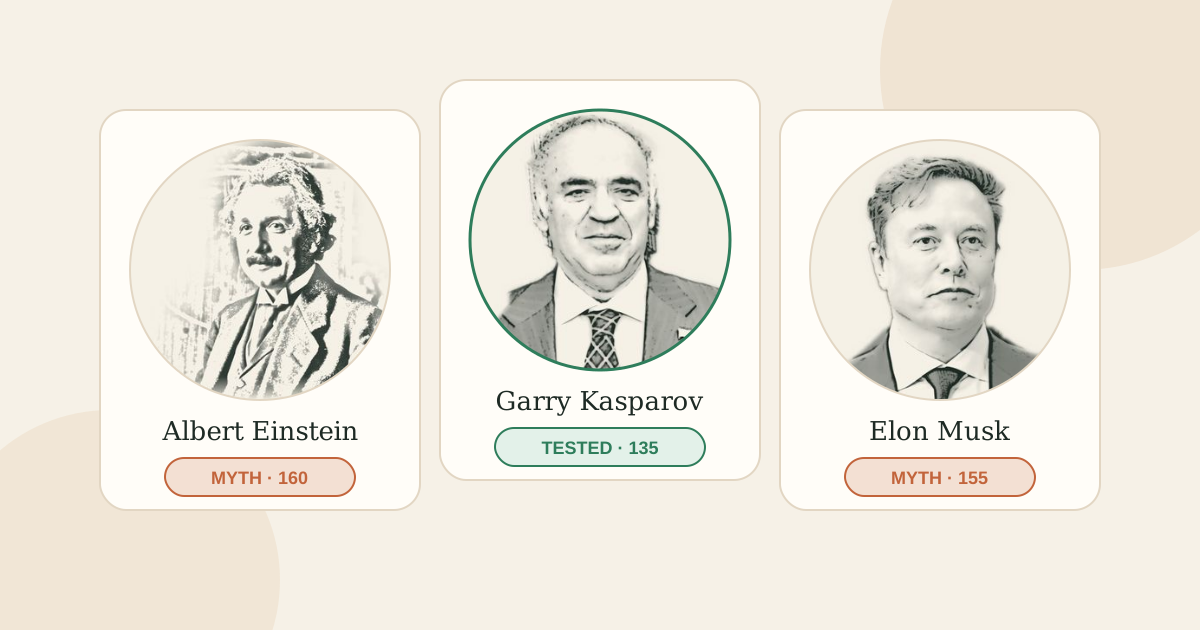
In short: Garry Kasparov's IQ was measured at 135 on one test and 123 on another in 1987. Both are well above average. The 190 you often see has no source.
The 1987 IQ tests in Baku
In 1987 Garry Kasparov was 24 and had been world chess champion for two years. That year the German news magazine Der Spiegel arranged for him to sit a series of psychological tests in his home city of Baku, then part of the Soviet Union, and published the results in an article titled "Genieblitze und Blackouts", roughly "flashes of genius and blackouts".
For three days, in an apartment of the Hotel Aserbaidschan in Baku, a Spiegel team tested him mostly with pen, paper and a stopwatch. They brought three major intelligence tests, a chess test and several smaller tasks, all carefully translated into Russian. Even the names in the questions were changed, so that "Erika Müller" became "Lena Melnikova" and Kasparov faced no harder language problems than a German taking the same test.
- Hans Eysenck's test. The German-born British psychologist compiled it specially for Kasparov. Result: IQ 135.
- Raven's Advanced Progressive Matrices. Developed by the English psychologist John C. Raven, who worked in Scotland: 48 pattern puzzles of a single type, with 50 minutes allowed. Result: IQ 123.
- The Berlin Intelligence Structure test by Adolf Otto Jäger: 30 types of task, designed to show a profile of specific abilities rather than one number. We look at what it revealed below.
Kasparov had no idea beforehand what he would be asked to do, and, short of time as always, he had neither read test books nor practised test questions.
What makes this case so valuable is that Der Spiegel didn't oversell its own numbers. Its verdict on what the tests showed was measured and, for a magazine story about a celebrity, unusually honest:
„Über die Intelligenz Kasparows läßt sich aufgrund dieser Tests nur sagen, daß sie erheblich über dem Durchschnitt liegt, aber bei weitem nicht so hoch ist wie die Intelligenz von Jahrhundert-Genies …"
"All these tests can tell us about Kasparov's intelligence is that it is considerably above average, but nowhere near as high as that of the geniuses of the century …"
Der Spiegel, 1987 (our translation)The same article added that an IQ can be no more than a vague indication, and that differences like his 12-point gap are common even though psychologists rarely advertise them. That combination, a real measurement plus an honest caution, is exactly what is missing from almost every other famous person's IQ.
Why one man scored 135 and 123
Two IQ scores 12 points apart can look like a contradiction. They aren't. Four ordinary reasons explain the gap:
- The tests measure different things. Raven's test is made up entirely of one kind of visual pattern puzzle, while Eysenck's mixes many kinds of task. As the next section shows, visual-figural thinking was Kasparov's weakest area, so a purely visual test was always likely to give him a lower score.
- Each test has its own norms. A score compares you with the group the test was standardised on. Different tests, built in different years with different samples, place the same person slightly differently.
- He refused to guess. Der Spiegel noticed that Kasparov hesitated far more often than the German comparison groups and left many questions blank when he wasn't sure. His answer sheets had considerably more unanswered questions than wrong ones. On a timed test, that cautious, chess-trained habit costs points.
- Every score has a margin of error. Tiredness, focus and luck on a few items move a result up or down. Good professional tests have a margin of a few points; shorter tests have more.
Try it yourself. Choose a margin of error and see how far the plausible range around each of Kasparov's scores stretches.
With the margins typical of tests like these, the two ranges overlap. Both results are consistent with one person whose ability sits in the high 120s or low 130s, scoring a little higher on one test and a little lower on the other. That is why psychologists prefer to report a range rather than a single number, and why a single score should never be treated as exact.
Inside the three-day test: genius flashes and blackouts
The most revealing part of the 1987 study isn't an IQ number at all. Jäger's Berlin test, which breaks intelligence into separate abilities, showed that Kasparov's performance swung from outstanding to weak depending on whether the task involved numbers, words or shapes. Der Spiegel compared his results with those of several hundred Berlin school pupils and students, and with 30 German Bundesliga chess players who took the same tests.
Our illustration of Der Spiegel's written findings; the magazine did not publish exact scores for each ability.
The genius flashes
- Numbers. On almost all of the dozen kinds of number task, from continuing number series to checking sums too fast to calculate them, Kasparov was "einsame Spitze": in a class of his own. The magazine linked this to his reputation as the fastest calculator at the board among the top players of the day.
- Logic. He solved almost every abstract reasoning puzzle, even absurd ones such as "All pencils are books" and "Some books eat sawdust", where he had to judge which conclusions follow.
- Chess memory. Shown chess positions with 22 or 30 pieces for just five seconds, he had to write them into an empty diagram. Across five tasks he recalled 117 of 120 pieces. His brain, the magazine wrote, worked like a camera. You can try a version of this task in our photographic memory test.
- Reading. Given a Stefan Zweig essay on the French writer Stendhal, 83 pages he had never seen, he needed less than the hour allowed to read it. Then, without notes, he summarised it in a torrent of sentences that, when the tape was transcribed, were all fit to print, and offered his own critique as well.
The blackouts
- The ellipse test. Given a sheet of 24 ellipses and three minutes to turn as many as possible into different patterns or objects, he stared at the blank page for half the time and drew just three. Young chess players from a Hamburg club averaged seven, and not one of the two dozen Hamburg pupils and students given the same task came up with as few.
- Visual puzzles. Unfolded cubes, fitting triangles together and remembering objects on a section of a street map all left him behind not only the Bundesliga players but also the Berlin pupils and students.
- Starting from nothing. Open questions, such as listing uses for a brick, produced only modest results. Der Spiegel thought this reflected a chess professional's habit of building on existing structures, not a lack of creativity, and doubted the test measured creativity at all.
- Concentration dips. He worked in short bursts of high intensity. Midway through one test of steadily harder questions he missed seven of eight, then recovered and solved almost all of the harder ones that followed.
This uneven profile is the real answer to "how smart is Kasparov?" A single IQ number averages away exactly the peaks and troughs that make his mind interesting. In the magazine's words, the strengths and weaknesses stayed hidden in the two tests that produce only an IQ.
Where the "Kasparov IQ 190" myth came from
Despite the published results, you will find Kasparov's IQ given as 180 or 190 all over the internet. On question sites and chess forums, people regularly ask why his real score is 135 rather than 180, which shows how surprised they are when they meet the real figure.
The inflated numbers have no source. They seem to come from a simple but mistaken line of reasoning: Kasparov is one of the greatest chess players in history, chess is the classic "intelligent" game, so his IQ must be among the highest ever recorded. That logic confuses being the best in the world at one demanding skill with having an extreme score on a general test.
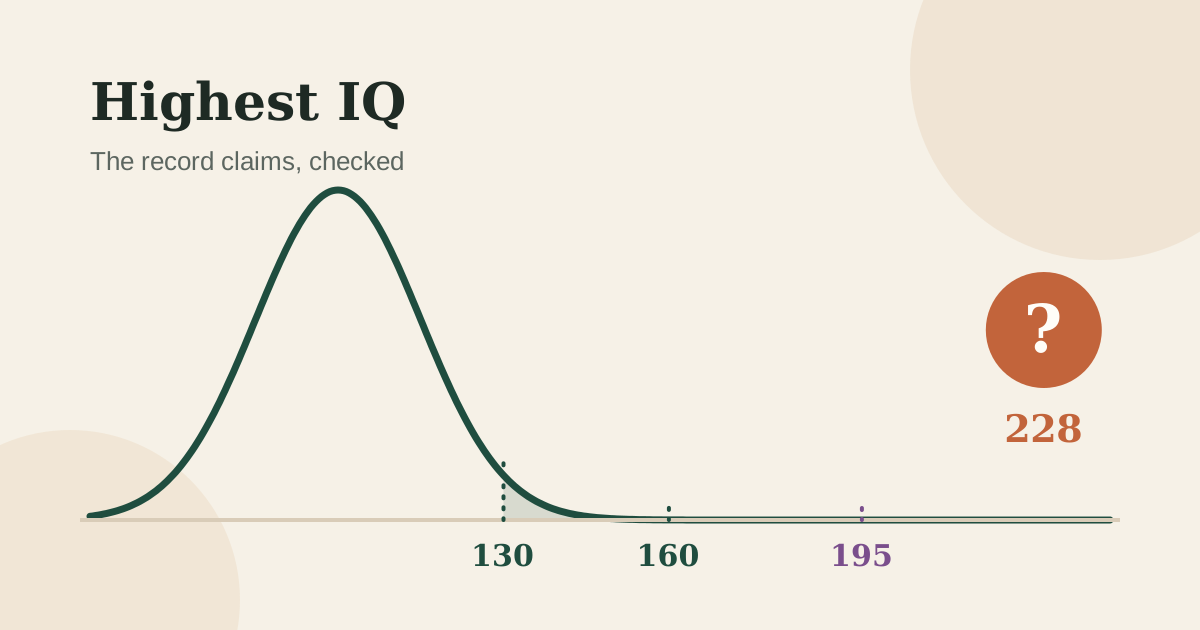
The scale shows how far off the myth is. An IQ of 180 would be expected in about one person in 21 million, and 190 in about one person in a billion. No IQ test can measure reliably at those levels, and Kasparov was never given a result anywhere near them. The figures of 180 and 200 in the 1987 article belonged to someone else entirely: they were the posthumous estimates for Goethe and Einstein that Der Spiegel mentioned for comparison. You can read how the Einstein number spread in our article on Einstein's IQ.
The real secret behind chess mastery: memory for the game
If not an extreme IQ, what lets a player like Kasparov see so much on a chessboard? Psychologists have studied that question for decades, and one experiment changed how we think about expertise.
In 1973 William Chase and Herbert Simon showed chess positions to players of different strengths for a few seconds and asked them to rebuild the positions from memory. A master recalled positions from real games far better than a beginner. But when the pieces were placed at random, the master's advantage almost disappeared.
Kasparov's own results fit this perfectly: near-perfect recall of real chess positions, yet weak scores on everyday visual puzzles. Der Spiegel explained it with a line from the German master Siegbert Tarrasch: a good player doesn't see "a wooden piece with a horse's head" in a knight, but "a piece with a peculiar move, worth about three pawns". The chess view of the board is far more abstract than ordinary seeing.
The lesson is that chess skill rests on an enormous library of patterns built up through years of study, which strong players recognise as "chunks". By 24, Kasparov had devoted two thirds of his life to chess. His greatness reflects that knowledge and work at least as much as raw reasoning ability, which is exactly what his two IQ scores suggest.
Does a higher IQ make a stronger chess player?
Kasparov's case fits the wider research. In the same 1987 report, Der Spiegel found no link between IQ and playing strength among the strong German league players it compared him with. A 2016 analysis of 19 studies in the journal Intelligence found a real but modest link between reasoning ability and chess skill (an average correlation of about 0.24), and the link with fluid reasoning was weaker among ranked, experienced players.
In other words, being clever helps you learn chess, but at the top level nearly everyone is clever, and the difference between a good grandmaster and a world champion comes from other things: study, memory for positions, competitive nerve and preparation. We look at this research and other famous claims in our guide to famous people's IQ: real scores vs myths.
Kasparov's record in numbers
The best evidence of Kasparov's ability isn't an IQ test. It is one of the most dominant careers in the history of any sport.
He beat Anatoly Karpov for the title in 1985, held the world No. 1 ranking almost continuously until he retired from professional chess in 2005, and set a rating record that stood until Magnus Carlsen passed it in 2013. His 1996 win and 1997 loss against IBM's Deep Blue became a landmark moment in the history of artificial intelligence. None of that required an IQ of 190.
Kasparov in his own words: talent and hard work
Kasparov has often argued that the usual split between "talented" and "hard-working" players is false. Speaking to graduates of Saint Louis University in 2015, as reported by St. Louis Public Radio, he put it plainly:
"Hard work is a talent. The ability to keep trying when others quit is a talent."
Garry Kasparov, Saint Louis University commencement, 2015Coming from someone with a measured IQ in the 120s and 130s who became perhaps the greatest chess player of his era, it is a fitting summary. A high IQ opens doors; persistence, study and practice decide how far you go through them.
What an IQ of 135 or 123 actually means
Both of Kasparov's results are well above the average score of 100. On the standard IQ scale:
- An IQ of 135 is higher than about 99% of people, roughly one person in 100. Read more about what an IQ of 135 means.
- An IQ of 123 is higher than about 94% of people, roughly one person in 16. Read more about what an IQ of 123 means.
So in a room of 100 randomly chosen people, Kasparov would typically be among the top one or two scorers, but in a large university or a big company there would be plenty of people at his level. That is the honest picture: clearly very able, not off the scale, and a reminder that being the best in the world at something takes far more than a test result. You can compare these levels with the rest of the scale on our IQ scale and score chart.
Frequently asked questions
What is Garry Kasparov's IQ?
Garry Kasparov scored 135 on one intelligence test and 123 on another when Der Spiegel tested him in Baku in 1987. He is one of the very few famous people with real, published IQ test results. Both scores are well above the average of 100.
Is Kasparov's IQ 190?
No. The figure of 190, and the 180 that also circulates, has no test or source behind it. His only documented results are 135 and 123, from 1987. An IQ of 190 would be expected in about one person in a billion and is beyond what IQ tests can reliably measure.
Why did Kasparov get two different IQ scores?
Because he took two different tests. Each test samples different kinds of reasoning, uses its own norm group and carries a margin of error, so a gap of several points between tests is normal. Der Spiegel reported the gap of 12 points as an example of how imprecise IQ scores are.
Which IQ tests did Kasparov take?
Three major intelligence tests: one compiled specially for him by the British psychologist Hans Eysenck, on which he scored 135; Raven's Advanced Progressive Matrices, developed by the English psychologist John C. Raven, on which he scored 123; and the Berlin Intelligence Structure test by Adolf Otto Jäger, which showed his strengths and weaknesses rather than a single IQ.
Did Kasparov have a photographic memory?
For chess, almost. Shown chess positions of 22 or 30 pieces for just five seconds each, he correctly recalled 117 of 120 pieces across five tasks. But Der Spiegel found his general visual thinking, outside chess, was weaker than that of German school pupils and students.
Do you need a high IQ to be a chess champion?
Reasoning ability helps, especially when learning, but it is not the main thing separating top players. Research finds only a modest link between IQ and chess skill, and it is weakest among strong, ranked players, where years of study and a huge memory for chess patterns matter far more.
Sources
- Der Spiegel (1987). Genieblitze und Blackouts: the three-day test in Baku, the Eysenck, Raven and Jäger results, the memory and chess tests, and the comparison with 30 Bundesliga players.
- Howard, R. W. (2009). Individual differences in expertise development over decades in a complex intellectual domain. Memory & Cognition, 37(2), 194–209: cites the Der Spiegel study.
- Chase, W. G. and Simon, H. A. (1973). Perception in chess. Cognitive Psychology, 4(1), 55–81.
- Burgoyne, A. P. et al. (2016). The relationship between cognitive ability and chess skill: a comprehensive meta-analysis. Intelligence, 59, 72–83.
- Kasparov tells graduates to set new goals, see hard work as a talent, St. Louis Public Radio (2015).
- Garry Kasparov, Encyclopaedia Britannica: career and records.
Get your own IQ score
Kasparov needed a magazine's testing team to find out his IQ. You only need 25 minutes: 36 questions across four kinds of reasoning, with your estimated IQ as soon as you finish.
Take the free IQ test