In short: Bill Gates' IQ is not known. The figure of 160 is a conversion from his SAT score, not the result of an IQ test, and a near-perfect SAT can't tell you how far above the top of the test someone really is. His strongest evidence is a published maths paper, not a number.
Where the Bill Gates IQ figure of 160 comes from
Ask what Bill Gates' IQ is and most websites answer 160. Some widen it to "151 to 160" or "160 to 170", and a few give oddly precise versions such as "157". We could not find any version that names an IQ test, a date or a psychologist. Gates has not published a score, and none is reported in his 2025 memoir Source Code: My Beginnings.
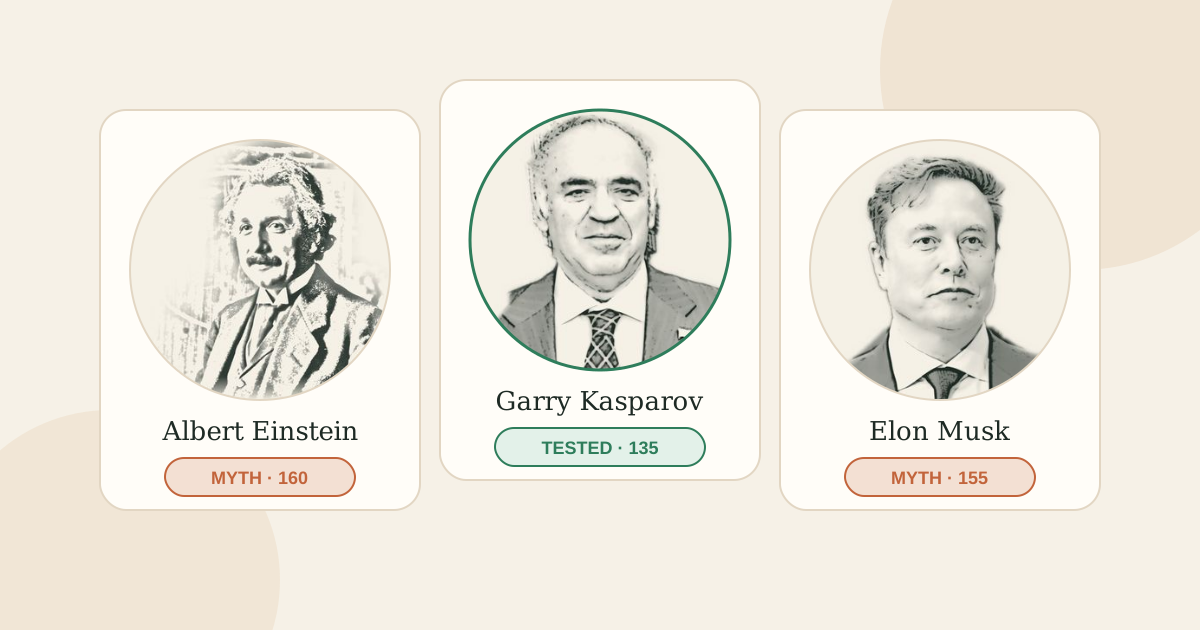
Unlike many celebrity IQ figures, this one does have a method behind it. Where a source is given, it is his SAT result: the 160 is what you get by running a near-perfect college admissions score through an SAT-to-IQ conversion. That makes it an estimate, not a measurement, and as the next sections show, it is an estimate built on the weakest part of the scale. It is the same pattern we found for Elon Musk's IQ, where the popular number also traces back to an SAT score.
In the terms used in our guide to the IQ of famous people, Gates' 160 sits between an estimate and a myth: there is a real test behind it, but not an IQ test, and the step from one to the other is where the certainty disappears.
Bill Gates' SAT score: 1590 out of 1600
The score that everything rests on is well documented. Gates scored 1590 out of a possible 1600 on the SAT, which he took at Lakeside School in Seattle before entering Harvard in the autumn of 1973. Biography.com notes that for years he would mention the result when introducing himself to new people, a detail that fits his own description of himself as a competitive teenager. For what an SAT score can and can't say about IQ in general, see our SAT to IQ conversion chart.
Two details are often lost when the number is repeated:
- It was not a perfect score. Many sites say Gates "aced" the SAT. He was 10 points short.
- It was on the old scale. Before the College Board re-centred the SAT in 1995, average scores were well below 500 per section, and totals near 1600 were far rarer than they are today. Our Elon Musk article explains the 1995 change in more detail.
So 1590 in the early 1970s was an exceptional result, almost certainly in the top fraction of one per cent of test takers. What it can't do is tell you how exceptional.
The ceiling problem: why a top SAT score can't give an IQ
Every test has a highest possible score. When someone scores at or just below it, you learn that their ability is at least that high, but not how far beyond it they might go. Psychologists call this a ceiling effect, and it is the main reason Gates' 160 is shakier than it looks.
What a 1590 can and can't show
The dashed area past the lid is the part of the range the SAT can't see. Someone at 1590 might be far into it or only just there; the test gives the same answer.
A conversion has to guess where in that hidden area to place him, and the guess is what produces 160. Choose slightly different assumptions and you get 150 or 170, which is exactly the spread we see online. There are two further problems:
- Very strong verbal and maths reasoning as a teenager
- Performance near the top of a test taken by about a million students a year
- A result that is consistent with a very high IQ
- How far above the ceiling his ability went
- An IQ number: SAT and IQ are related, but they are different tests
- Abilities the SAT doesn't test, such as spatial reasoning
A 2004 study by Frey and Detterman found that SAT scores correlate strongly with general intelligence, at about 0.82, but even a correlation that high leaves a margin of more than 15 IQ points either way for any one person. You can see that margin for yourself with the correlation tool on our Elon Musk IQ page. At the very top of the scale, where Gates was, the margin only grows.
Gates at Lakeside: a computer terminal at 13
William Henry Gates III was born in Seattle on 28 October 1955. As a boy he read constantly and argued with his parents just as constantly. In Source Code he describes how the conflict at home grew bad enough that his parents took him to a therapist, Dr Charles Cressey, whom he saw for about two years. Cressey's view, as Gates retells it, was that the boy would eventually win the power struggle, and that his parents should give him room. Soon afterwards they moved him to Lakeside, a private school in north Seattle.
In 1968, when Gates was in eighth grade, the Lakeside Mothers' Club used money from its rummage sale to buy a Teletype Model 33 terminal and a block of time on a General Electric computer. Gates was 12 or 13 and was hooked at once. One of his first programs, written in BASIC, let people play tic-tac-toe against the computer. With older students including Paul Allen, he went on to swap programming work for free computer time, and the two later set up Traf-O-Data, a small business that turned traffic-counter tapes into reports for road engineers.
His school record was strong but not flawless. A reviewer of the memoir noted that the book's own fact-checking found Gates' memory of straight A's in ninth grade was wrong: he had a mix of A's and B's. It is a useful reminder that even first-hand accounts of a famous person's early brilliance tend to improve with time.
Harvard and Math 55: meeting people who were better
At Harvard, Gates enrolled in Math 55, the university's notoriously difficult introductory maths course for students with exceptional preparation. It was there that he met his limits. A freshman upstairs in his dormitory, Andy Braiterman, was better at maths than he was, and the two worked through problem sets together late into the night. Gates later named Braiterman and Jim Sethna, who became a physics professor at Cornell, as the maths stars of his year. In an interview for Walter Isaacson's history of the digital revolution, he put it plainly:
"I met several people in the math department who were quite a bit better than I was in math. It changed my mind about going into math."
Bill Gates, quoted in the Harvard Gazette (2013)This is one of the most telling details in the whole story. Gates, the student with the 1590, found himself in a room where he was not the strongest mathematician, and he drew the practical conclusion. He moved towards applied mathematics and computing, and spent much of his time in Harvard's Aiken computer lab and playing poker, before leaving in 1975.
The pancake problem: Gates' only research paper
The strongest evidence of Gates' mathematical ability isn't a test score at all. In a class taught by the computer scientist Harry Lewis, students were set a puzzle known as the pancake problem: if you have a stack of pancakes of different sizes and a spatula that can flip any number from the top, what is the largest number of flips you could ever need to sort the stack, smallest on top?
Gates came back to Lewis with a better method than anyone had found. Working with Christos Papadimitriou, then a young assistant professor, he turned it into a paper, "Bounds for Sorting by Prefix Reversal", published in the journal Discrete Mathematics in 1979. It proved that any stack of n pancakes can always be sorted in at most (5n + 5)/3 flips, about five flips for every three pancakes. By the time it was accepted, Gates was running Microsoft in Albuquerque. Papadimitriou later recalled thinking, when Gates showed little interest in the news: "Such a brilliant kid. What a waste."
Try the problem yourself. Tap a pancake to slide the spatula under it and flip it together with everything above it.
Sort the pancakes
Get the smallest on top and the largest at the bottom in as few flips as possible.
For a small stack, a simple strategy works: flip the largest pancake to the top, then flip it to the bottom, and repeat. That needs up to two flips per pancake. Gates and Papadimitriou showed that a cleverer method never needs more than about five for every three, and also that some stacks need more than one flip per pancake however cleverly you work. Their upper bound stayed the best known for close to 30 years, until a team at the University of Texas at Dallas improved it to 18n/11, announced in 2008 and published in 2009. The exact answer for large stacks is still unknown.
A single research paper is not an IQ score either. But it is a better kind of evidence: an original solution to an open problem, checked by referees, that experts failed to beat for decades. Harry Lewis told NPR in 2008: "If he'd wanted to, he could've been a mathematician."
Bill Gates' record in brief
- Born in Seattle28 October, the second of three children.
- First programs at LakesideWrites software on the school's new computer terminal.
- Enters HarvardAfter scoring 1590 on the SAT. Takes Math 55.
- Founds MicrosoftWith Paul Allen in Albuquerque, after writing a version of BASIC for the Altair 8800. Leaves Harvard.
- Pancake paper publishedWith Christos Papadimitriou in Discrete Mathematics.
- MS-DOS ships with the IBM PCThe deal that made Microsoft the standard for personal computers.
- World's richest personTops the Forbes ranking for the first time, and stays there in most years until 2017.
- Gates FoundationSteps down as Microsoft's chief executive; the foundation becomes his main work.
- Harvard degree, at lastAn honorary doctorate, 32 years after he left.
- Source CodePublishes a memoir of his early life, the first of three planned volumes.
A record like this shows several abilities working together: technical skill, the business judgement to license MS-DOS rather than sell it, and the persistence to run a company for 25 years. IQ tests measure only the first of these well. Our guide What is IQ? explains what the tests do and don't cover.
How Gates learns: Think Weeks and 50 books a year
Gates is often described as having an extraordinary memory and reading speed. What is documented is less about speed and more about habit. He has said he reads about 50 books a year, and he has reviewed many of them on his blog, Gates Notes, for more than a decade.
At Microsoft he also became known for his "Think Weeks". Twice a year he would spend a week alone in a cabin in the Pacific Northwest, reading papers written by employees about new ideas for the company, sometimes for 18 hours a day. His 1995 memo "The Internet Tidal Wave", which turned Microsoft towards the web, came out of one of them. The habit is a reminder that what looks like raw intelligence from outside often includes a great deal of deliberate, structured effort.
In Source Code, Gates also wrote that if he were growing up today, he would probably be diagnosed on the autism spectrum, pointing to his intense focus and his difficulty reading social cues as a child. That is not the same as a statement about IQ. Neurodivergence describes how a brain processes information and interacts with the world, and it occurs at every level of measured intelligence.
Myths about Bill Gates' intelligence
Bill Gates has a tested IQ of 160.
No IQ test result for Gates has ever been published. The figure is a conversion from his SAT score.
Gates got a perfect score on the SAT.
He scored 1590 out of 1600: outstanding, but 10 points short of perfect.
Gates dropped out of Harvard because he couldn't keep up.
He left in 1975 to build Microsoft, while he was doing original maths that would be published in a research journal.
Gates said, "I choose a lazy person to do a hard job, because a lazy person will find an easy way to do it."
There is no evidence he said it. Quote Investigator found the closest early match in 1947 remarks by a car industry executive, Clarence Bleicher, and similar ideas from earlier efficiency experts, long before the line was pinned on Gates.
If Gates scored 160, how rare would that be?
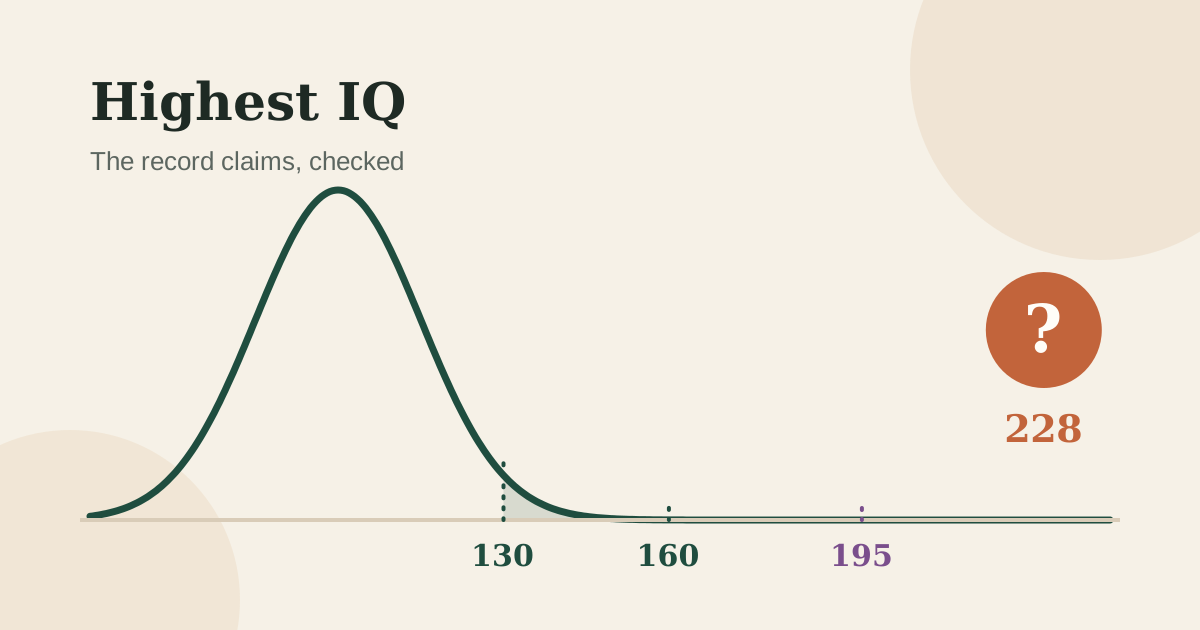
Suppose the popular number were correct. On the standard scale, where the average is 100 and the standard deviation is 15, 160 lies four standard deviations above the average. That level is reached by roughly one in every 31,600 people, which across today's world population means about 260,000 people: a group the size of a small city, spread across every country.
It is also right at the edge of what professional IQ tests can measure, which brings us back to the ceiling problem. Even if Gates sat a modern IQ test tomorrow, a result of 160 would mean "at or near the top of this test" rather than an exact position. To see how this level compares with everything below it, explore the IQ scale and score ranges, or read about the highest IQ in the world to see why claims far above 160 can't be true.
Frequently asked questions
What is Bill Gates' IQ?
Nobody outside his private life knows. Gates has never published an IQ score, and none appears in his memoir or in reliable biographies. The figure of 160 that circulates online is an estimate worked back from his SAT result, not a test score.
Did Bill Gates take an IQ test?
There is no public record of one. The only standardised test result that is widely reported for him is the SAT, the college admissions test he took before entering Harvard in 1973.
What did Bill Gates score on the SAT?
1590 out of 1600, according to Biography.com and many other profiles. That was on the scale used before 1995, when near-perfect totals were much rarer than they are today. It was not a perfect score.
Did Bill Gates graduate from Harvard?
No. He entered Harvard in 1973 and left in 1975 to build Microsoft with Paul Allen. Harvard gave him an honorary doctorate in 2007, when he was introduced as the most illustrious member of the class of 1977 never to have graduated.
Is Bill Gates autistic?
He has not said he has a diagnosis. In his 2025 memoir, Source Code, he wrote that if he were growing up today he would probably be diagnosed on the autism spectrum. Being neurodivergent and having a high IQ are separate things, and one says nothing about the other.
Who has the higher IQ, Bill Gates or Elon Musk?
There is no way to know, because neither has published an IQ score. Both have a reported SAT result: 1590 for Gates and 1400 for Musk on his second attempt. SAT scores are a weak basis for an IQ comparison, for the reasons explained on this page and on our Elon Musk IQ page.
Sources
- Gates, W. H. and Papadimitriou, C. H. (1979). Bounds for sorting by prefix reversal. Discrete Mathematics, 27(1), 47–57.
- Chitturi, B. et al. (2009). An (18/11)n upper bound for sorting by prefix reversals. Theoretical Computer Science, 410(36), 3372–3390.
- Harry Lewis recalls Bill Gates and the pancake problem, Harvard John A. Paulson School of Engineering and Applied Sciences (2008).
- Dawn of a revolution, Harvard Gazette (2013), adapted from Walter Isaacson's The Innovators: Math 55, Andy Braiterman and the quote on changing his mind about maths.
- People of ACM: Christos Papadimitriou, Association for Computing Machinery (2013): his recollection of Gates and the pancake paper.
- Even Bill Gates thinks AI is a little scary, Harvard Gazette (2025): Math 55 and his friends Andy Braiterman and Jim Sethna.
- Gates, B. (2025). Source Code: My Beginnings. Knopf: his childhood, therapy with Dr Charles Cressey and Lakeside.
- Bill Gates, Biography.com: the 1590 SAT score, Lakeside and his first program.
- Bill Gates on the autism spectrum and his childhood, Fortune (2025), on Source Code: My Beginnings.
- Review of Source Code, GeekWire (2025): therapy, Lakeside and the corrected ninth-grade grades.
- Bill Gates took solo Think Weeks in a cabin in the woods, CNBC (2019).
- Choose a lazy person to do a hard job, Quote Investigator (2014).
- Frey, M. C. and Detterman, D. K. (2004). Scholastic Assessment or g? Psychological Science, 15(6), 373–378.
See where your own reasoning lands
Gates' IQ will probably stay a mystery. Yours doesn't have to: our free test measures fluid, logical, spatial and numerical reasoning and gives you an estimated IQ and percentile straight away.
Take the free IQ test