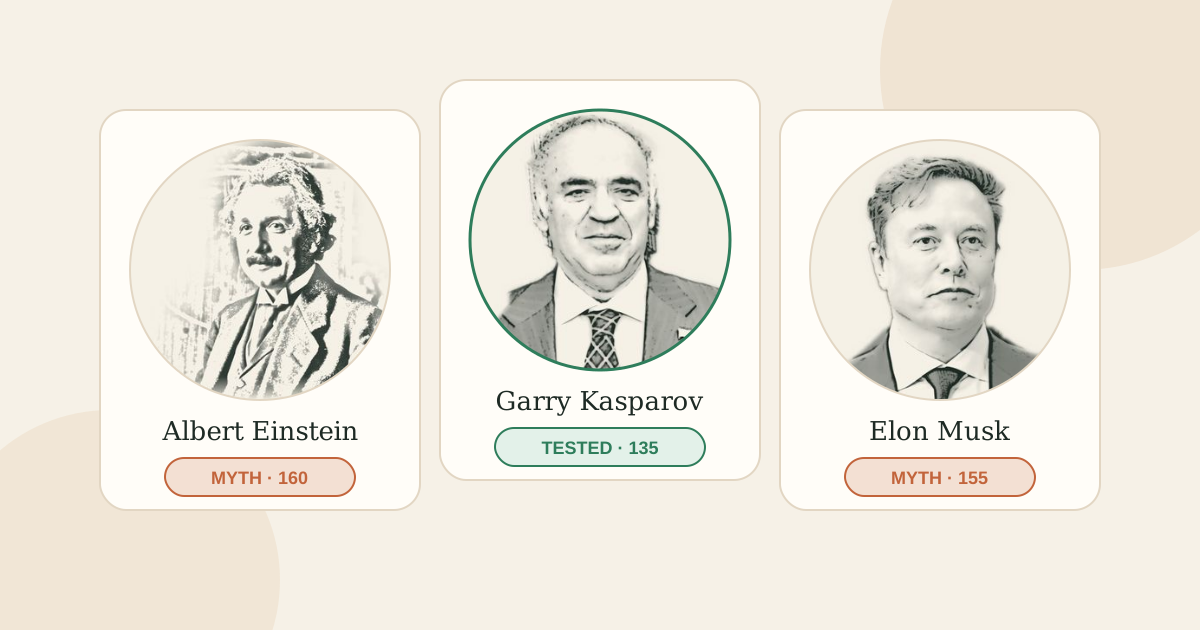
In short: Elon Musk's IQ is unknown. He has never published an IQ score, and none appears in his biographies. The popular 155 has no traceable source.
Where the "Elon Musk IQ 155" number comes from
The figure of 155 is everywhere: in celebrity IQ rankings, social media posts and countless articles. We could not find a single version of it that names a test, a date, a psychologist or an organisation that gave Musk an IQ test. We also found no IQ score reported in his two major biographies, by Ashlee Vance in 2015 and Walter Isaacson in 2023.
That puts "155" in the same group as Einstein's famous 160, which we trace in our article on Einstein's IQ. A plausible-sounding number appeared, was copied from site to site, and gained authority through repetition. In the language of our guide to famous people's IQ scores, it is a myth: widely repeated, with no traceable origin.
That doesn't mean Musk's IQ is low, or high. It means the question "what is Elon Musk's IQ level?" has no factual answer yet. Everything beyond that is an estimate, and the estimates disagree badly.
Same facts, two very different IQs
Look at enough websites and you'll find Elon Musk's IQ given as two very different numbers. Most say about 155. At least one IQ site, Riot IQ, works from his SAT result and lands at about 122 to 124, while noting that this is probably an underestimate.
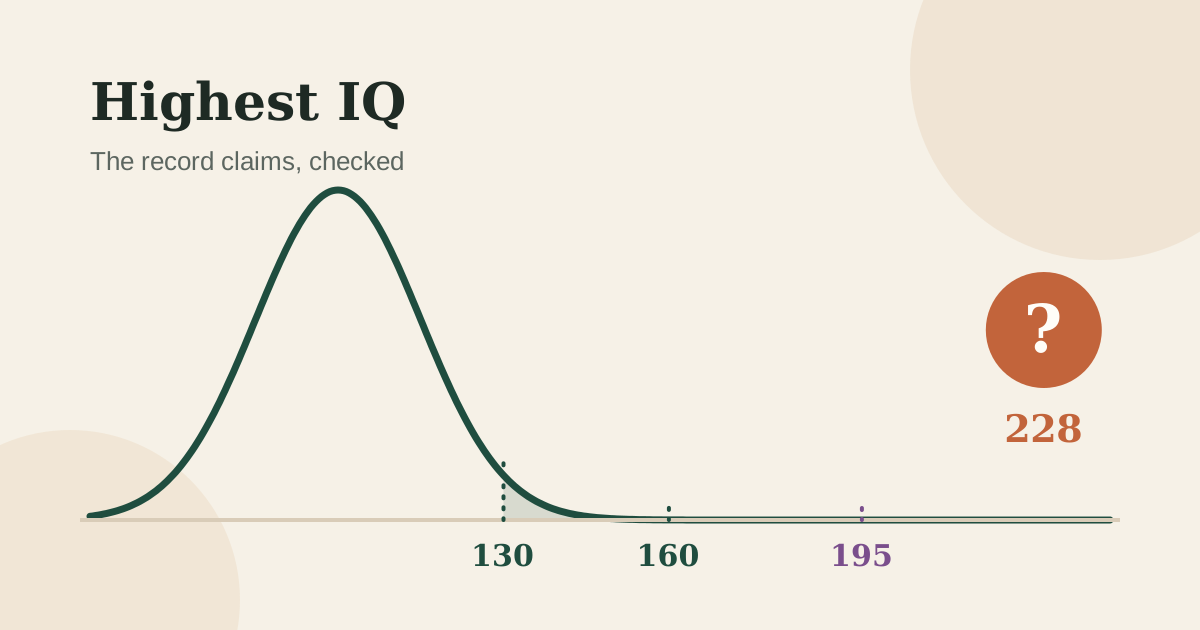
A 31-point gap is enormous. On the standard IQ scale, 124 is reached by about 1 person in 18, while 155 is reached by about 1 in 8,100. Both can't be right, and the honest conclusion is that neither is reliable. When the same public facts produce numbers that far apart, the numbers are telling you about the method, not about the man.
Elon Musk's SAT score: the one documented test
The only standardised test result for Musk that a reliable source has published is his SAT. According to Walter Isaacson's 2023 biography, as excerpted in The Globe and Mail, he scored 670 on the verbal section and 730 on the maths section, a total of 1400, on his second attempt in the late 1980s.
That is a strong result, well above the average test taker, with maths as the stronger side. It is also a result that many thousands of students achieve every year: good, but not the kind of score that by itself marks someone out as exceptional.
One detail matters a lot here. Musk took the SAT before April 1995, when the College Board re-centred the scoring scale. Before then, the average verbal score was only about 420 and the average maths score about 478. Re-centring moved both averages to 500, so a 1400 from the 1980s is not the same as a 1400 today, and any conversion has to start by guessing how to translate between the two scales. Our SAT to IQ conversion guide explains how the scale changes affect any estimate.
Why an SAT score can't give you Elon Musk's IQ
SAT scores and IQ scores are related. In a well-known 2004 study in Psychological Science, Meredith Frey and Douglas Detterman found a correlation of about 0.82 between SAT scores and a measure of general cognitive ability. That is a strong link, and it is the reason SAT-to-IQ conversion tables exist.
But a strong correlation across hundreds of people (917 in that study) still leaves a wide margin for any one person. Try it below: choose how closely the two tests are related, and see how wide the plausible IQ range is for someone whose SAT score is known exactly.
Plausible range: about ±18 IQ points around the converted score, 95% of the time.
Even at a correlation of 0.82, the converted score could be off by 17 points either way for any one person. That is a 34-point spread, enough to stretch from "above average" all the way to "gifted". Add the other problems and the uncertainty only grows:
- The scale changed. As explained above, a 1980s SAT score has to be translated to a modern scale before any conversion.
- The SAT measures learning, too. It rewards school knowledge, vocabulary, test practice and preparation, not only reasoning.
- Musk sat it twice. Second attempts usually score higher, and a conversion can't know how much of that was practice.
- Language and schooling differ. He was educated in South Africa, and the test was designed around American schooling.
That is why Assessivo doesn't convert Musk's SAT, or anyone else's, into an IQ figure. Our editorial policy rules out publishing guessed IQ numbers for living people, and this case shows why: the same SAT score can be turned into very different IQs depending on the assumptions you choose. The same problem, made worse by a score near the top of the test, lies behind the 160 often quoted for Bill Gates' IQ.
What Elon Musk's record actually shows
If there is no IQ score, what does the evidence say about his abilities? The documented record is unusually rich, and some of it starts very young.
Born in Pretoria, South Africa.
Aged 12, publishes the code for his space game Blastar in a South African computer magazine and is paid about $500.
Moves to Canada at 17 and later studies at Queen's University in Kingston, Ontario.
Transfers to the University of Pennsylvania to study physics and economics.
Accepted to a graduate program at Stanford, but leaves to start the software company Zip2.
Penn awards his two bachelor's degrees: physics, and economics from the Wharton School.
Zip2 is sold to Compaq, and he co-founds the online bank X.com, which becomes PayPal.
Founds SpaceX. eBay buys PayPal the same year.
Invests in Tesla and becomes its chairman, later its chief executive.
"Elon Musk IQ 155" is repeated across the internet. No test result has ever been published.
The earliest item is the most striking. As a boy in Pretoria, Musk taught himself to program, and at 12 he wrote a space shooting game called Blastar. Its code was printed in the South African magazine PC and Office Technology in 1984, credited to "E. R. Musk", and he was paid about $500, as Vice reported from Vance's biography. Vance also describes a child who read for hours a day, working through books and even an encyclopaedia.
His university years show a mind drawn to both science and business. After two years at Queen's University in Canada he transferred to the University of Pennsylvania, where he earned two bachelor's degrees, one in physics and one in economics from the Wharton School, formally awarded in 1997.
None of this converts into an IQ score. Early programming, strong maths results and two demanding degrees are consistent with well above average reasoning ability, but they are also consistent with many different scores, and they say as much about curiosity and drive as about intelligence.
The Stanford "two days" story
Almost every article about Elon Musk's IQ or education repeats one story: he enrolled in a PhD program in physics at Stanford in 1995 and dropped out after two days to join the internet boom. It is often used as proof of how quickly he could judge where his talents were best used.
The facts are less dramatic. In 2024 Stanford's media relations office told The Stanford Daily that Musk had applied and been accepted to a graduate program in materials science and engineering, but that the university does not have "any record of him enrolling." In a talk recorded by Stanford's own entrepreneurship program, Musk described it as being accepted and putting his place on hold to start an internet company.
So the most accurate version is: accepted to Stanford, with no record of ever enrolling, and started Zip2 instead. It is a small correction, but it shows how stories about famous people's intelligence grow more impressive each time they are retold, just like their IQ scores.
How Elon Musk describes his own thinking
When Musk explains how he solves problems, he talks less about raw intelligence and more about a method. In a 2013 TED interview, as reported by CNBC, he explained that he tries to reason from "first principles" instead of by analogy:
"Boil things down to their fundamental truths and reason up from there, as opposed to reasoning by analogy."
Elon Musk, TED interview, 2013In a 2012 interview with Kevin Rose, he gave the cost of batteries as an example. Instead of accepting the market price of a battery pack, he asked what its raw materials cost on the open market and found the gap was huge, suggesting batteries could become far cheaper. The same approach underlies SpaceX's push to build and reuse its own rockets.
This kind of thinking overlaps with what IQ tests measure: breaking a problem into parts, spotting what really matters and reasoning step by step. It also goes well beyond it, because a test gives you a problem with a known answer, while Musk's projects start by questioning whether the usual answer is right at all.
How rare would an IQ of 155 be?
Suppose the popular figure were true. On the standard IQ scale, with an average of 100 and a standard deviation of 15, a score of 155 sits more than three and a half standard deviations above the average. Only about 1 person in 8,100 would reach it, which in a city of a million people means roughly 120 people.
That rarity is part of why the number is so popular: it sounds exceptional without sounding absurd. It is also near the top of what most professional IQ tests can measure reliably. To see how the levels below it compare, explore our IQ scale and score chart or read what an IQ of 145 means in everyday life.
The bigger lesson is that a number this precise needs evidence just as precise: a named test, a date and a source. For Elon Musk, that evidence doesn't exist yet. Until it does, the most accurate answer to "what is Elon Musk's IQ?" is that nobody outside his own circle knows, and the real evidence of his abilities is in his record, not in a score.
Frequently asked questions
What is Elon Musk's IQ?
It is unknown. Elon Musk has never published an IQ test result, and no biography reports one. The figure of 155 that appears on many websites, and other figures between about 124 and 160, are estimates or guesses without a test behind them.
Has Elon Musk ever taken an IQ test?
There is no public record that he has. His two major biographies, by Ashlee Vance (2015) and Walter Isaacson (2023), describe his schooling and early talent in detail, and we found no IQ score reported in either.
What was Elon Musk's SAT score?
According to Walter Isaacson's biography, Musk scored 670 on the verbal section and 730 on the maths section on his second attempt, a total of 1400. He took the test around 1989 or 1990, before the SAT's scoring scale was changed in 1995.
Did Elon Musk drop out of Stanford after two days?
That is the popular story. Stanford has confirmed that he was accepted to a graduate program in 1995, but told The Stanford Daily in 2024 that it has no record of him enrolling. Musk has described it as putting his place on hold to start an internet company.
Is Elon Musk a genius?
There is no test score to settle it, and "genius" has no official definition. What the record shows is an early talent for programming, degrees in physics and economics, and a career founding companies that took on very difficult engineering problems. Whether that makes him a genius is a matter of opinion, not measurement.
How does Elon Musk's IQ compare with Einstein's?
Neither is known. Einstein never took an IQ test, and Musk has never published a result, so any comparison between them is a comparison of guesses. You can read how Einstein's famous 160 came about in our article on Einstein's IQ.
Is Elon Musk a member of Mensa?
We found no public record that he is a member. Oddly, the SAT score reported in his biography (1400, taken before 1994) is above the 1250 that American Mensa accepts for SATs taken in that period, but there is no sign that he has ever applied.
Sources
- Isaacson, W. (2023). Elon Musk. Simon & Schuster. Excerpt: Elon Musk, a Canadian, The Globe and Mail.
- Vance, A. (2015). Elon Musk: Tesla, SpaceX, and the Quest for a Fantastic Future. Ecco.
- Play the video game Elon Musk coded when he was 12, Vice: Blastar and PC and Office Technology (1984).
- Elon Musk's Stanford ties raise questions about legal status, The Stanford Daily (2024).
- Frey, M. C. and Detterman, D. K. (2004). Scholastic Assessment or g? The relationship between the Scholastic Assessment Test and general cognitive ability. Psychological Science, 15(6), 373–378.
- Elon Musk calls this a "powerful" way of thinking, CNBC: first-principles reasoning.
- What is Elon Musk's IQ?, Riot IQ forum: the SAT-based estimate of about 122 to 124.
- Qualifying test scores, American Mensa: SAT cut-offs by test date.
- SAT recentering, The Dartmouth (1995): average scores before the 1995 change.
Find out your own IQ score
Elon Musk's IQ may stay a mystery, but yours doesn't have to. Take our free test: 36 questions across four kinds of reasoning, with your estimated IQ as soon as you finish.
Take the free IQ test