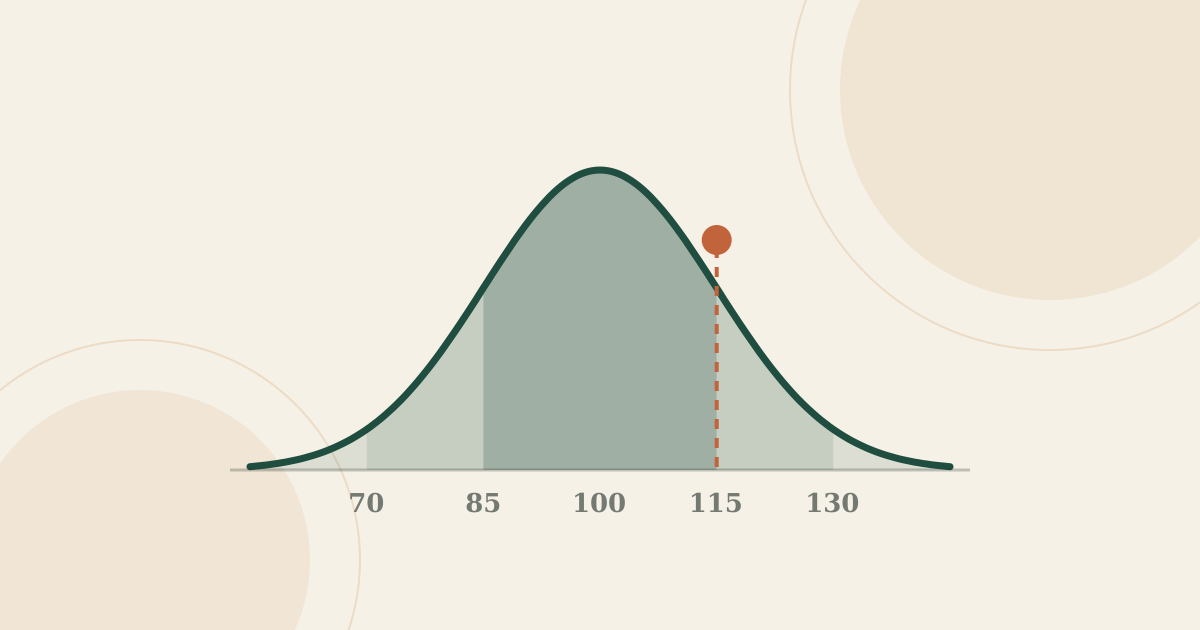
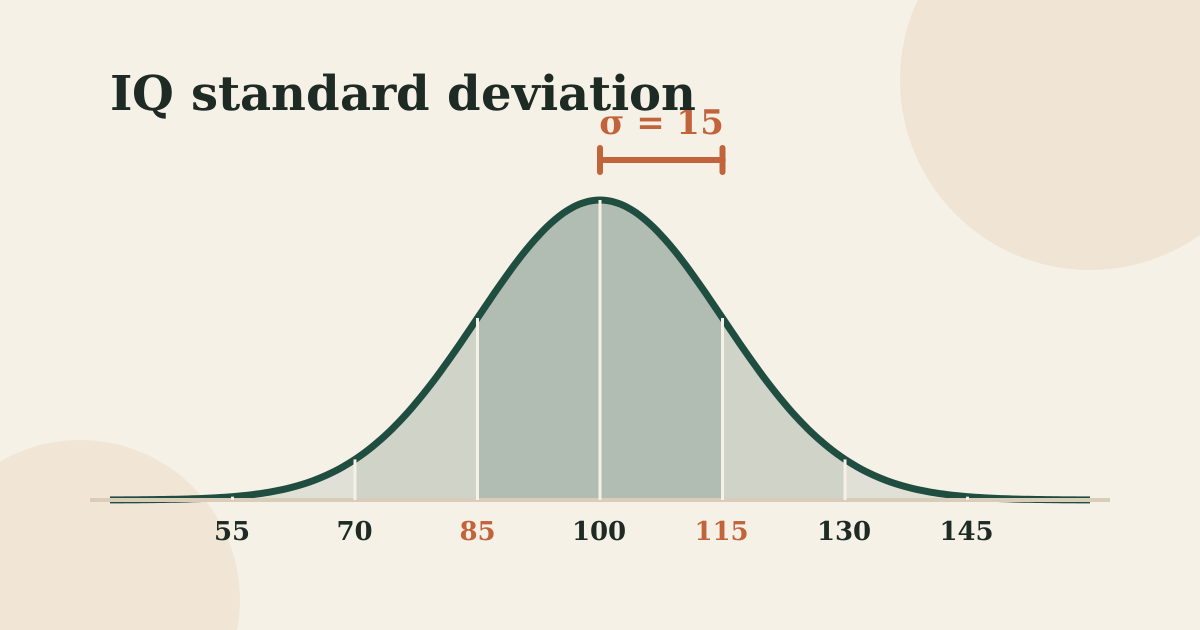
In short: this IQ calculator works out percentiles from the bell curve that IQ tests are built on, with an average of 100 and a standard deviation of 15 unless you choose another scale. An IQ of 115 is at about the 84th percentile, 130 at about the 98th and 145 at about the 99.9th. It converts a score you already have; to get a score, you need to take a test.
IQ calculator
How to use the IQ calculator
- IQ to percentile. Enter a score to see its percentile, how rare it is, its classification and roughly how many people score as high or higher, in the world and in a few large countries. On the standard scale, the result links to that score's own page.
- Percentile to IQ. Enter a percentile, such as 95 for the top 5%, to find the matching score. Decimals work too: 99.9 gives the score for the top 0.1%.
- Between two scores. Enter two scores to see what share of people fall between them, for example how many people score in the high average range of 110 to 119.
Choose the scale first if your score came from a test that doesn't use a standard deviation of 15. If you're not sure, it almost certainly does: the Wechsler tests and the current Stanford-Binet both use 15. Our guide to the IQ standard deviation explains the other scales and has a converter between them.
What IQ is the top 1%, 5% or 10%?
Many people come to an IQ percentile calculator with the question the other way round: how high do you need to score to be in the top 10%, or the top 1%? This table answers the common cases on all three scales.
| Share of people | IQ (SD 15) | SD 16 | SD 24 |
|---|---|---|---|
| Top 50% | 100 | 100 | 100 |
| Top 25% | 110 | 111 | 116 |
| Top 16% | 115 | 116 | 124 |
| Top 10% | 119 | 121 | 131 |
| Top 5% | 125 | 126 | 139 |
| Top 2% (Mensa) | 131 | 133 | 149 |
| Top 1% | 135 | 137 | 156 |
| Top 0.5% | 139 | 141 | 162 |
| Top 0.1% | 146 | 149 | 174 |
| Top 0.01% (1 in 10,000) | 156 | 160 | 189 |
| 1 in a million | 171 | 176 | 214 |
Scores are rounded to the nearest whole number. "Top 16%" is one standard deviation above average.
The 2% line is the one most people know, because high-IQ societies such as Mensa use it. Our guide to what counts as a good IQ score covers the other benchmarks, and the IQ percentile chart reads the table the other way, from score to percentile.
Why percentiles bunch up at the top
Equal steps in IQ don't move you past equal numbers of people. Near the middle of the bell curve, where most people score, a 15-point step carries you past about a third of the population. Out in the tail, the same 15 points passes only a sliver, because so few people are left to overtake.
| From IQ | To IQ | Percentile points gained |
|---|---|---|
| 70 | 85 | 13.6 |
| 85 | 100 | 34.1 |
| 100 | 115 | 34.1 |
| 115 | 130 | 13.6 |
| 130 | 145 | 2.1 |
That is why a percentile on its own can mislead. Going from the 50th to the 84th percentile is a 15-point climb, but so is going from the 98th to the 99.9th. Above about 130, rarity, such as "1 in 741", says more than the percentile does, and the calculator shows both.
How the calculator works
Professional IQ tests are scaled so that scores in each age group follow a normal distribution, the bell curve, with a mean of 100. The calculator does three things with that curve:
- Standardise. It turns your score into a z-score: (IQ − 100) ÷ standard deviation. An IQ of 127 on the standard scale is (127 − 100) ÷ 15 = 1.8 standard deviations above average.
- Look up the area. It finds the share of the bell curve below that z-score, using a standard numerical approximation that stays accurate far into the tails. For z = 1.8 that is 96.4%, so 127 is at about the 96th percentile.
- Turn it around. For "percentile to IQ", it runs the same curve backwards: the 96.4th percentile is 1.8 standard deviations up, which is 127.
The answers assume a perfect bell curve. Real test data follow it closely in the middle but are thinner at the extremes, so very high and very low percentiles are best read as approximate. The z-score section of our standard deviation guide goes through the arithmetic in more detail.
Percentile vs percentage correct
A percentile is a comparison with people, not a mark out of 100. The 70th percentile means a score higher than about 70% of people of the same age. Someone at the 70th percentile might have answered half of the questions right on a hard test, or most of them on an easy one. Equally, an IQ of 100 isn't a perfect score: it is the middle one.
Our own free IQ test reports both an estimated IQ and its percentile, worked out the same way as on this page.
What a calculator can't tell you
- Your IQ. No calculator can produce a score from nothing. You need a test, and the quality of the percentile depends on the quality of that test. Our guide to whether online IQ tests are accurate explains what to look for.
- The precision of your score. A single result comes with a margin of error of a few points, so a percentile is really a range. A 120 measured on a good test could reasonably be anything from about 115 to 125, the 84th to the 95th percentile.
- Your rank among people you know. Percentiles compare you with the whole population of your age, not with your school, workplace or friends, who are rarely a random sample.
For any single score from 55 to 180, its own page goes further, with the likely range, classification and what research says about that level. Start from the score index on the IQ scale page.
Frequently asked questions
How do you calculate an IQ percentile?
Turn the score into a z-score, the number of standard deviations from the average: (IQ minus 100) divided by 15 on most tests. Then look up the share of a normal bell curve that lies below that z-score. For an IQ of 120, z is 1.33, and about 91% of the curve lies below it, so 120 is at about the 91st percentile.
What IQ is in the top 1%?
About 135 on a test with a standard deviation of 15, such as the Wechsler scales. On a scale with a standard deviation of 16 it is about 137, and on the Cattell scale, which uses 24, about 156. That is why a "top 1%" score can look very different depending on the test.
What IQ is in the top 10%?
About 119 on the standard scale. Anyone scoring 120 or more is in roughly the top 9%, and the top 5% starts at about 125.
Is an IQ percentile the same as the percentage of questions right?
No. A percentile compares you with other people: the 75th percentile means you scored higher than about 75% of people your age. It says nothing directly about how many questions you answered correctly, which depends on the test.
Can this calculator tell me my IQ?
No. It converts an IQ score you already have into a percentile, or a percentile into an IQ score. To get a score in the first place you need a test, such as a supervised professional assessment or, for a free estimate, our online IQ test.
Why do IQ percentile calculators give slightly different answers?
Mostly because of rounding and the scale they assume. Some round to whole percentiles, some use a standard deviation of 16 or 24 instead of 15, and some use less precise formulas far out in the tails. This calculator shows decimals above the 99th percentile so very high scores are not all rounded to "99".
What percentile is an IQ of 100?
Exactly the 50th. IQ tests are scaled so that 100 is the middle score for each age group: half of people score higher and half lower.
What is a good IQ percentile?
Anything from about the 25th to the 75th percentile, IQ 90 to 110, is in the average range that covers half of the population. The 75th percentile and above, IQ 110 or more, is above average, and the 98th percentile, IQ 130, is the line Mensa uses for entry. Gifted programmes set their own cut-offs.
Sources
- Percentiles are worked out from the normal distribution with a mean of 100, using the complementary error function approximation in Press, W. H. and others, Numerical Recipes (Cambridge University Press), and P. J. Acklam's algorithm for the inverse normal distribution.
- Classifications follow the Wechsler descriptive categories used across this site; see the IQ chart.
- Population: World Bank, total population, 2025.
Need a score to put in?
The free Assessivo IQ test gives an estimated IQ score and percentile in about 25 minutes, with no sign-up.
Take the free IQ test