In short: a good online reaction time is under 250 ms, and under 200 ms is very fast. Most people's median lands between 250 and 300 ms on an online test, because screens, mice and browsers add some delay. In a calibrated lab study of 1,469 adults, the average simple reaction time was 231 ms, or 213 ms with the equipment's own delay removed.
How the reaction time test works
Choose a mode, then click or tap the panel to begin. After a random pause of between one and a half and four seconds, the signal appears and you respond as fast as you can. The pause changes every time, so you can't simply learn the rhythm. It plays like a quick reflex game, but the result is measured carefully enough to compare with research.
How your score is worked out
Your headline result is the median, the middle of your times. One distracted try or one lucky guess barely moves a median, which makes it a fairer summary than your single fastest click. You also see your average, your fastest time and your consistency: how far your tries typically were from your average.
False starts
Clicking before the signal counts as a false start and that try is repeated. So does any response under 100 ms, which is faster than the signal could have travelled from your eye or ear to your hand; at that speed you guessed rather than reacted. The same 100 ms line is used to judge false starts in sprinting.
Saving and sharing your results
Your best time in each mode and your last results are saved in your browser, so you can track your progress on this device without an account. We also record each finished test, without your IP address, for our statistics (see our privacy policy). Challenge a friend creates a link with your time; when they open it, the test shows your score and tells them whether they beat it.
What is a good reaction time?
A normal reaction time depends on how it was measured. Lab equipment adds almost no delay, while your phone or computer adds some, so the same person scores slower online than in a lab. This table is for the visual mode of an online test like this one:
| Your median | Rating | What it means |
|---|---|---|
| Under 200 ms | Very fast | Faster than the average adult even in a calibrated lab, with no device delay |
| 200–249 ms | Fast | Around or better than the lab average of 231 ms |
| 250–299 ms | Typical | Where most people land online; Human Benchmark's median is 273 ms |
| 300–349 ms | A little slow | Often device delay, a wireless mouse or divided attention |
| 350 ms and over | Slow | Usually tiredness, distraction or a laggy device; worth retesting |
Ratings are our own guide, anchored to the lab average from Woods and others (2015) and the online median published by Human Benchmark. Sound reactions are usually a little faster and choice reactions slower, so compare those with your own past results.
Is a 200 ms reaction time good?
Very good. A 200 ms median online beats the lab average of 231 ms, even though your device has added delay the lab took out. Single clicks around 200 ms are common; a median of 200 ms over five tries is not.
Is 170 to 180 ms good?
As a median, it is exceptional: about 50 to 60 ms quicker than the average adult in a calibrated lab. As a single best click it is less rare, because one well-timed anticipation can slip under 200 ms. If your median is in the 170s, you have genuinely fast reactions, a fast setup, or both.
Average reaction time
In the lab and online
The most careful modern measurement comes from a 2015 study that calibrated its equipment to the millisecond. In 1,469 adults between 18 and 65, simple visual reactions averaged 231 ms. The researchers measured how much the computer itself added, about 18 ms, and estimated the true figure at 213 ms. People differed from one another by a standard deviation of only 27 ms (Woods and others, 2015).
Online tests run slower. Human Benchmark, the best-known online reaction test, reports a median of 273 ms across its users, and notes that a computer can add 10 to 50 ms.
Why published averages disagree
If you search for the average reaction time you will find figures from under 200 ms to nearly 400 ms. Much of that spread comes from the equipment, not the people. The same 2015 paper lists large studies that used different computers and procedures:
| Study | People | Ages | Average |
|---|---|---|---|
| Woods and others (2015), calibrated | 1,469 | 18–65 | 231 ms |
| Krieg and others (2001) | 4,896 | 20–59 | 233 ms |
| Vincent and others (2012) | 107,413 | 17–65 | 261 ms |
| Reeves and others (2006) | 2,261 | 17–46 | 285 ms |
| Deary and Der (2005) | 1,930 | 16–63 | 328 ms |
| Bugg and others (2006) | 196 | 20–89 | 397 ms |
From Table 1 of Woods and others (2015). The authors attribute much of the variation to timing delays in each study's hardware and software.
The authors also compared their results with the 19th-century scientist Francis Galton, who recorded visual reaction times under 190 ms in young people. With modern equipment's delays taken out, they found today's adults react just as quickly as Galton's Victorian volunteers did.
Average reaction time by age
Reactions do slow with age, but gradually. In the 2015 lab study, simple reaction time rose by about 0.55 ms per year between 18 and 65, which makes a typical 60-year-old only around 20 ms slower than a typical 25-year-old. The slowing came almost entirely from the movement part of the response; the time to notice the signal did not change with age.
| Age | Expected lab average | Fair online comparison |
|---|---|---|
| 20 | 217 ms | 227–267 ms |
| 30 | 222 ms | 232–272 ms |
| 40 | 228 ms | 238–278 ms |
| 50 | 233 ms | 243–283 ms |
| 60 | 239 ms | 249–289 ms |
Calculated from the study's average of 231 ms at its mean age of about 46, plus 0.55 ms per year. The online column adds Human Benchmark's estimate of 10 to 50 ms of device delay. The test above makes this comparison for your own age.
A much larger survey of 7,130 adults in the UK found the same broad picture over a wider age range: simple reaction time "shows little slowing until around 50", while reactions that involve a choice slow steadily throughout adult life (Der and Deary, 2006).
Men and women
In the calibrated 2015 study, simple reaction times were "unaffected by sex or education". Other studies do find differences: the UK survey reported significant sex differences, most notably in how variable people's choice reactions were, and a study of 120 medical students found men faster than women on both visual and sound reactions (Jain and others, 2015). Where differences appear, they are small next to the spread between individuals.
What reaction time measures
The simplest definition of reaction time is the delay between a signal appearing and your response starting: the light turns green, and some fraction of a second later your finger presses. That fraction has two parts. First your senses detect the signal and your brain registers it; then your brain sends the command and your muscles carry it out. In the 2015 study, detecting the signal took about 131 ms on average, and the rest was spent moving.
Simple and choice reaction time
Simple reaction time is what the visual and sound modes measure: one signal, one response. Choice reaction time adds a decision, such as left or right. It is always slower, and the more options there are, the longer it takes. The psychologist William Hick showed in 1952 that choice reaction time grows in step with the amount of information in the choice, a pattern now called Hick's law (Hick, 1952).
Reacting to sound and to light
People usually react faster to sound than to light. A study of 120 students aged 18 to 20 found auditory reaction times significantly faster than visual ones in both men and women, and faster reactions in students who exercised regularly than in sedentary students (Jain and others, 2015). Try the visual and sound modes back to back to see the difference for yourself.
Reaction time and reflexes
A reflex, such as pulling your hand from something hot, is handled largely by the spinal cord and happens without a decision. A reaction time test measures a voluntary response that goes through the brain. People often call any quick response "reflexes", and a reflex test online is really a reaction test.
Why your device changes your score
Every reaction test running on a computer or phone measures you plus your equipment. Between the real change on the screen and the moment the browser records your click, delay builds up in several places:
- The display. The screen only redraws a set number of times a second, and some add processing on top. Human Benchmark notes that some modern TVs add as much as 150 ms.
- The input. Wireless mice, touchscreens and some keyboards take longer to report a press than a wired mouse.
- The browser. Other tabs, extensions and a busy processor can delay the moment the page responds.
- Sound output. Bluetooth headphones and speakers can delay the beep in the sound mode noticeably.
Even the purpose-built lab setup in the 2015 study added about 18 ms. To get your truest result here, use a computer with a wired mouse or the space bar, close other tabs, and use wired headphones or the built-in speaker for the sound mode. Your result notes which input you used, and if you test on a phone, compare yourself with your own phone results rather than with lab averages.
The fastest human reaction times
Sprinting has the clearest rule about how fast a human can react. A runner who reacts in less than 100 ms after the starting gun is judged to have made a false start, on the assumption that no genuine reaction to sound can be that fast. Researchers have tested that assumption: with instrumented starting blocks, five of nine athletes averaged under 100 ms in at least one condition, and the authors concluded that the body's part of an auditory reaction "can be under 85 ms" (Pain and Hibbs, 2007).
Those times were measured from the gun to force on the blocks, with no screen or mouse involved. On any online test, device delay makes sub-100 ms reactions to a signal practically impossible, which is why this test treats them as guesses. We know of no officially recognised world record for online reaction tests, and very low scores on leaderboards are hard to tell apart from anticipation or unusually fast hardware.
Reaction time in everyday life
Driving and braking
A driver's reaction time is far longer than a click on a test, because they have to notice a hazard, understand it and move their foot. Human factors expert Marc Green, reviewing braking studies, gives three best estimates in good visibility (Green):
At 60 mph a car covers about 27 metres a second, so the difference between 0.7 and 1.5 seconds is around 21 metres travelled before the brakes even start working.
Sport and games
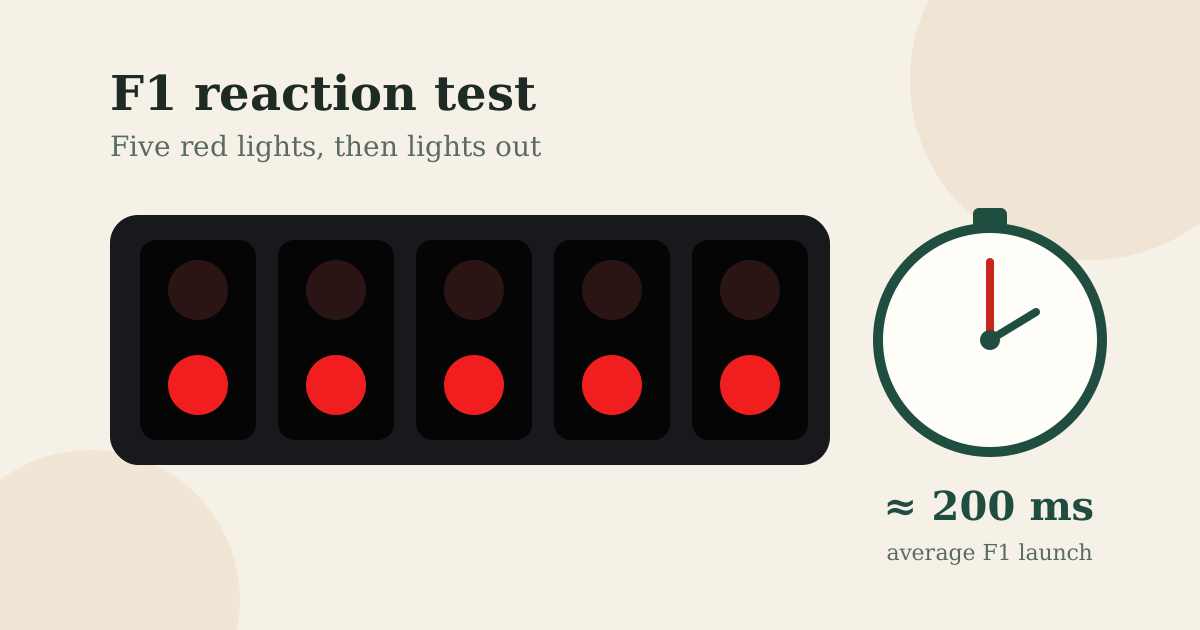
In sport, reaction time is usually choice reaction time: a tennis player must decide where the ball is going before moving, and a goalkeeper must read the shot. Experience also helps players anticipate what is coming. The choice mode gives a feel for that extra decision step, and our F1 reaction test recreates a Formula 1 lights-out start.
What slows your reactions
- Lack of sleep. In a study of 39 people, after 17 to 19 hours awake performance on some tests was as bad as or worse than at a blood alcohol level of 0.05%, and response speeds were up to 50% slower on some tests (Williamson and Feyer, 2000).
- Alcohol. The same study measured performance at blood alcohol levels up to about 0.1%; longer sleep loss produced impairment equal to the highest dose.
- Age. Simple reactions change little before about 50; choice reactions slow gradually through adulthood.
- Surprise and distraction. As the driving figures show, an unexpected signal can double your reaction time compared with one you are ready for.
- Lack of exercise. In the student study, regularly exercising students reacted faster than sedentary ones.
Practice helps too, mostly with that particular task: the more familiar the signal and the response, the less thinking is involved. If you want to see the effect, take the test at different times of day, or after a poor night's sleep, and compare results in your history. For what actually helps, from caffeine and warm-ups to drills and action games, see our guide on how to improve reaction time.
Reaction time and intelligence
Psychologists have studied the link between quick reactions and intelligence for more than a century, since Galton's early tests. A review of 172 studies published between 1955 and 2005 found an average correlation of about -0.24 between speed on simple tasks and scores on ability tests (Sheppard and Vernon, 2008). The minus sign means faster responders tend to score a little higher.
That is a weak link, far too weak to estimate anyone's IQ from a reaction time. Quick reactions are one small part of processing speed, which professional IQ tests measure with tasks such as copying symbols against the clock, and processing speed is itself only one of several abilities that make up an IQ score. For a measure of reasoning rather than raw speed, try our free IQ test, which mixes pattern, logic, spatial and number problems.
Frequently asked questions
What is a good reaction time?
On an online test like this one, anything under about 250 ms is good and under 200 ms is very fast. Most people score between 250 and 300 ms online, partly because the screen, mouse and browser add some delay. In a carefully calibrated lab study of 1,469 adults, the average was 231 ms.
What is the average human reaction time?
For a simple visual reaction, such as clicking when a light comes on, a large lab study found an average of 231 milliseconds in adults aged 18 to 65, or 213 ms once the delay added by the equipment was removed. On online tests, where devices add more delay, the median is higher: Human Benchmark reports 273 ms.
Is 200 ms a good reaction time?
Yes. 200 ms on an online test is very good: it is faster than the lab average of 231 ms, even though your screen and mouse add delay that the lab removed. Few people average under 200 ms over several tries.
Is 171 ms a good reaction time?
It is exceptionally fast for a median over several tries, about 60 ms quicker than the average adult in a calibrated lab. A single 171 ms click is more common than a 171 ms median, because one try can be helped by a well-timed guess. Check your median, not just your best click.
Is 250 ms a good reaction time?
Yes, 250 ms is a good online result. It is a little quicker than the typical online median of about 273 ms, and close to the lab average of 231 ms once you allow for the delay your device adds.
Does reaction time get slower with age?
Yes, but slowly at first. In a lab study of adults aged 18 to 65, simple reaction time rose by about 0.55 ms per year, so a 60-year-old was only about 20 ms slower than a 25-year-old on average. A UK survey of 7,130 adults found little slowing until around 50, with choice reactions slowing throughout adult life.
Are reactions to sound faster than to light?
Usually, yes. Studies comparing the two consistently find people respond faster to a beep than to a flash of light. That is one reason sprint races start with a gun, and why this test has a separate sound mode.
Why is my reaction time slower on my phone?
Touchscreens, screen refresh rates, wireless mice and busy browsers all add delay between the real event and the moment the test can record your response. Human Benchmark estimates computers add 10 to 50 ms. For your best result, use a wired mouse or the space bar on a computer, close other tabs and test in a quiet moment.
Can you improve your reaction time?
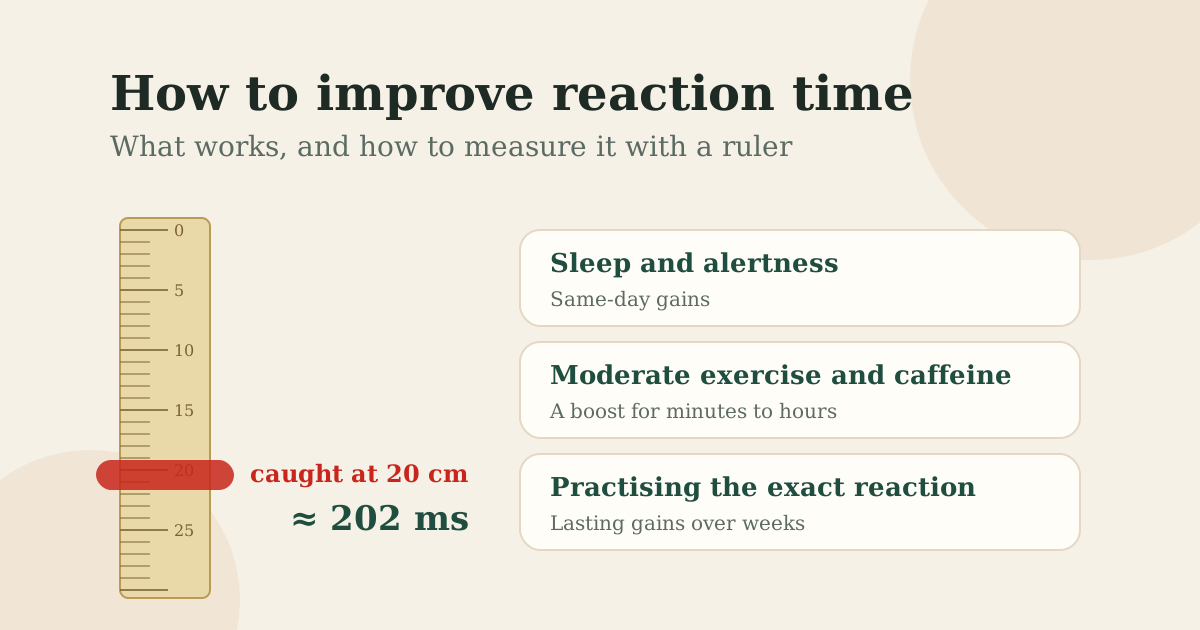
Somewhat. Being rested and alert makes the biggest difference, and practising a particular task makes you quicker at that task. Our guide to improving reaction time covers what the research supports, with exercises and a ruler drop calculator.
Is reaction time linked to intelligence?
Weakly. A review of 172 studies over 50 years found an average correlation of about -0.24 between speed on simple tasks and scores on ability tests: faster people tend to score a little higher, but the link is far too loose to judge anyone's intelligence from their reaction time.
Sources
- Woods, D. L., Wyma, J. M., Yund, E. W., Herron, T. J. and Reed, B. (2015). Factors influencing the latency of simple reaction time. Frontiers in Human Neuroscience, 9, 131.
- Der, G. and Deary, I. J. (2006). Age and sex differences in reaction time in adulthood: results from the United Kingdom Health and Lifestyle Survey. Psychology and Aging, 21(1), 62–73.
- Jain, A., Bansal, R., Kumar, A. and Singh, K. D. (2015). A comparative study of visual and auditory reaction times on the basis of gender and physical activity levels of medical first year students. International Journal of Applied and Basic Medical Research, 5(2), 124–127.
- Hick, W. E. (1952). On the rate of gain of information. Quarterly Journal of Experimental Psychology, 4(1), 11–26.
- Pain, M. T. G. and Hibbs, A. (2007). Sprint starts and the minimum auditory reaction time. Journal of Sports Sciences, 25(1), 79–86.
- Williamson, A. M. and Feyer, A.-M. (2000). Moderate sleep deprivation produces impairments in cognitive and motor performance equivalent to legally prescribed levels of alcohol intoxication. Occupational and Environmental Medicine, 57(10), 649–655.
- Green, M. (2000). "How long does it take to stop? Methodological analysis of driver perception-brake times". Transportation Human Factors, 2(3), 195–216; summarised in Driver reaction time, Visual Expert.
- Sheppard, L. D. and Vernon, P. A. (2008). Intelligence and speed of information-processing: a review of 50 years of research. Personality and Individual Differences, 44(3), 535–551.
- Reaction time test, Human Benchmark: median online result and device delay.
Fast reactions, sharp reasoning?
Reaction time shows how quickly you respond. The free Assessivo IQ test shows how well you reason. It takes 25 minutes, and your estimated score appears the moment you finish.
Take the free IQ test