In short: to qualify for Mensa you need a score in the top 2% of the population on an approved intelligence test taken under supervision. For the Wechsler scales and the fifth-edition Stanford-Binet, the IQ required for Mensa is 130; other tests have their own cut-offs at the same rarity, for example 132 on pre-2003 Stanford-Binet editions and 148 on Cattell's wider scale. You can take Mensa's own admission test or send in a qualifying score from a test you have already taken. Ordinary online tests don't count.
The Mensa IQ requirement: the top 2%
Mensa has one entry requirement and no others: a score "within the upper two percent of the general population on an approved intelligence test that has been properly administered and supervised", in the words of Mensa International. Education, job and background play no part, and there are no other qualifications.
Mensa sets the bar as a percentile rather than an IQ number on purpose; as its own FAQ puts it, it "keeps it simple with a cutoff of 98%". The reason is that IQ tests don't all use the same scale, so the same performance can be written as different numbers on different tests. A percentile is the same on all of them: being at the 98th percentile means scoring higher than 98 people in 100, whatever the test. Each test then has its own qualifying score that marks that point, which is why the minimum IQ for Mensa is 130 on one test and 148 on another.
Do you qualify for Mensa? Score checker
Mensa score checker
Choose the test you took and enter your score. The qualifying scores are American Mensa's; other national Mensas use the same 98th-percentile rule but may accept a different list of tests.
Enter a score to check it against the qualifying level.
For guidance only: Mensa's supervisory psychologists review every application and make the final decision, and qualifying scores can change when tests are re-normed.
Mensa qualifying scores by test
American Mensa says it accepts scores from about 200 standardized intelligence tests. These are the ones people ask about most often, from its published list. A score must come from the full test, given by a neutral, qualified person under the test's normal conditions, and Mensa needs the original report or a notarized copy.
| Test | What counts | Qualifying score |
|---|---|---|
| Clinical IQ tests | ||
| Wechsler adult and children's scales (WAIS, WISC, WPPSI, all editions)Counts: Full Scale IQThe whole test must be given; a part-test or most index scores are not accepted. | Full Scale IQ | 130 |
| Stanford-Binet 5Counts: IQ | IQ | 130 |
| Stanford-Binet (earlier editions)Counts: IQ | IQ | 132 |
| Reynolds Intellectual Assessment ScalesCounts: IQ | IQ | 130 |
| Differential Ability Scales, second edition (DAS-II)Counts: GCA | GCA | 130 |
| Differential Ability Scales (first edition)Counts: GCA | GCA | 132 |
| Woodcock-Johnson Tests of Cognitive Abilities IVCounts: IQEditions I to III need 132. The achievement battery is not accepted. | IQ | 131 |
| CattellCounts: IQThe Cattell scale uses a wider spread (standard deviation 24). | IQ | 148 |
| California Test of Mental MaturityCounts: IQ | IQ | 132 |
| School ability tests | ||
| Cognitive Abilities Test (CogAT)Counts: Composite SAS | Composite SAS | 132 |
| Otis-Lennon School Ability Test (OLSAT)Counts: Total SAI | Total SAI | 132 |
| Naglieri Nonverbal Ability Test 2 or 3Counts: Nonverbal Ability IndexThe first edition (NNAT) needs 130. | Nonverbal Ability Index | 132 |
| Henmon-NelsonCounts: Score | Score | 132 |
| Otis-GammaCounts: IQ | IQ | 131 |
| College and graduate tests | ||
| SAT taken before 30 September 1974Counts: Verbal + math | Verbal + math | 1300 |
| SAT taken 30 September 1974 to 31 January 1994Counts: Verbal + mathSATs taken after January 1994 are not accepted. | Verbal + math | 1250 |
| ACT taken before September 1989Counts: CompositeLater ACTs are not accepted. | Composite | 29 |
| GRE taken before May 1994Counts: Verbal + quantitative | Verbal + quantitative | 1250 |
| GRE taken May 1994 to 30 September 2001Counts: Verbal + quantitative + analyticalLater GREs are not accepted. | Verbal + quantitative + analytical | 1875 |
| LSAT taken after 1982Counts: Percentile rankBefore 1982 the qualifying score was 662. Only an original report from the Law School Admission Council is accepted. | Percentile rank | 95th percentile |
| Military tests | ||
| AFQT taken before October 1980Counts: PercentileLater military tests are not accepted. | Percentile | 98th percentile |
| Army GCT or GT taken before October 1980Counts: Score | Score | 136 |
| Navy GCT taken before October 1980Counts: Score | Score | 68 |
Source: American Mensa, qualifying test scores, checked October 2026. Tests with "achievement" in the title, the ASVAB and modern SAT, ACT and GRE scores are not accepted.
The college and military rows surprise many people. Mensa accepts older versions of the SAT, ACT and GRE, but not later ones; its only explanation is that the later versions "no longer correlate with an IQ test". The date that matters is when you sat the test, not when you apply, so a 1990 SAT of 1250 or more still qualifies today.
Why 130, 132 and 148 mean the same thing
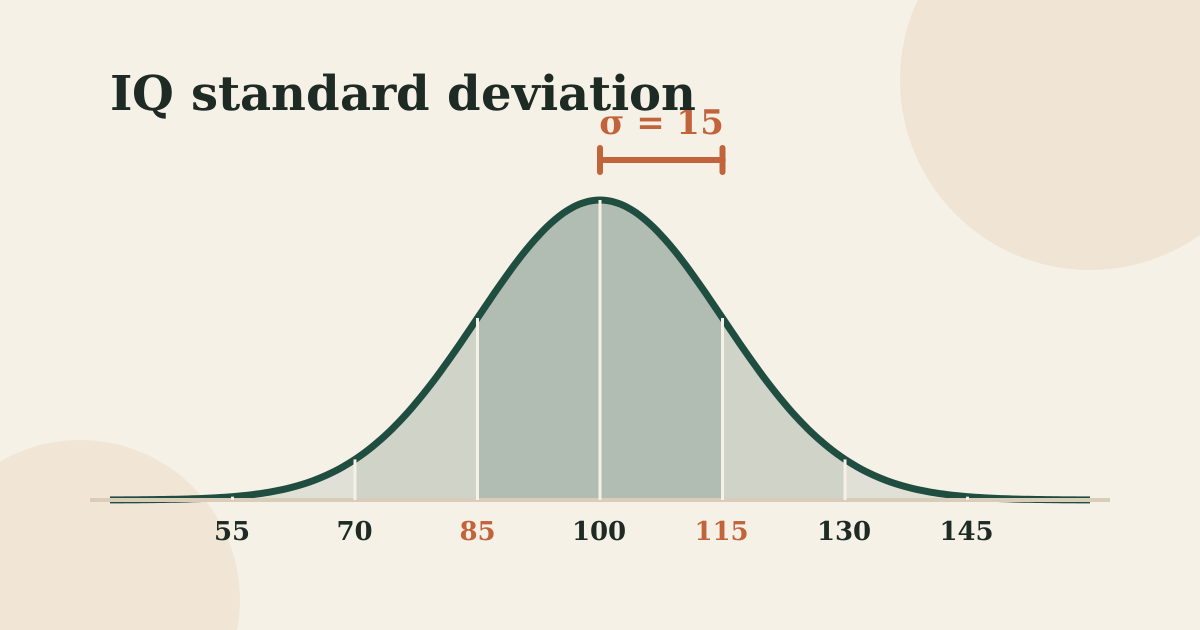
The cut-offs differ because the tests spread their scores differently. Every IQ test sets its average at 100, but the size of one standard deviation, the usual step away from average, varies: 15 points for the Wechsler family, 16 for the Stanford-Binet before its fifth edition and 24 for Cattell's test.
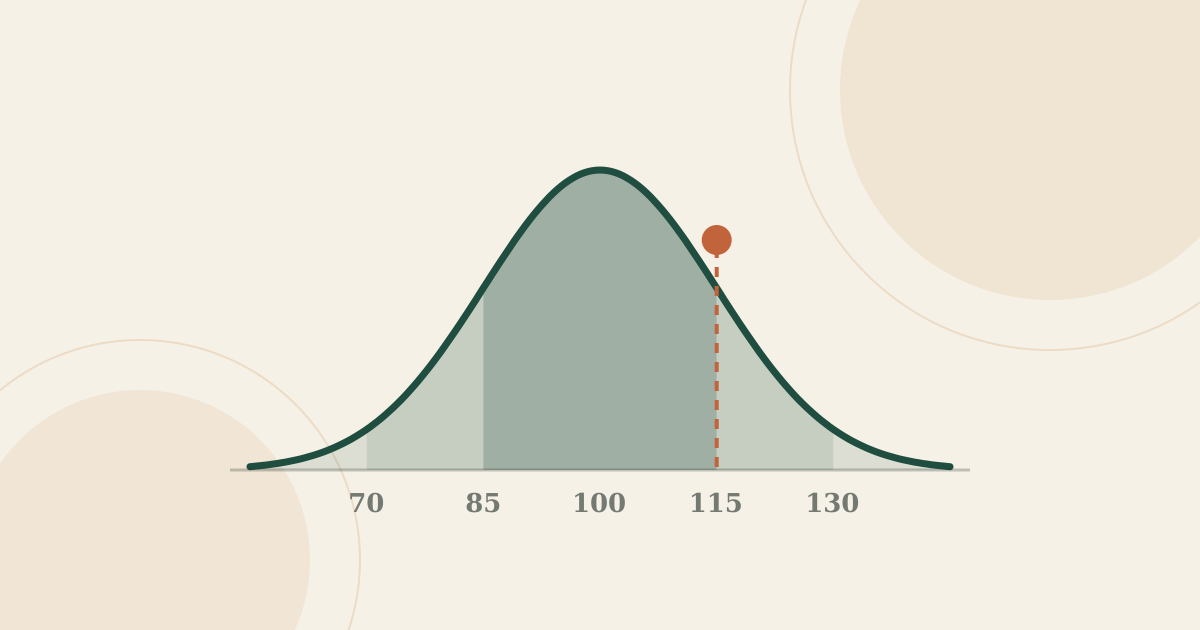
Mensa's published cut-offs on these three tests sit at the same place, two standard deviations above the average: 100 + 2 × 15 = 130, 100 + 2 × 16 = 132 and 100 + 2 × 24 = 148. Two standard deviations is the 97.7th percentile, which rounds to the top 2%. Our guide to IQ standard deviation converts any score between the three scales, and the IQ percentile calculator shows how rare each score is.
That also explains a common mix-up. Someone with a Cattell score of 140 might think they are above Mensa's "130", but on the standard scale a Cattell 140 is only about 125, below the line. Always compare a score with the cut-off for the test it came from.
Two ways to qualify for Mensa
For prior evidence, Mensa International says a school result must be a certified copy showing your name, date of birth, the test's name and a clear score, stamped with the school seal; a psychologist's report must be on letterhead, signed and include their licence or registration number. It does not accept achievement tests. If you would rather have an official score first, see what a psychologist's assessment with the Wechsler IQ test involves.
What the Mensa admission test is like
Mensa's admission tests, often called the Mensa entrance test, are run by each national Mensa, so the details depend on where you live. Here is what two national groups publish about theirs:
- American Mensa says its admission test takes one to two hours, is offered at local sessions run by volunteers and at more than 400 private testing centres, and needs photo ID showing your date of birth. It does not test anyone under 14. You can retake it after eight weeks. You find out whether you qualified, but no more: Mensa says the test is given "for the purpose of admission into Mensa and not to quantify intelligence", so it does not give out an IQ score or percentile (American Mensa).
- British Mensa offers a supervised test at test centres, which takes about two and a quarter hours, and a fully proctored online version of about an hour and a half. Both are open from age 10 and a half, both cost £49 at the time of writing, and candidates receive their IQ score, with those in the top 2% invited to join. Applicants must live in the UK or Ireland (British Mensa).
Mensa doesn't publish its admission questions, but supervised intelligence tests generally mix pattern, number and word problems under time pressure. Our sample IQ test questions show the main types with worked answers. There is little to cram: practice helps only a little, mostly by making question types familiar, which is exactly why Mensa makes you wait before retesting. If you land just short of the line, our page on an IQ of 129 covers what to do next.
Mensa practice tests online
Mensa itself points people who want to try first to free practice tests. The best known is the Mensa IQ Challenge on Mensa International's site, built by Mensa Norway and also available at test.mensa.no:
- 35 visual pattern puzzles, each a grid with one missing piece, to solve in 25 minutes;
- the puzzles get harder as you go, every correct answer scores one point and wrong answers cost nothing, so it pays to guess;
- it reports scores only between 85 and 145, on a scale with a standard deviation of 15.
Both Mensa International and Mensa Norway are clear that it is practice only: it is not a substitute for a professional test and its score can't be used to join. British Mensa also offers a free 15-minute online workout that gives no IQ score, and a paid 45-minute home test that gives an indicative score. In some other countries, Mensa International says, a home pre-test can earn you an invitation to the supervised test.
Our free IQ test is another way to get a sense of where you stand: it mixes four kinds of reasoning in a timed set of 36 questions and shows an estimated score and percentile when you finish. Like any online test, it is an estimate, not a qualifying score. Our guide Are online IQ tests accurate? explains what a practice score can and can't tell you.
Who is in Mensa
Mensa was founded in Britain in 1946 and is now organised country by country. Mensa International counts around 150,000 members, in established national groups in almost 50 countries plus individual members elsewhere; the groups range from a few hundred members to nearly 50,000 in the United States (Mensa International). Our page on an IQ of 130 tells the story of its founding and why so few of the people who could join ever do.
Mensa takes no position on politics, religion or social issues, and in every country the only entry requirement is the qualifying score described above.
As for the average IQ of Mensa members, Mensa doesn't publish one. Everyone has qualified at the 98th percentile or above, so on the standard scale the average must be above 130. If members were a random sample of everyone who qualifies, it would be about 136, the average of everyone at 130 or above on a bell curve; members are not a random sample, so treat that as an illustration. For how high scores go above Mensa's level, see the highest IQ in the world, and for what 130 means in everyday terms, our page on IQ 130.
Frequently asked questions
What IQ do you need to get into Mensa?
A score in the top 2% of the population on an approved, supervised intelligence test. With the two tests psychologists use most, the Wechsler scales and Stanford-Binet 5, that means a full-scale IQ of 130 or more. Tests that spread their scores more widely need a higher number for the same rarity, such as 148 on the Cattell scale.
Is 130 the minimum IQ for Mensa?
On the Wechsler and Stanford-Binet 5 tests, yes: 130 is the lowest qualifying full-scale IQ. But 130 is not a universal number. Each accepted test has its own cut-off, set at the same rarity, so the minimum is 132 on several school ability tests and 148 on the Cattell scale.
Can I join Mensa with an online IQ test?
Not with an ordinary online test. Mensa International says online tests cannot be used for admission, and American Mensa rejects unsupervised internet tests. The one exception is a test Mensa itself supervises remotely: British Mensa offers a fully proctored online IQ test that can qualify you, if you live in the UK or Ireland.
How many questions are on the Mensa IQ test?
It depends on which test you mean. The free Mensa IQ Challenge practice test, built by Mensa Norway, has 35 puzzles to solve in 25 minutes. The supervised admission tests are longer: American Mensa says its admission test takes one to two hours, and British Mensa's in-person test takes about two and a quarter hours. We could not find a published question count for either admission test.
Does Mensa tell you your IQ?
It depends on the country. American Mensa says its admission test is "not to quantify intelligence" and that it cannot give candidates a score report, percentile or IQ. British Mensa says candidates who take its supervised test receive their IQ score.
What is the average IQ of Mensa members?
Mensa does not publish one. Everyone who joins has qualified at or above the 98th percentile, so the average must be above 130 on a standard scale. If members were a random sample of everyone who qualifies, the average would be about 136, but people who join may not be typical of everyone eligible, so that is an illustration rather than a measured figure.
Can I use my SAT score to join Mensa?
Only an old one. American Mensa accepts SATs taken before 30 September 1974 with a score of 1300, and those taken from then until 31 January 1994 with 1250. SATs taken after January 1994 are not accepted, because the test changed and no longer lines up with an IQ test.
How old do you have to be to join Mensa?
The age limits apply to Mensa's own tests. American Mensa does not test anyone under 14, and British Mensa does not test anyone under 10 and a half. Younger children can qualify by submitting a score from a psychologist or school test.
Is the Mensa Norway test accurate?
It is a well-made practice test, but Mensa Norway says it is not a substitute for a professional test. It reports scores only between 85 and 145, so it cannot show a score above 145, and a result from it cannot be used to join Mensa.
What if I score just below the Mensa level?
A score one or two points under the cut-off is within any test's margin of error, so it does not mean you are clearly below the line. American Mensa lets candidates retest after eight weeks, and you can also submit a qualifying score from a different approved test.
Sources
- Getting your IQ tested: FAQs, Mensa International: the top 2% rule, prior evidence, online tests and pre-tests.
- Qualifying test scores, American Mensa: the qualifying score on each test.
- Take the Mensa admission test, American Mensa: length, age, retesting and results.
- IQ testing and puzzles, British Mensa: supervised, online and home tests.
- Mensa IQ Challenge, Mensa International, and IQ test made by Mensa Norway: format and score range.
- About us, Mensa International: membership and national groups.
Find out roughly where you stand
A supervised test is the only way into Mensa, but a free practice run shows you what timed reasoning questions feel like. Ours takes 25 minutes and ends with an estimate of where you stand.
Take the free IQ test