In short: no US president has an official IQ score. The figures that circulate come from a 2006 study by the psychologist Dean Keith Simonton, who estimated the IQ of all 42 presidents from George Washington to George W. Bush. John Quincy Adams comes out highest, at 165 to 175, followed by Thomas Jefferson, John F. Kennedy and Bill Clinton. Ulysses S. Grant has the lowest average estimate, 120, which is still well above the population average of 100. Only 8 of the 42 rest on direct ratings of a president's early life; the rest were calculated from other measures and are rougher.
All 42 US presidents ranked by IQ
The table lists every president in Simonton's study, ranked by the average of his four IQ estimates for each man. Search for a name, or click a column heading to sort. The four estimates differ because they cover two periods of life, childhood up to 17 and ages 17 to 26, each with and without a correction for how much biographical evidence survived. On a phone, the table shows each president's range instead of the four separate estimates.
| Rank | President | Average | Range | To 17 | To 17, corrected | 17–26 | 17–26, corrected | Brilliance |
|---|---|---|---|---|---|---|---|---|
| 1 | John Quincy Adams Cox6th president, 1825–1829 | 168.8 | 165.0–175.0 | 165.0 | 170.0 | 165.0 | 175.0 | +1.2 |
| 2 | Thomas Jefferson Cox3rd president, 1801–1809 | 153.8 | 145.0–160.0 | 145.0 | 160.0 | 150.0 | 160.0 | +3.1 |
| 3 | John F. Kennedy35th president, 1961–1963 | 150.7 | 138.9–159.8 | 138.9 | 155.7 | 148.2 | 159.8 | +1.8 |
| 4 | Bill Clinton42nd president, 1993–2001 | 148.8 | 135.6–159.0 | 135.6 | 153.6 | 147.0 | 159.0 | +1.0 |
| 5 | Woodrow Wilson28th president, 1913–1921 | 145.1 | 133.0–155.2 | 133.0 | 148.3 | 143.9 | 155.2 | +1.3 |
| 5 | Jimmy Carter39th president, 1977–1981 | 145.1 | 130.2–156.8 | 130.2 | 149.0 | 144.4 | 156.8 | 0.0 |
| 7 | John Adams Cox2nd president, 1797–1801 | 142.5 | 120.0–155.0 | 120.0 | 150.0 | 145.0 | 155.0 | +0.6 |
| 8 | Theodore Roosevelt26th president, 1901–1909 | 142.3 | 129.7–153.0 | 129.7 | 144.6 | 141.8 | 153.0 | +0.9 |
| 9 | James A. Garfield20th president, 1881 | 141.5 | 129.0–152.3 | 129.0 | 143.5 | 141.2 | 152.3 | +0.9 |
| 9 | Chester A. Arthur21st president, 1881–1885 | 141.5 | 129.0–152.3 | 129.0 | 143.5 | 141.2 | 152.3 | +0.9 |
| 11 | James Madison Cox4th president, 1809–1817 | 141.3 | 120.0–160.0 | 120.0 | 150.0 | 135.0 | 160.0 | +0.6 |
| 12 | Abraham Lincoln Cox16th president, 1861–1865 | 140.0 | 125.0–150.0 | 125.0 | 145.0 | 140.0 | 150.0 | +0.8 |
| 13 | Franklin D. Roosevelt32nd president, 1933–1945 | 139.6 | 127.4–150.5 | 127.4 | 140.9 | 139.7 | 150.5 | +0.9 |
| 14 | John Tyler10th president, 1841–1845 | 136.2 | 122.9–148.1 | 122.9 | 136.6 | 137.2 | 148.1 | +0.2 |
| 15 | Millard Fillmore13th president, 1850–1853 | 136.0 | 120.8–149.0 | 120.8 | 136.7 | 137.4 | 149.0 | -0.7 |
| 16 | Franklin Pierce14th president, 1853–1857 | 134.8 | 120.6–147.4 | 120.6 | 134.8 | 136.3 | 147.4 | -0.3 |
| 17 | William Henry Harrison9th president, 1841 | 133.9 | 120.3–146.3 | 120.3 | 133.6 | 135.5 | 146.3 | -0.1 |
| 17 | Rutherford B. Hayes19th president, 1877–1881 | 133.9 | 120.3–146.3 | 120.3 | 133.6 | 135.5 | 146.3 | -0.1 |
| 19 | Martin Van Buren8th president, 1837–1841 | 133.4 | 119.4–146.0 | 119.4 | 132.9 | 135.1 | 146.0 | -0.3 |
| 20 | George Washington Cox1st president, 1789–1797 | 132.5 | 125.0–140.0 | 125.0 | 130.0 | 135.0 | 140.0 | +0.3 |
| 21 | Benjamin Harrison23rd president, 1889–1893 | 132.2 | 117.5–145.4 | 117.5 | 131.4 | 134.3 | 145.4 | -0.7 |
| 22 | Dwight D. Eisenhower34th president, 1953–1961 | 131.9 | 117.3–145.1 | 117.3 | 131.1 | 134.1 | 145.1 | -0.7 |
| 23 | Richard Nixon37th president, 1969–1974 | 131.0 | 118.9–142.9 | 118.9 | 129.2 | 133.0 | 142.9 | +0.4 |
| 23 | Grover Cleveland22nd and 24th president, 1885–1889, 1893–1897 | 131.0 | 116.9–144.0 | 116.9 | 129.6 | 133.3 | 144.0 | -0.5 |
| 25 | James K. Polk11th president, 1845–1849 | 130.2 | 116.0–143.4 | 116.0 | 128.7 | 132.7 | 143.4 | -0.6 |
| 25 | William McKinley25th president, 1897–1901 | 130.2 | 116.0–143.4 | 116.0 | 128.6 | 132.7 | 143.4 | -0.6 |
| 27 | George H. W. Bush41st president, 1989–1993 | 130.1 | 116.5–143.0 | 116.5 | 128.4 | 132.6 | 143.0 | -0.3 |
| 28 | Ronald Reagan40th president, 1981–1989 | 130.0 | 118.0–141.9 | 118.0 | 127.9 | 132.2 | 141.9 | +0.4 |
| 29 | Herbert Hoover31st president, 1929–1933 | 129.8 | 118.0–141.6 | 118.0 | 127.5 | 132.0 | 141.6 | +0.5 |
| 30 | Lyndon B. Johnson36th president, 1963–1969 | 127.8 | 114.8–140.6 | 114.8 | 125.2 | 130.7 | 140.6 | -0.2 |
| 31 | Harry S. Truman33rd president, 1945–1953 | 127.6 | 115.5–139.8 | 115.5 | 124.6 | 130.3 | 139.8 | +0.2 |
| 32 | Calvin Coolidge30th president, 1923–1929 | 127.1 | 111.4–141.6 | 111.4 | 124.8 | 130.6 | 141.6 | -1.5 |
| 32 | Gerald Ford38th president, 1974–1977 | 127.1 | 113.3–140.4 | 113.3 | 124.4 | 130.2 | 140.4 | -0.6 |
| 34 | William Howard Taft27th president, 1909–1913 | 126.9 | 114.5–139.5 | 114.5 | 123.8 | 129.8 | 139.5 | 0.0 |
| 35 | Andrew Jackson Cox7th president, 1829–1837 | 126.3 | 110.0–145.0 | 110.0 | 120.0 | 130.0 | 145.0 | -0.6 |
| 36 | James Buchanan15th president, 1857–1861 | 125.9 | 111.9–139.6 | 111.9 | 122.8 | 129.4 | 139.6 | -0.8 |
| 37 | Zachary Taylor12th president, 1849–1850 | 125.7 | 110.8–139.8 | 110.8 | 122.7 | 129.3 | 139.8 | -1.2 |
| 37 | Andrew Johnson17th president, 1865–1869 | 125.7 | 110.8–139.8 | 110.8 | 122.7 | 129.3 | 139.8 | -1.2 |
| 39 | George W. Bush43rd president, 2001–2009 | 124.9 | 111.1–138.5 | 111.1 | 121.4 | 128.5 | 138.5 | -0.7 |
| 40 | Warren G. Harding29th president, 1921–1923 | 124.3 | 107.8–139.9 | 107.8 | 121.1 | 128.4 | 139.9 | -2.0 |
| 41 | James Monroe5th president, 1817–1825 | 124.1 | 109.0–138.6 | 109.0 | 120.7 | 128.2 | 138.6 | -1.4 |
| 42 | Ulysses S. Grant Cox18th president, 1869–1877 | 120.0 | 110.0–130.0 | 110.0 | 115.0 | 125.0 | 130.0 | -1.4 |
Showing all 42 presidents.
Source: Simonton (2006), Table 1. Averages are of the four estimates. Brilliance is Intellectual Brilliance in standard deviations from the presidential average (Simonton, 1986), available for presidents up to Reagan; the figures for George H. W. Bush, Clinton and George W. Bush were calculated. Grover Cleveland served two separate terms and is counted once, so the 43 presidencies to 2009 make 42 presidents.
The 10 highest IQ presidents
On the average of the four estimates, these are the presidents with the highest IQs. Ties share a place, which is why Garfield and Arthur, whose calculated scores are identical, both appear.
- John Quincy Adams: 168.8 (estimates 165.0 to 175.0)A direct rating from Cox's 1926 study of eminent people. Intellectual Brilliance +1.2.
- Thomas Jefferson: 153.8 (estimates 145.0 to 160.0)A direct rating from Cox's 1926 study of eminent people. Intellectual Brilliance +3.1.
- John F. Kennedy: 150.7 (estimates 138.9 to 159.8)Calculated by Simonton from his other ratings, not rated directly. Intellectual Brilliance +1.8.
- Bill Clinton: 148.8 (estimates 135.6 to 159.0)Calculated by Simonton from his other ratings, not rated directly. Intellectual Brilliance +1.0, also calculated.
- Woodrow Wilson: 145.1 (estimates 133.0 to 155.2)Calculated by Simonton from his other ratings, not rated directly. Intellectual Brilliance +1.3.
- Jimmy Carter: 145.1 (estimates 130.2 to 156.8)Calculated by Simonton from his other ratings, not rated directly. Intellectual Brilliance 0.0.
- John Adams: 142.5 (estimates 120.0 to 155.0)A direct rating from Cox's 1926 study of eminent people. Intellectual Brilliance +0.6.
- Theodore Roosevelt: 142.3 (estimates 129.7 to 153.0)Calculated by Simonton from his other ratings, not rated directly. Intellectual Brilliance +0.9.
- James A. Garfield: 141.5 (estimates 129.0 to 152.3)Calculated by Simonton from his other ratings, not rated directly. Intellectual Brilliance +0.9.
- Chester A. Arthur: 141.5 (estimates 129.0 to 152.3)Calculated by Simonton from his other ratings, not rated directly. Intellectual Brilliance +0.9.
The top of the list holds no surprises for historians. John Quincy Adams was famously precocious, and Simonton noted that his early record outshines even Jefferson's, which is why their estimates don't overlap: 165 to 175 against 145 to 160. Jefferson, though, is the clear leader on Intellectual Brilliance, a separate measure of curiosity and breadth of mind, at 3.1 standard deviations above the presidential average. Nobody else reaches 2. For twentieth-century presidents, Kennedy and Clinton lead, with Wilson and Carter close behind.
The lowest presidential IQ estimates
At the other end, Ulysses S. Grant has the lowest average, 120.0, from Cox's direct ratings. James Monroe (124.1), Warren G. Harding (124.3) and George W. Bush (124.9) come next. Harding has both the single lowest estimate in the table, 107.8, and the lowest Intellectual Brilliance score of any president, two standard deviations below the presidential average. As Simonton later put it, "Absolutely nobody scored lower!"
"Lowest" here means lowest among presidents, not low. Every average in the table is at least 120, and the average across all 42 is about 135. On the modern scale, 120 is higher than about 9 in 10 people (see IQ 120). Of George W. Bush, the subject of most of the internet arguments, Simonton wrote that his estimates average around 125, "in the upper range of college graduates", and that "he is certainly smart enough to be president of the United States".
How presidential IQ was estimated
Since no president sat an IQ test in office, Simonton used historiometry: measuring psychological traits from the historical record. He combined three earlier sets of ratings, each made a different way, and each covering only some presidents:
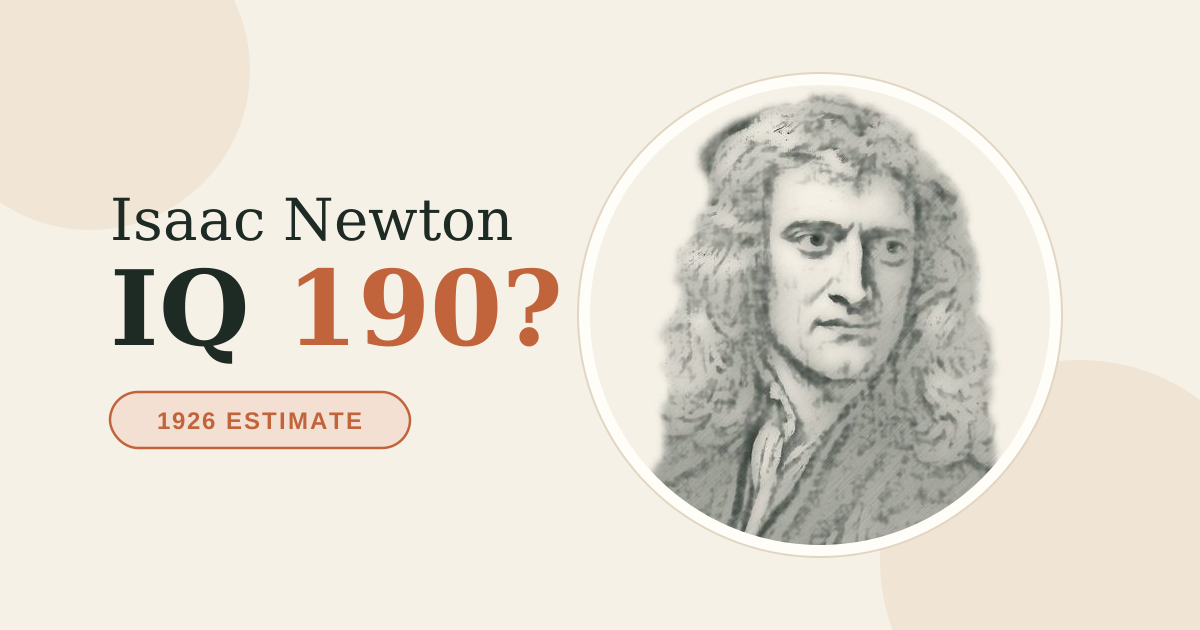
- Cox's IQ estimates (8 presidents). In 1926 the psychologist Catharine Cox, working with Lewis Terman at Stanford, estimated the IQ of 301 eminent people from detailed records of what they had achieved and at what age. Washington, John Adams, Jefferson, Madison, John Quincy Adams, Jackson, Lincoln and Grant were famous enough to be included. Each got four estimates: childhood up to 17 and ages 17 to 26, each raw and corrected for how much evidence was available.
- Intellectual Brilliance (39 presidents). Simonton's own 1986 rating, built from personality descriptions in biographies: whether a president came across as having wide interests and as artistic, curious, sophisticated, complicated and insightful. It covered every president from Washington to Reagan.
- Openness to Experience (32 presidents). From a 2004 survey in which presidential biographers rated their subjects on a standard personality questionnaire (Rubenzer and Faschingbauer). Openness takes in curiosity, imagination and willingness to consider new ideas.
The three measures agreed strongly where they overlapped, with correlations from 0.69 to 0.94. That allowed Simonton to fill in each president's missing scores statistically, using a standard method for missing data called expectation maximization. Every president had at least one real score to start from, which is how the study reached all 42.
The result is a set of IQ figures that read like test scores but aren't. Cox worked with the old ratio IQ, mental age divided by real age, which has no fixed spread, and Simonton's table treats the scores as having a standard deviation of 16, a little wider than the 15 most tests use today. Our IQ standard deviation guide explains why that difference matters at the top of the scale.
How far to trust the numbers
Simonton was candid about the limits, and they are worth keeping in mind before quoting any figure from the table:
- 34 of the 42 IQ figures are calculated, not rated. He described the IQ scores as "more tentative and approximate" than the other two measures, because they needed the most filling in. Calculated values also tend to drift towards the middle, so the real spread among presidents is probably wider.
- The corrected estimates may run high. Cox's correction raises scores for people with thin records, and Simonton cautioned that the corrected figures "might be too high". The uncorrected columns are the more conservative reading.
- Some ratings rest on little evidence. George W. Bush's figures were calculated from one score, his Openness rating, which the survey's authors at first had to make themselves because none of the biographers they asked returned the questionnaire. They warned that "greater caution is called for" in reading it.
- The measures are not partisan. Simonton tested whether Democratic and Republican presidents differed and found no difference in expected intelligence on any of the six measures.
The fair way to read the table, then, is as a rough ordering with wide margins. Gaps of a few points between neighbours mean nothing; the difference between the top and bottom of the list probably means something. Every famous IQ figure deserves the same caution; our famous people IQ guide traces many more of them.
Do presidents with higher IQs do a better job?
A little. Simonton compared each measure with a composite of 12 expert rankings of presidential greatness, from Arthur Schlesinger's 1948 survey to a C-SPAN survey in 2000. The four IQ estimates correlated only 0.31 to 0.35 with greatness, about 10% of the differences between presidents. Intellectual Brilliance did noticeably better, at 0.56.
In a 2018 review of the same data, Simonton went further. Once the other known predictors of a president's reputation were taken into account (years in office, years at war, assassination, scandals and being a war hero), Intellectual Brilliance still made a significant difference, but none of the IQ estimates did. The title of the review sums up the finding: pure intelligence doesn't suffice. In the 2006 paper he had also noted an awkward side effect for candidates: highly intelligent presidents are much less likely to have won their elections by a landslide.
Research outside politics points the same way. A study of 379 mid-level business leaders found that how effective their colleagues judged them rose with IQ only up to about 120 and then fell; our IQ 118 page looks at that "too smart to lead" effect.
The fake presidential IQ list
Many of the presidential IQ numbers you'll find online come not from Simonton but from a hoax. In the summer of 2001 an article began circulating that credited a "Lovenstein Institute" of Scranton, Pennsylvania, with measuring the IQ of every president from Franklin D. Roosevelt to George W. Bush. It put Bill Clinton at 182 and Bush at 91. According to Snopes, the institute and the people quoted never existed, and pranksters later registered a website in its name to make the story look real.
| President | Hoax "IQ" | Simonton's average estimate |
|---|---|---|
| Franklin D. Roosevelt | 147 | 139.6 |
| John F. Kennedy | 174 | 150.7 |
| Richard Nixon | 155 | 131.0 |
| Jimmy Carter | 175 | 145.1 |
| Ronald Reagan | 105 | 130.0 |
| George H. W. Bush | 98 | 130.1 |
| Bill Clinton | 182 | 148.8 |
| George W. Bush | 91 | 124.9 |
Hoax figures as quoted by Snopes, a selection of the 12 presidents it listed. Simonton's averages from his 2006 study.
The giveaway, as Snopes noted, is the politics: the hoax's six Democrats averaged 156 and its six Republicans 115.5, and Clinton's score was exactly double Bush's. Real estimates show nothing of the kind. In his 2018 review, Simonton recalled that publishing his own figures, which put Bush well above average but near the bottom of the presidents, drew "vicious attacks" from people who thought the estimate too high and others who thought it too low.
Obama, Trump and Biden: what is known
Simonton's study ends with George W. Bush, and we found no comparable published estimate for later presidents. What does exist is easily misread:
- Donald Trump. In January 2018 the White House physician, Ronny Jackson, said Trump had scored 30 out of 30 on the Montreal Cognitive Assessment, a test he asked to take (CBS News). The MoCA is a 10-minute, 30-point screen designed to detect mild cognitive impairment (Nasreddine and others, 2005). A full score means no sign of impairment; it says nothing about IQ.
- Joe Biden. No IQ score has been published. A 2024 claim that the White House had announced an IQ of 187 was false (Snopes). The IQ remark people remember is from 1987, when Biden told a voter in New Hampshire, "I think I probably have a much higher IQ than you do", while describing an academic record that turned out to be overstated.
- Barack Obama. No IQ test result or historiometric estimate has been published, so any figure you see is a guess.
That leaves the honest answer for every recent president the same as for Washington: we don't know their IQ, and the best evidence about their minds is what they did. For a sense of what the numbers in this article mean, our IQ scale shows every score range, and the highest IQ in the world looks at how far the scale really goes.
Frequently asked questions
Which US president had the highest IQ?
John Quincy Adams, the sixth president, has the highest IQ estimate of any president: four estimates from 165 to 175, an average of 168.8. They come from the psychologist Catharine Cox, who rated his early intellectual development from biographical records in 1926. Thomas Jefferson is second, at 145 to 160. Neither man ever took an IQ test.
Who was the smartest president of the United States?
It depends on the measure. John Quincy Adams has the highest IQ estimate, but Thomas Jefferson has by far the highest score for Intellectual Brilliance, a rating of curiosity, breadth and insight drawn from biographies, at 3.1 standard deviations above the presidential average. John F. Kennedy is second on that measure. Intellectual Brilliance is also the measure that best predicts how historians rate a presidency.
Has any US president taken an IQ test?
No president has released an official IQ score, and taking one is not part of running for office. Every number on this page is an estimate from historical records. Claims of measured scores for presidents do circulate online, but we found none with a source we could check.
What is Bill Clinton's IQ?
No IQ test score has been published. In Dean Keith Simonton's 2006 estimates, Clinton's four figures run from 135.6 to 159.0, an average of 148.8, fourth of the 42 presidents studied. Simonton pointed to his record as a Rhodes Scholar and Yale Law School graduate. The often-quoted 182 comes from a 2001 hoax.
What was John F. Kennedy's IQ?
There is no published test score. Simonton's estimates for Kennedy run from 138.9 to 159.8, an average of 150.7, third among the 42 presidents in the study. His figures were calculated from other measures rather than rated directly, so they are among the more tentative ones.
What was Abraham Lincoln's IQ?
Lincoln is one of eight presidents whose IQ Catharine Cox rated herself, working from accounts of his boyhood and youth. Her four estimates run from 125 to 150, an average of 140. He never took an IQ test, which did not exist in his lifetime.
Which president had the lowest IQ?
On the average of Simonton's four estimates, Ulysses S. Grant is lowest at 120, followed by James Monroe and Warren G. Harding at about 124. Harding has the single lowest estimate, 107.8, and the lowest Intellectual Brilliance rating of any president. Even these figures are above the population average of 100.
What is Joe Biden's IQ?
It is not known. No IQ score for Biden has been published, and a 2024 social media claim that the White House announced an IQ of 187 was false, according to Snopes. In 1987 Biden told a voter, "I think I probably have a much higher IQ than you do", while making claims about his academic record that turned out to be inaccurate.
What did Donald Trump score on his cognitive test?
In January 2018 the White House physician, Ronny Jackson, said Trump scored 30 out of 30 on the Montreal Cognitive Assessment (MoCA). The MoCA is a 10-minute screening test for mild cognitive impairment and dementia, not an IQ test, so a full score shows no sign of impairment rather than a level of intelligence.
Is the list showing Clinton at 182 and George W. Bush at 91 real?
No. It comes from a 2001 internet hoax that credited a "Lovenstein Institute" in Scranton, Pennsylvania. Snopes found that the institute and the researchers quoted do not exist. Simonton's later estimates put George W. Bush's average at about 125, nowhere near 91.
Do presidents with higher IQs do a better job?
Somewhat, but IQ is a weak predictor. In Simonton's data, the IQ estimates correlated about 0.31 to 0.35 with historians' ratings of presidential performance, while Intellectual Brilliance correlated 0.56. When other factors such as years in office, war and scandal were taken into account, only Intellectual Brilliance still made a significant difference.
Sources
- Simonton, D. K. (2006). Presidential IQ, openness, intellectual brilliance, and leadership: estimates and correlations for 42 U.S. chief executives. Political Psychology, 27(4), 511–526. Table 1 is the source of every estimate on this page.
- Simonton, D. K. (2018). Intellectual brilliance and presidential performance: why pure intelligence (or openness) doesn't suffice. Journal of Intelligence, 6(2), 18.
- Cox, C. M. (1926). Genetic Studies of Genius, Vol. II: The Early Mental Traits of Three Hundred Geniuses. Stanford University Press.
- Rubenzer, S. J. and Faschingbauer, T. R. (2004). Personality, Character, and Leadership in the White House: Psychologists Assess the Presidents. Brassey's.
- Mikkelson, D. (2001). Presidential IQ hoax, Snopes.
- Did the White House say Biden's IQ is 187?, Snopes (2024), including the 1987 remark.
- Welch, A. (2018). White House doctor: "No concerns" about Trump's cognitive health, CBS News.
- Nasreddine, Z. S. and others (2005). The Montreal Cognitive Assessment, MoCA: a brief screening tool for mild cognitive impairment. Journal of the American Geriatrics Society, 53(4), 695–699.
- List of presidents of the United States, Wikipedia: years in office.
How would your own score compare?
No historian needed: our free test puts your own reasoning on the same IQ scale in 25 minutes, with your estimated score and percentile at the end.
Take the free IQ test