In short: to choose a career, start with what you enjoy doing, then check which of those careers fit your abilities, personality and values. Look up the training, pay and job outlook for each one, and try the work in a small way before you commit. A free career test turns your interests into a shortlist in about ten minutes.
How to choose the right career in 6 steps
Choosing a career feels like one huge decision, but it is easier as a series of small ones. Each step narrows the field, so by the end you are comparing two or three careers instead of staring at thousands. Work through them in order the first time; later you can come back to any step.
- STEP 1Know your interestsThe kinds of work you enjoy, summed up in your Holland code.
- STEP 2Match your abilitiesWhat you're good at, and what each job asks of you.
- STEP 3Fit your personalityHow you like to work: pace, people, structure.
- STEP 4Weigh money and meaningWhat you need a career to pay, and what it must respect.
- STEP 5Check the factsTraining needed, typical pay and job outlook.
- STEP 6Try it, then decideTalk to people, shadow, volunteer, compare your shortlist.
Step 1: Start with your interests
Interests are a good place to start because they are about the work itself, and they can be measured. A review of more than 60 years of research found that interests are related to how well people perform and how long they persist, at work and in study, and that the fit between a person's interests and their job predicted performance better than interest scores alone (Nye and others, 2012). A separate meta-analysis of 74 studies found that interests relevant to the job were linked to better performance and to people being less likely to leave (Van Iddekinge and others, 2011).
What are Holland codes?
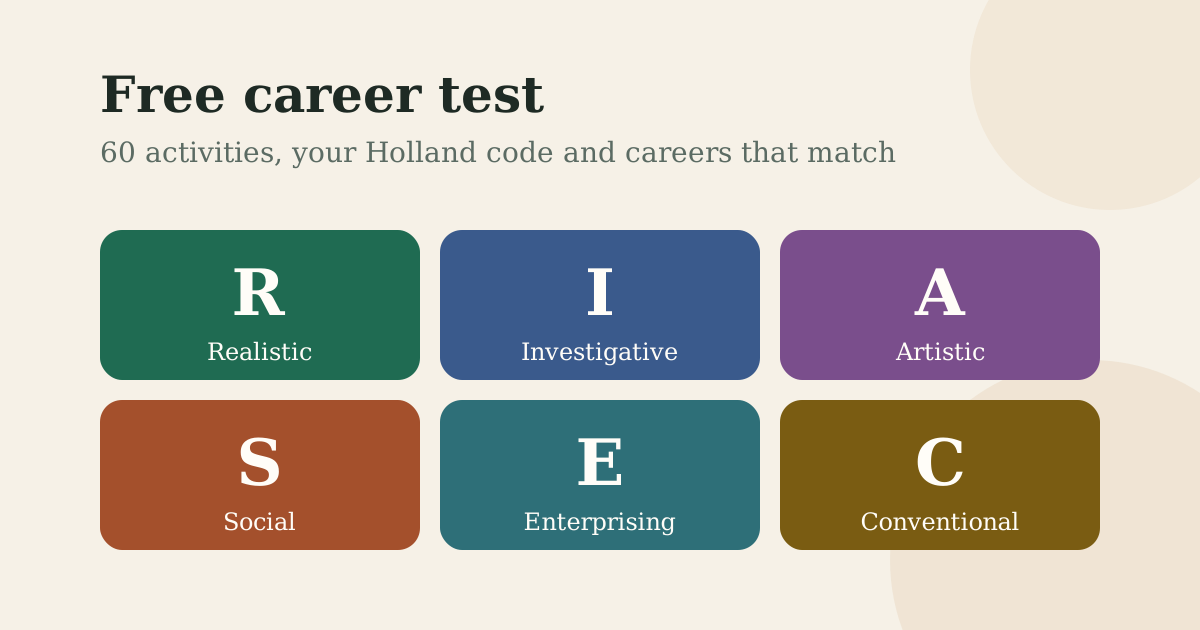
The most widely used way to describe work interests comes from the psychologist John Holland, who sorted them into six types, known by their initials as RIASEC. Your Holland code is your two or three strongest types, for example "SA" or "IRC". The US Department of Labor's O*NET database codes every occupation the same way, which is what makes matching possible: if your code is "IA", careers whose strongest types are Investigative and Artistic are worth a look. Our career test page describes the six interest areas in detail.
To see how wide each type is, here are example careers whose strongest interest is that type, at three levels of preparation. Pay is the US median for the occupation.
| Type | Medium preparation | Considerable (often a degree) | Extensive (often graduate school) |
|---|---|---|---|
| R: Realistic | Maintenance and repair worker$49,590 | Civil engineer$100,840 | Veterinarian$130,100 |
| I: Investigative | Computer systems analyst$105,850 | Software developer$135,980 | Nurse practitioner$132,300 |
| A: Artistic | Camera operator$74,990 | Graphic designer$62,960 | Set and exhibit designer$75,240 |
| S: Social | Nursing assistant$42,260 | Registered nurse$97,550 | Mental health counselor$60,320 |
| E: Enterprising | Construction supervisor$79,920 | General and operations manager$105,770 | Lawyer$159,670 |
| C: Conventional | Bookkeeping clerk$50,670 | Accountant or auditor$83,680 | Librarian$68,270 |
Interest codes and preparation levels (O*NET Job Zones 3 to 5) from O*NET 30.1; median annual wage, 2025, from the BLS Employment Projections.
Notice that every type includes careers at every level of training. Your interests point you to a kind of work; how far you want to train decides which job within it.
Step 2: Match your abilities and skills
Interest tells you what you would enjoy; ability tells you what you could do well. Make an honest list of your strengths from three sources: subjects or tasks that came easily, things other people ask you for help with, and what your results, reports or feedback have said. Then, for each career on your shortlist, look at the tasks and skills it lists in O*NET and ask whether you have them or could learn them.
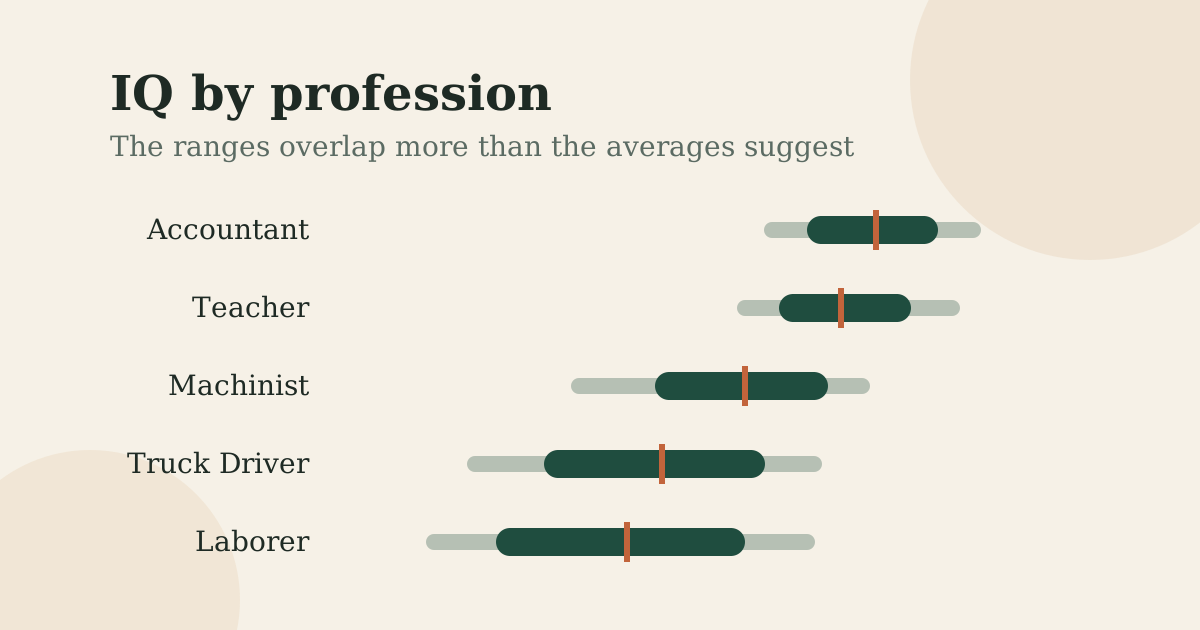
Reasoning ability matters more in some jobs than others. Our guide to IQ by profession shows the range of test scores in different occupations, and how wide that range is within every job, so a score is never a reason to rule a career out. If you're curious where you stand, our free IQ test estimates your reasoning across four areas. Skills, unlike abilities, can be learned, so a gap in skills is a training question, not a verdict.
Step 3: Fit your personality
Two people with the same interests can thrive in very different jobs because of personality. Someone outgoing may enjoy a sales or teaching role in a field they love, while someone more reserved may prefer research or behind-the-scenes work in the same field. Ask yourself:
- Do I get energy from working with people, or do I prefer long stretches on my own?
- Do I like clear structure and routine, or freedom and variety?
- How do I handle pressure, deadlines and conflict?
- Do I want to lead, or to be the expert others rely on?
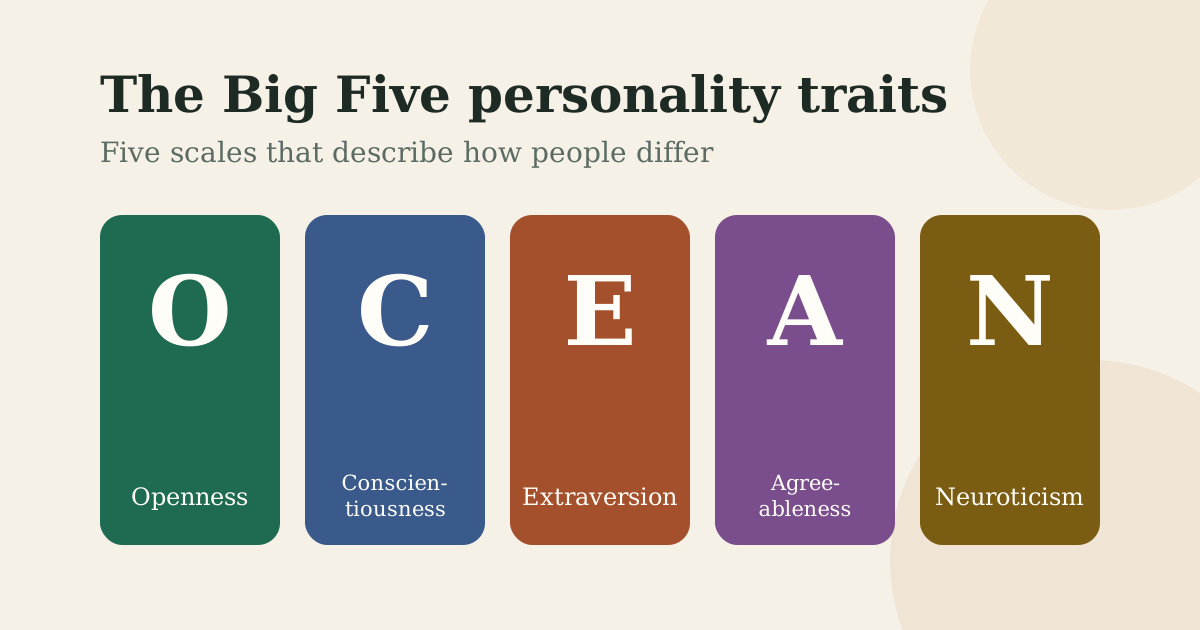
The Big Five personality traits give a research-based language for these questions, and our guide explains what each trait does and doesn't predict at work. Our free Big Five personality test measures all five in about ten minutes. Use your personality to choose the kind of role and workplace within a field, rather than the field itself.
Step 4: Money or passion? What the research says
This is the question people argue about most, and the evidence suggests a middle path. A meta-analysis of 92 samples found that pay level was only weakly linked to job satisfaction, with a correlation of .15, and more strongly linked to satisfaction with pay itself, at .23 (Judge and others, 2010). In plain terms, higher-paid people are not much more satisfied with their work. Meanwhile, as step 1 showed, people whose interests fit their job tend to perform better and stay longer.
So choose a career that fits your interests, then make sure it pays enough for the life you want. A popular way to picture this is three overlapping circles:
- What you enjoyYour interests and the tasks you'd happily do on an ordinary Tuesday.
- What you're good atYour abilities and the skills you have or can build.
- What the world pays forCareers with enough openings and pay for your needs.
Careers in the middle, where all three overlap, are the ones to put on your shortlist. Add your values as a final filter: helping people, independence, security, creativity, status, location or time with family. A career that breaks a value you care about will rarely feel right, however well it pays.
Step 5: Check the facts: training, pay and job outlook
Before you fall for a career, check three facts about it. The US Department of Labor's O*NET database and the Bureau of Labor Statistics (BLS) publish them free for every occupation.
- Training. O*NET puts every occupation in one of five "Job Zones", from little or no preparation needed to extensive preparation, where most occupations require graduate school (O*NET Job Zones). Ask how many years each option needs and whether you can afford them.
- Pay. The median annual wage across all US occupations was $50,980 in 2025. Compare each career's median with what you need, remembering that pay is often lower at the start of a career and varies by place.
- Job outlook. BLS projects employment across all occupations to grow by 3.5% between 2025 and 2035. Careers growing much faster than that will have more openings; shrinking ones will have fewer.
For a sense of where growth is concentrated, these are the ten fastest-growing occupations in the BLS projections. Several are in healthcare and clean energy.
| Occupation | Projected growth, 2025 to 2035 | Median pay, 2025 |
|---|---|---|
| Nurse practitioners | 41.0% | $132,300 |
| Solar photovoltaic installers | 36.5% | $53,140 |
| Data scientists | 34.6% | $120,230 |
| Wind turbine service technicians | 29.5% | $64,120 |
| Medical and health services managers | 24.2% | $123,860 |
| Physical therapist assistants | 23.0% | $68,380 |
| Psychiatric technicians | 22.3% | $45,130 |
| Computer and information research scientists | 21.8% | $140,300 |
| Occupational therapy assistants | 21.5% | $72,300 |
| Ophthalmic medical technicians | 21.4% | $45,570 |
Source: BLS Employment Projections, fastest growing occupations, 2025 to 2035. Fast growth in a small occupation can still mean few openings.
Your career test result lists pay for every career it suggests, and the full report adds projected growth and the study programmes that lead to each one.
Step 6: Try a career before you commit
Reading about a job is no substitute for seeing it. Before you invest years of training, test your top choices in small, cheap ways:
- Talk to someone who does it. A 20-minute conversation, often called an informational interview, tells you what the day really involves, what people wish they had known and how they got in. Many people are glad to talk about their work if you ask politely and keep it short.
- Shadow for a day. Watching someone work shows you the pace, the setting and the parts nobody mentions in job adverts.
- Volunteer or work part-time in a related setting: a clinic, a school, a workshop, a studio or an office.
- Take a short course or a free online introduction to the subject. If you enjoy learning it, that is a good sign.
- Do a small project. Build, write, design, organise or sell something. Doing a sample of the real work is the most honest test of all.
After each experiment, note what energised you and what drained you. Those notes are worth more than any ranking.
Compare your shortlist
When you are down to two or three careers, compare them on the same points. Write in the careers you're considering, rate each from 1 to 5, and set how much each point matters to you. The scores update as you go. Your answers stay in this browser; nothing is sent anywhere.
Not sure how to rate interest fit? Your career test result shows how well careers match your interests.
A score is a way to make your thinking visible, not an answer. If two careers come out close, that is useful too: it means either could work, and a small real-world try (step 6) should decide it.
What if you don't know what you want?
This is the most common situation, not a failure. A few patterns come up again and again:
You have no idea where to start
Drop job titles for now and think in activities. Over a week, notice which tasks make time pass quickly and which you put off, at school, at work, in hobbies or helping friends. Then take an interest test that asks you to rate work activities rather than jobs; it turns those likes into a list of careers you may never have heard of.
You like everything, or have many interests
Look for what your interests have in common. Someone who loves biology, drawing and explaining things might enjoy medical illustration or science teaching. Careers that combine two of your strongest Holland types are a good place to look, and many people build a career that mixes several interests over time.
Nothing interests you
Feeling that nothing appeals can come from your circumstances rather than a lack of interests: exams, burnout, low mood or simply not having tried much yet. Start with small experiments instead of a big decision, and if you feel persistently flat or hopeless, talk to a doctor or counsellor, because that is worth looking after first.
You're afraid of choosing wrong
Almost no career choice is final. Americans born between 1957 and 1964 held an average of 12.9 jobs between the ages of 18 and 58 (BLS, 2025). Choose a good next step that keeps options open, learn from it, and adjust.
Choosing a career after high school, in college and later in life
After high school
Interests are still settling in the teenage years and become much more stable during the college years, around 18 to 21, staying fairly steady for the next two decades (Low and others, 2005). So at this stage, choose a direction rather than a destination: a course, apprenticeship or job that fits your current interests and keeps several careers open. If you are going to college, our college major quiz turns your interests into a shortlist of majors. Taking an interest test now and again a year or two later shows you which interests are lasting.
In college or after graduation
Your degree narrows the field less than it seems: many careers accept graduates from a range of subjects. Use internships, part-time work and your college's career service to test options, and talk to graduates from your course about where they ended up. If your interests have moved away from your subject, a conversion course or a first job in a related field can bridge the gap.
Changing career at 30, 40 or 50
Later in life you choose with more self-knowledge and more experience, but also more commitments. List the skills from your current work that transfer, such as managing people, handling money, teaching or technical know-how, and look for careers where they count. Check each option's training time and pay carefully, and try to test it part-time or through a short course before you leave your current job.
Helping your child choose a career
The most useful thing a parent can do is widen the options, not pick one. Encourage your child to try different activities, help them meet people in different jobs, and let them take an interest test and talk through the results with you. Be open about money and training costs, but let their interests lead.
Common mistakes to avoid
- Choosing on salary alone. Pay matters, but on its own it has little to do with how satisfied people are at work.
- Following other people's plans. Family and friends mean well, but they won't be doing the job every day.
- Judging a career by its image. TV and social media show the exciting moments, not the ordinary days. Talk to people who do the work.
- Ignoring training time and cost. Some careers need many years of study. Know the path before you start.
- Waiting for certainty. You will never have perfect information. A good, reversible next step beats years of indecision.
Frequently asked questions
How do I choose the right career?
Start with what you enjoy doing: interests are linked to how well people do and how long they stay in a job, and they change less over the years than personality does. Then check which of those careers fit your abilities, personality and values, look up the training, pay and job outlook, and try the work through a conversation, a day of shadowing or a short course before you commit.
How do I know what career is best for me?
No test can name one best career, but you can narrow the field. A career that matches your interests, uses your strengths and fits your values is usually a good fit. A free interest test gives you a shortlist; comparing that shortlist on pay, outlook and training, and trying the work, does the rest.
What should I do if I have no idea what career I want?
Stop trying to pick a job title and start with activities: which tasks do you enjoy, at school, at work or in your free time? An interest test that asks you to rate work activities can turn those likes into a list of careers to look into. Then try two or three of them in small ways.
Should I choose a career for money or passion?
Ideally neither alone. Research finds that pay is only weakly linked to how satisfied people are with their jobs, while people whose interests fit their work tend to perform better and are less likely to quit. Choose work that fits your interests, then check that it pays enough for the life you want.
Is it too late to choose a new career at 30, 40 or 50?
No. Changing jobs is normal: Americans born between 1957 and 1964 held an average of 12.9 jobs between the ages of 18 and 58. Later in life you have more experience to draw on, so look for careers where your existing skills count, and check how much retraining each option needs.
Can a test tell me what career to choose?
A good interest test can suggest careers that fit what you enjoy, which is a strong starting point. It cannot weigh your circumstances, your values or the jobs available where you live, so treat the result as a shortlist to explore, not a decision.
How do I choose a career after high school?
Use the time to explore rather than to decide forever. Interests settle down a lot during the late teens and early twenties, so take an interest test, try part-time work or volunteering in fields that appeal to you, and choose a next step, such as a course, an apprenticeship or a job, that keeps several doors open.
How do I find my career passion?
Rather than waiting for a passion to appear, follow your curiosity. Notice which activities you lose track of time doing, try more of them, and look for careers built around those activities. Give a promising option a fair try before deciding it is not for you.
How do I choose between two careers?
Compare them on the same points: how much you would enjoy the daily tasks, how well they use your strengths, pay, job outlook, training time and fit with your values, weighted by what matters most to you. Our shortlist scorer does this for up to three careers. If they are still close, try both in a small way before deciding.
Sources
- Nye, C. D., Su, R., Rounds, J. and Drasgow, F. (2012). Vocational interests and performance: a quantitative summary of over 60 years of research. Perspectives on Psychological Science, 7(4), 384–403.
- Van Iddekinge, C. H., Roth, P. L., Putka, D. J. and Lanivich, S. E. (2011). Are you interested? A meta-analysis of relations between vocational interests and employee performance and turnover. Journal of Applied Psychology, 96(6), 1167–1194.
- Judge, T. A., Piccolo, R. F., Podsakoff, N. P., Shaw, J. C. and Rich, B. L. (2010). The relationship between pay and job satisfaction: a meta-analysis of the literature. Journal of Vocational Behavior, 77(2), 157–167.
- Low, K. S. D., Yoon, M., Roberts, B. W. and Rounds, J. (2005). The stability of vocational interests from early adolescence to middle adulthood: a quantitative review of longitudinal studies. Psychological Bulletin, 131(5), 713–737.
- U.S. Bureau of Labor Statistics (2025). Number of jobs, labor market experience, marital status, and health: results from a national longitudinal survey. News release, 26 August 2025.
- U.S. Bureau of Labor Statistics. Employment Projections 2025 to 2035: fastest growing occupations, occupational projections and median wages.
- National Center for O*NET Development. Job Zones and the O*NET 30.1 database (USDOL/ETA, CC BY 4.0). O*NET® is a trademark of USDOL/ETA; this page is not endorsed by them.
Start with what you enjoy
Rate 60 everyday work activities and get your Holland code with matching careers and pay. Free, about ten minutes, no sign-up.
Start the test