In short: the Big Five personality traits, also called the Big 5 personality traits or the OCEAN personality traits, are openness to experience, conscientiousness, extraversion, agreeableness and neuroticism. They are the five broad dimensions psychologists use most to describe how people differ. Each trait is a scale, not a box: everyone sits somewhere between low and high on all five, and each trait splits into six narrower facets. You can measure yours with our free Big Five personality test.
What are personality traits?
A personality trait is a lasting tendency to think, feel and behave in a certain way across many situations: being talkative, organised, anxious or trusting, for example. Traits are about what is typical for you, not about one day or one mood. There are thousands of words for traits in English, and the Big Five is the best-supported way of grouping them into a few core personality traits.
What are the Big Five personality traits?
The Big Five personality traits are five broad dimensions of personality: openness to experience, conscientiousness, extraversion, agreeableness and neuroticism. Together these 5 personality traits are called the Big Five or Big 5 personality traits, the Big Five model, the five-factor model of personality (sometimes written as the 5 factor model) or the OCEAN model, after the first letter of each trait. You may also see them called the Big 5 character traits. They describe how people typically think, feel and behave, and they are the model behind most published personality research today.
The Big Five personality traits list
The main characteristics of each trait, in OCEAN order:
There are no Big Five personality types. Three things make the model different from personality "types". First, every trait is a continuum: you are not an extravert or an introvert, you sit at a point on the extraversion scale, and most people sit near the middle on at least some traits. Second, the traits are broadly independent, so knowing someone's extraversion tells you little about their conscientiousness. Third, each trait is made of narrower facets. The widely used IPIP-NEO scoring key lists six per trait, 30 in all, and this guide names them under each trait below.
The opposite of each Big Five trait
Because each trait is a scale, its "opposite" is simply the low end of the same scale, not a separate trait. Only two low ends have everyday names: introversion and emotional stability.
- Openness to experience runs down to low openness: practical and down to earth, prefers the familiar.
- Conscientiousness runs down to low conscientiousness: flexible and spontaneous, keeps options open.
- Extraversion runs down to introversion: reserved, prefers a few close people, recharges alone.
- Agreeableness runs down to low agreeableness: direct, sceptical and competitive.
- Neuroticism runs down to emotional stability: calm and even-tempered, recovers quickly.
Neither end is good or bad in itself. Each section below describes both ends of the trait.
Where the five-factor model comes from
The Big Five was found rather than invented. It grew out of the lexical hypothesis: the idea that the personality differences that matter most to people end up as words in everyday language. Researchers collected thousands of descriptive words, asked people to rate themselves and others on them, and used a statistical method called factor analysis to see which words cluster together. Again and again, the ratings fell into five broad groups.
US Air Force researchers Ernest Tupes and Raymond Christal reported five recurring factors in 1961, and Warren Norman confirmed them in 1963. Lewis Goldberg's work in the 1980s and 1990s made the name "Big Five" standard, and Paul Costa and Robert McCrae built the NEO questionnaires that measure what they called the five-factor model (history of the Big Five). Because the NEO questionnaires are commercial, Goldberg also started the International Personality Item Pool, a free, public-domain library of statements that researchers can use without permission. Our test uses the IPIP-NEO-120 built from it by John A. Johnson (Johnson, 2014).
Openness to experience
Openness to experience describes curiosity, imagination and interest in ideas, art and new experiences. People high in openness tend to enjoy abstract thinking, variety and the unfamiliar; people low in openness tend to be practical and to prefer the proven and familiar.
Curious and imaginative, enjoys new ideas, art and travel, gets bored by routine, comfortable with complexity.
Practical and down to earth, prefers familiar routines and concrete facts, values tradition, wary of change for its own sake.
The six facets of openness:
- Imagination
- Artistic interests
- Emotionality
- Adventurousness
- Intellect
- Liberalism
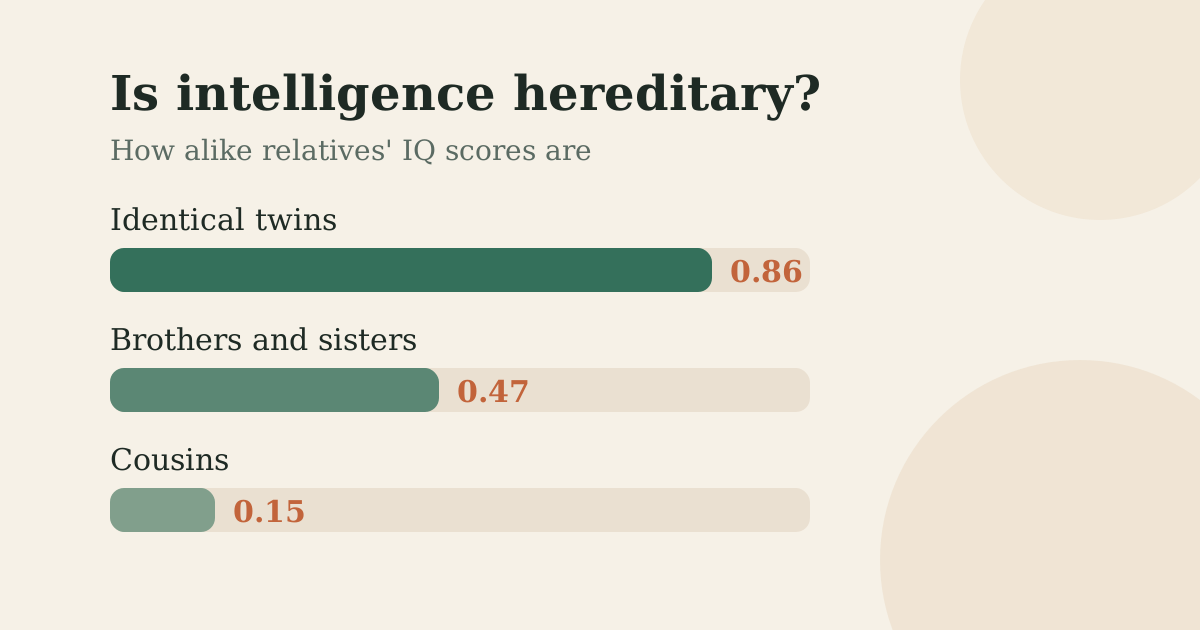
Openness is the trait most closely tied to intellectual curiosity, and its "intellect" facet overlaps a little with interest in learning. It says nothing on its own about intelligence: a curious person is not necessarily a quick reasoner, which is a different question that an IQ test tries to answer.
Conscientiousness
Conscientiousness describes organisation, self-discipline and following through on goals. People high in conscientiousness tend to plan ahead, keep promises and finish what they start; people low in conscientiousness tend to be flexible and spontaneous, and may put things off.
Organised, reliable and goal-driven, plans ahead, keeps promises, thinks before acting.
Flexible and spontaneous, comfortable with mess, keeps options open, may procrastinate or miss details.
The six facets of conscientiousness:
- Self-efficacy
- Orderliness
- Dutifulness
- Achievement-striving
- Self-discipline
- Cautiousness
Of the five traits, conscientiousness has the most consistent link with work. A large review of job studies found it related to performance in every type of job examined, from professionals and managers to sales and skilled work (Barrick and Mount, 1991).
Extraversion
Extraversion describes how much energy you draw from people and activity: sociability, assertiveness and enthusiasm. People high in extraversion tend to enjoy company and speak up easily; people low in extraversion, often called introverts, tend to prefer quiet, small groups and time alone to recharge.
Outgoing and talkative, enjoys crowds and attention, energetic, takes charge in groups, often cheerful.
Reserved and independent, prefers a few close people, recharges alone, listens before speaking.
The six facets of extraversion:
- Friendliness
- Gregariousness
- Assertiveness
- Activity level
- Excitement-seeking
- Cheerfulness
Introversion is not the same as shyness or poor social skills: a low score means you need less social stimulation, not that you are anxious about it (anxiety about social situations sits under neuroticism). In the review of job studies, extraversion helped most in roles built on social contact, such as managers and sales (Barrick and Mount, 1991).
Agreeableness
Agreeableness describes trust, kindness and cooperation. People high in agreeableness tend to be warm, helpful and keen to avoid conflict; people low in agreeableness tend to be direct, sceptical and competitive, and comfortable standing their ground.
Warm and trusting, kind and helpful, avoids arguments, modest, moved by others' problems.
Direct and sceptical, competitive, willing to argue, tough-minded, comfortable saying no.
The six facets of agreeableness:
- Trust
- Morality
- Altruism
- Cooperation
- Modesty
- Sympathy
Neither end is better. High agreeableness helps teams and close relationships; lower agreeableness can help in negotiation, critical review and decisions that disappoint people. Agreeableness is also one of the two traits where women and men differ most on average, as the figures below show.
Neuroticism
Neuroticism describes how strongly and how often you feel negative emotions such as worry, anger, sadness and stress. People high in neuroticism tend to react more strongly to setbacks and pressure; people low in neuroticism, described as emotionally stable, tend to stay calm and recover quickly.
Sensitive to stress, worries often, moods change easily, self-conscious, feels overwhelmed under pressure.
Calm and even-tempered, rarely worried, recovers quickly from setbacks, steady in a crisis.
The six facets of neuroticism:
- Anxiety
- Anger
- Depression
- Self-consciousness
- Immoderation
- Vulnerability
Neuroticism is not a disorder, and a high score is not a diagnosis. It is, though, the trait most strongly linked to mental health: a meta-analysis of 175 studies found people with anxiety, depressive and substance use disorders scored much higher on neuroticism, by an average of 1.65 standard deviations, and lower on conscientiousness (Kotov and others, 2010). If worry or low mood are affecting your life, a doctor or counsellor can help.
How the traits differ by age and sex
We worked out the average scores in the largest public dataset for this questionnaire: 619,150 people who took the IPIP-NEO-120 online between 2001 and 2011, published by its author (Kajonius and Johnson, 2019, CC BY 4.0). Scores are the average answer per statement, on the 1 to 5 scale from "very inaccurate" to "very accurate".
| Group | Openness | Conscientiousness | Extraversion | Agreeableness | Neuroticism |
|---|---|---|---|---|---|
| Everyone | 3.46 | 3.62 | 3.43 | 3.68 | 2.82 |
| Women | 3.50 | 3.65 | 3.44 | 3.79 | 2.92 |
| Men | 3.41 | 3.58 | 3.41 | 3.51 | 2.66 |
| Under 18 | 3.44 | 3.36 | 3.50 | 3.54 | 2.93 |
| 18 to 24 | 3.44 | 3.60 | 3.46 | 3.66 | 2.83 |
| 25 to 34 | 3.52 | 3.71 | 3.37 | 3.70 | 2.81 |
| 35 to 49 | 3.47 | 3.85 | 3.33 | 3.82 | 2.71 |
| 50 and over | 3.49 | 3.95 | 3.31 | 3.92 | 2.57 |
Average answer per statement (1 to 5). Our calculation from the IPIP-NEO-120 data of Johnson (2014); script: tools/big-five-stats.py. Online volunteers, mostly young adults and mostly from the USA, so not a representative population.
Two patterns stand out. Women scored higher than men on agreeableness and neuroticism: the gaps are about half and four tenths of a standard deviation, while the differences on the other three traits are small. Older people scored higher on conscientiousness and agreeableness and lower on neuroticism: compared with 18 to 24 year olds, people aged 50 and over were about six tenths of a standard deviation higher on conscientiousness. Both patterns match what long-term studies find, but these are averages over large groups. The ranges overlap heavily, so your sex or age says little about your own scores.
Is personality genetic or inherited, and can it change?
Personality is partly genetic, so in part inherited. A meta-analysis of 134 behaviour genetic studies found that about 40% of the differences in personality between people are linked to genetic differences and about 60% to environment, with twin studies giving higher estimates (about 47%) than family and adoption studies (about 22%) (Vukasović and Bratko, 2015). As with the heritability of intelligence, that is a statement about differences in a population, not about how much of one person's personality came from their parents.
Personality also changes slowly. A review of 92 long-term studies found that, on average, people become more conscientious, more emotionally stable and more socially confident with age, mostly between 20 and 40, while social vitality and openness rise in adolescence and dip in old age (Roberts, Walton and Viechtbauer, 2006). Retaking a Big Five test after a few years and seeing different scores is normal.
What the Big Five predicts
Big Five scores relate to real outcomes, though each link is modest on its own. In 2019, a large replication project re-tested 78 published links between the five traits and life outcomes, from wellbeing and relationships to health and work, in samples of more than 6,000 adults. The replications reproduced the original findings about 85% of the time, although the effects were often smaller than first reported (Soto, 2019; summary by the Association for Psychological Science).
- Work: conscientiousness predicts job performance across occupations; extraversion helps in people-facing roles (Barrick and Mount, 1991). Biographers' openness ratings of US presidents even became one input to published IQ estimates for every president.
- Leadership: a review of 73 samples found all five traits except agreeableness linked to leadership. Extraversion was the strongest and most consistent (a correlation of .31), followed by conscientiousness (.28), openness (.24) and low neuroticism (-.24). Together the five traits correlated .48 with leadership, counting both who becomes a leader and how well they lead (Judge and others, 2002).
- Emotional intelligence: questionnaires that ask people to rate their own emotional intelligence overlap heavily with personality. A meta-analysis of 142 data sources found a correlation of about .85 with the factor the five traits share, close enough that the authors called the two perhaps synonymous (van der Linden and others, 2017). Our guide to IQ vs EQ explains how that differs from emotional intelligence tested as a skill, which is how our free EQ test works: you pick the best response in everyday situations instead of rating yourself. The main professional tests of both kinds are compared in emotional intelligence tests compared.
- Mental health: high neuroticism and low conscientiousness are linked to anxiety, depressive and substance use disorders (Kotov and others, 2010).
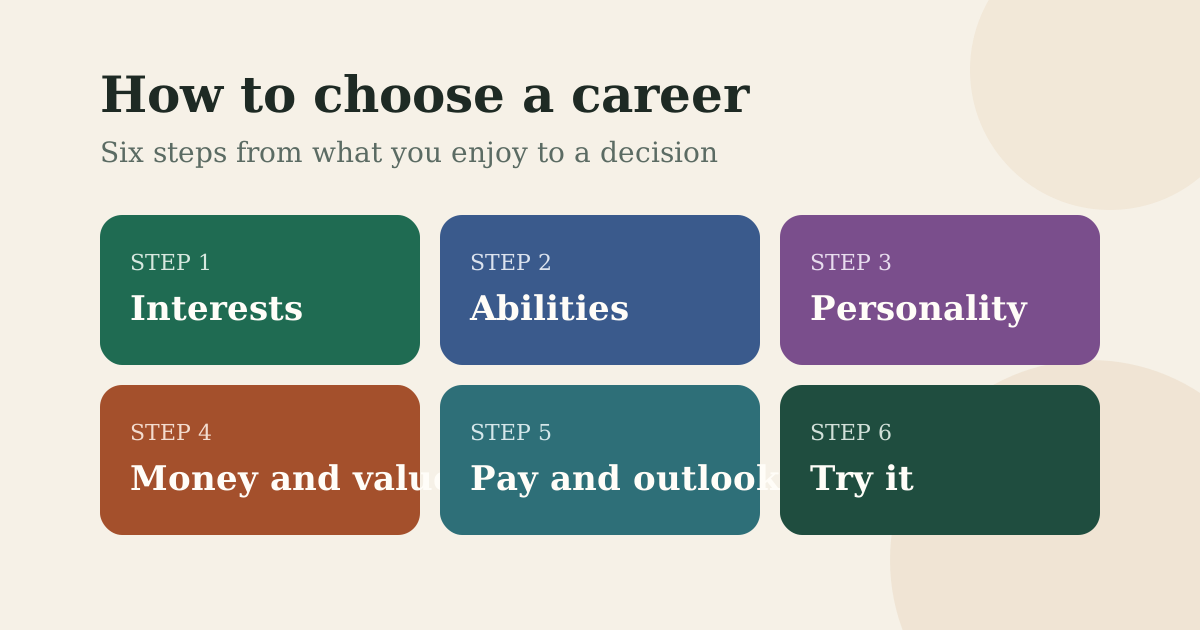
- Limits: traits describe tendencies across many situations. They cannot predict what one person will do on a given day, and they are no substitute for skills, interests or circumstances. For interests, try our free career test, and for putting interests, abilities and personality together, see our guide on how to choose a career.
Criticisms and alternatives
The Big Five is the most widely used personality model, but researchers point to three limits. It is descriptive: it says how traits cluster, not why people differ. It usually relies on self-report, so results depend on honest answers and self-knowledge. And some argue five is not quite enough: the HEXACO model adds a sixth trait, honesty-humility, covering sincerity, fairness and modesty (HEXACO model; Ashton and Lee, 2007).
Are the Big Five traits the same in every culture?
Mostly, but not everywhere. In a study across 50 cultures, students rated 11,985 people they knew well, and the same five-trait structure appeared clearly in most cultures and was recognisable in all of them. The sex differences were also similar, though largest in Western cultures (McCrae and Terracciano, 2005). The clearest exception is a study of 632 Tsimane forager-farmers in the Bolivian Amazon, where the authors "failed to find robust support" for five factors and found two broad ones instead, centred on helping others and on productive work (Gurven and others, 2013).
Is the Big Five a theory?
Strictly, the Big Five is a model: a map of how personality traits group together, found in the data rather than predicted by a theory. People often say "Big Five theory" or "big five trait theory" for it, and it belongs to the trait approach to personality, which describes people by lasting dispositions. Robert McCrae and Paul Costa later proposed five-factor theory, an attempt to explain the model: it treats the five traits as basic tendencies with a biological basis, which shape the habits, attitudes and roles people develop over their lives (overview).
Popular type systems such as MBTI-style 16-type tests are a different approach: they sort people into categories rather than measuring scales. Researchers prefer the Big Five because most people fall in the middle on at least some traits, where a type system has to push them to one side. Our test page has a side-by-side comparison of the Big Five and MBTI. The older Type A and Type B labels have the same problem, and the large studies behind them failed: see our guide to Type A vs Type B personality.
How to find your Big Five traits
The only way to find your own scores is to answer a Big Five questionnaire. Three options:
- Online, free: our Big Five personality test uses the 120 IPIP-NEO-120 statements, takes about 10 minutes and shows your five traits and 30 facets compared with 619,150 people, by sex and age group, with no sign-up.
- On paper: print the Big Five personality test questions as a free PDF and score it by hand with the key.
- With a professional: psychologists can use commercial questionnaires such as the NEO PI-R, with professional interpretation.
FAQ
What are the Big Five personality traits?
The Big Five personality traits are openness to experience, conscientiousness, extraversion, agreeableness and neuroticism, often remembered as OCEAN. They are five broad dimensions that describe how people differ in their typical thoughts, feelings and behaviour. Everyone has some of each trait: the model describes where you sit on each scale rather than sorting you into a type.
What does OCEAN stand for in psychology?
In personality psychology, OCEAN is a memory aid for the five traits of the five-factor model: Openness to experience, Conscientiousness, Extraversion, Agreeableness and Neuroticism. Some textbooks reorder the letters as CANOE; the traits are the same.
Is the five-factor model the same as the Big Five?
In everyday use, yes. "Big Five" usually refers to the five traits found when researchers studied the words people use to describe personality, while "five-factor model" is the name Paul Costa and Robert McCrae used for their version of the same structure, measured by the NEO questionnaires. Both describe the same five broad traits.
Which Big Five trait is the most important?
None is best overall: each trait helps in some situations and gets in the way in others. Conscientiousness has the most consistent link with job performance, across every type of job in a large review (Barrick and Mount, 1991). High neuroticism is the trait most strongly linked to anxiety and depressive disorders (Kotov and others, 2010).
Do men and women differ on the Big Five?
On average, a little. In Johnson's sample of 619,150 people, women scored higher than men on agreeableness and neuroticism, with smaller differences on the other three traits. These are averages: the ranges of men and women overlap heavily, so a person's sex says little about their own scores.
What is the opposite of each Big Five trait?
Each trait is a scale, so its opposite is the low end of the same scale. The low end of extraversion is introversion and the low end of neuroticism is emotional stability. The other three have no everyday names: low openness means practical and conventional, low conscientiousness flexible and spontaneous, and low agreeableness direct and competitive.
Which Big Five traits make a good leader?
In a review of 73 samples, extraversion was the trait most consistently linked to leadership, followed by conscientiousness, openness and low neuroticism. Agreeableness had almost no link. Together the five traits correlated .48 with leadership.
Are the Big Five the same in every culture?
Largely. A study across 50 cultures found the same five traits in most of them. But a study of the Tsimane, forager-farmers in Bolivia, found two broad traits instead of five, so the model is not universal.
Who created the Big Five personality model?
No single person. US Air Force researchers Ernest Tupes and Raymond Christal reported five recurring factors in 1961, Warren Norman confirmed them in 1963, Lewis Goldberg made the name "Big Five" standard, and Paul Costa and Robert McCrae built the NEO questionnaires that measure them.
How can I find out my Big Five personality traits?
Take a Big Five personality test. The free Assessivo test uses the 120 public-domain statements of the IPIP-NEO-120, takes about 10 minutes and shows your five traits and 30 facets compared with 619,150 people, with no sign-up. You can also print the questionnaire and score it by hand.
Sources
- Judge, T. A., Bono, J. E., Ilies, R. and Gerhardt, M. W. (2002). Personality and leadership: a qualitative and quantitative review. Journal of Applied Psychology, 87(4), 765–780.
- McCrae, R. R. and Terracciano, A. (2005). Universal features of personality traits from the observer's perspective: data from 50 cultures. Journal of Personality and Social Psychology, 88(3), 547–561.
- Gurven, M., von Rueden, C., Massenkoff, M., Kaplan, H. and Lero Vie, M. (2013). How universal is the Big Five? Testing the five-factor model of personality variation among forager-farmers in the Bolivian Amazon. Journal of Personality and Social Psychology, 104(2), 354–370.
- Johnson, J. A. (2014). Measuring thirty facets of the Five Factor Model with a 120-item public domain inventory: Development of the IPIP-NEO-120. Journal of Research in Personality, 51, 78–89.
- Kajonius, P. J., and Johnson, J. A. (2019). Supplementary materials: IPIP-NEO-120 data. PsychArchives, CC BY 4.0.
- Goldberg, L. R. and others. International Personality Item Pool.
- Barrick, M. R., and Mount, M. K. (1991). The Big Five personality dimensions and job performance: a meta-analysis. Personnel Psychology, 44, 1–26.
- Kotov, R., Gamez, W., Schmidt, F., and Watson, D. (2010). Linking "big" personality traits to anxiety, depressive, and substance use disorders: a meta-analysis. Psychological Bulletin, 136(5), 768–821.
- Vukasović, T., and Bratko, D. (2015). Heritability of personality: a meta-analysis of behavior genetic studies. Psychological Bulletin, 141(4), 769–785.
- Roberts, B. W., Walton, K. E., and Viechtbauer, W. (2006). Patterns of mean-level change in personality traits across the life course. Psychological Bulletin, 132(1), 1–25.
- Soto, C. J. (2019). How replicable are links between personality traits and consequential life outcomes? The Life Outcomes of Personality Replication Project. Psychological Science, 30(5), 711–727.
- Ashton, M. C., and Lee, K. (2007). Empirical, theoretical, and practical advantages of the HEXACO model of personality structure. Personality and Social Psychology Review, 11(2), 150–166.
Find out where you sit
Reading about the traits is one thing. The free Assessivo Big Five test shows your own five traits and 30 facets in about 10 minutes, with no sign-up.
Start the test