In short: emotional intelligence tests come in three kinds. Ability tests such as the MSCEIT score your answers against a best answer; self-report questionnaires such as the TEIQue and EQ-i 2.0 ask how you see yourself; mixed and 360 tools such as the ESCI add ratings from colleagues. The kinds agree with each other only weakly, so no test is "best" for every purpose. Professional tests are sold through qualified or certified practitioners, while free online quizzes give a rough self-portrait.
What are the three kinds of emotional intelligence test?
The three kinds are ability tests, trait (self-report) questionnaires and mixed or 360 tools, and each answers a different question about you. Researchers count more than 30 widely used measures of emotional intelligence, built on these three ideas of what it is (O'Connor and others, 2019). The kind matters more than the brand name, because it decides what your score can mean.
Questions with a best answer: name the emotion in a face, predict how a situation will make someone feel, or pick the most helpful response.
Can tell you: What you can do when you try, much like a skills exam.
Can't tell you: How you usually behave on an ordinary day.
Examples: MSCEIT 2, STEU and STEM, GECo
You rate how well statements describe you, for example "I can usually calm myself down when I'm upset".
Can tell you: How you see your own emotional habits, and how you feel about yourself.
Can't tell you: Whether that self-view is accurate. Scores overlap heavily with personality.
Examples: TEIQue, EQ-i 2.0, most free online quizzes
Self-ratings of workplace behaviours, often combined with ratings from colleagues, managers or reports.
Can tell you: How your behaviour comes across to the people who work with you.
Can't tell you: A pure measure of emotional skill: these tools also cover motivation, optimism and leadership habits.
Examples: ESCI, Emotional Intelligence Appraisal, Genos EI, Six Seconds SEI
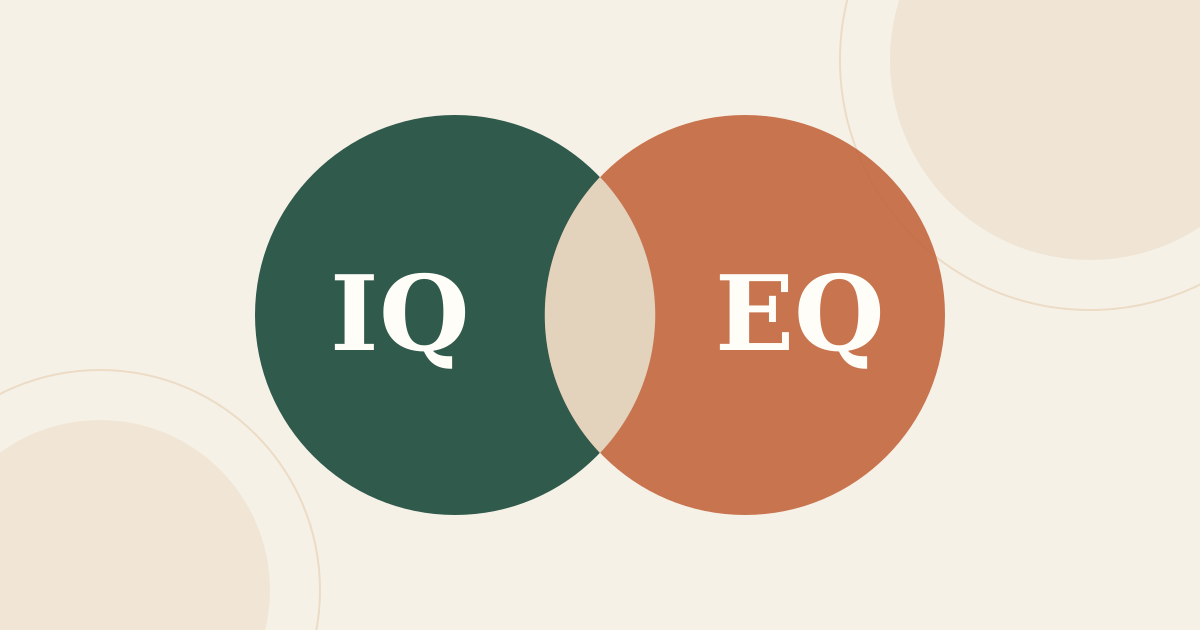
Ability tests follow the four-branch model of Peter Salovey and John Mayer (perceiving, using, understanding and managing emotions), which our guide to IQ vs EQ explains. Trait questionnaires treat emotional intelligence as part of personality. Mixed tools, popularised by Daniel Goleman's books, add motivation and social skills, which makes them practical for leadership work but harder to pin down.
Emotional intelligence tests compared at a glance
The most researched professional tests include the MSCEIT 2 and EQ-i 2.0 from the publisher MHS, the TEIQue from the London Psychometric Lab, and the ESCI from Korn Ferry. The table puts them side by side with the main workplace tools and two research tests. We read every price and access rule on the publisher's own page on 6 November 2026; where no price is published, we say so.
| Test | Kind | What it measures | Length | Access and price (Nov 2026) | Evidence |
|---|---|---|---|---|---|
| MSCEIT 2MHS | Ability | Perceiving, connecting (using), understanding and managing emotions | About 30 minutes; ages 18+ | Qualified users only (MHS "B-level"); price on request from MHS | Most researched ability test; original cited in 1,500+ studies |
| EQ-i 2.0MHS (revision of the Bar-On EQ-i) | Self-report (mixed model) | 15 subscales in 5 composites | 133 items, about 20 to 30 minutes; ages 18+ | Through MHS-certified practitioners; price on request | Publisher manual; total correlated .12 with the MSCEIT |
| TEIQueLondon Psychometric Lab | Trait (self-report) | 15 facets, 4 factors, global score | 153 items; short form (TEIQue-SF) 30 items | Short form free for research (donation); commercial reports via teique.com, no public price | Widely studied; small gain in prediction beyond personality |
| ESCIKorn Ferry (Boyatzis and Goleman) | Mixed, 360 | 12 competencies in 4 domains | About 30 to 45 minutes | Certified practitioners; price on request | Manual reports good reliability for colleague ratings |
| Emotional Intelligence AppraisalTalentSmartEQ (Bradberry and Greaves) | Mixed, self or 360 | 4 core skills, 28 behaviours | Not published | Anyone can buy: Self-Edition $70; multi-rater editions from $279 | Mainly publisher evidence |
| Six Seconds SEISix Seconds | Self-report, competency | Three pursuits split into competencies | Brief profile about 5 minutes | Free brief profile; Leadership Assessment with debrief $495 | Mainly publisher evidence |
| Genos EI InventoryGenos International | Mixed, workplace | 6 emotionally intelligent competencies | 42 items, about 10 to 15 minutes | Through Genos-certified practitioners; price on request | Good early support (2019 review) |
| STEU and STEMMacCann and Roberts (research) | Ability | Understanding (42 items) and managing (44 items) emotions | Short; no set time | Free for research; permission for other uses | Two validation studies (356 people) |
| GECoUniversity of Geneva (Schlegel and Mortillaro) | Ability, workplace | Recognising (video clips), understanding, regulating and managing emotions | Not published | Academic research, via the University of Geneva | Five studies, 888 people |
| Assessivo EQ testAssessivo | Ability and self-report | The four branches, and where self-view and answers differ | 24 situations and 20 statements, about 20 minutes | Free result; optional report $6.99 | New, in beta: no norms or validation study yet |
Prices in US dollars as shown on each publisher's site on 6 November 2026; they can change, and practitioners add their own fee for a debrief. Sources for each row are in the sections below and the source list.
How long each emotional intelligence test takes
Minutes to complete, as stated by each publisher (checked 6 and 7 November 2026). A dot is a single stated time, a bar a stated range. Tests with no published time (TEIQue, Emotional Intelligence Appraisal, STEU, STEM and GECo) are left out.
Free quizzes take 3 to 10 minutes; the professional tests take 20 to 45, and the longest free quiz, Queendom's, about an hour.
The main emotional intelligence tests, one by one
Each test below gets the same treatment: who publishes it, the model behind it, what it measures, the evidence we could verify, and the main criticisms.
MSCEIT 2 (Mayer-Salovey-Caruso Emotional Intelligence Test)
The MSCEIT is the best-known ability test of emotional intelligence: it scores what you can do, not what you say about yourself. It was built by John Mayer, Peter Salovey and David Caruso with the publisher MHS. The original version, the MSCEIT V2.0, has 141 questions across eight tasks, such as rating the emotions in faces and choosing the most effective way to handle a scene, and takes about 30 to 45 minutes. It has been cited in more than 1,500 studies (O'Connor and others, 2019).
The second edition, MSCEIT 2, scores perceiving, connecting (which takes the place of using emotions), understanding and managing emotions, plus a total. MHS lists it for adults aged 18 and over, at about 30 minutes, with norms from 3,000 people in the US and Canada tested in 2019 and 2020. Only qualified users can buy it (MHS), and no price is published.
Evidence: in the standardisation study, 21 emotion experts largely agreed with the answers chosen by 2,112 members of the public, and the test showed reasonable reliability (Mayer and others, 2003). Criticisms: "correct" answers come from agreement rather than from fixed facts, and a detailed review found weak points at every step from item to score (Maul, 2012). It is also long and costly compared with newer ability tests.
EQ-i 2.0 and the Bar-On EQ-i
The EQ-i 2.0 is a self-report questionnaire from MHS that gives a total EQ score on a scale like IQ's, plus 15 subscales. It revises Reuven Bar-On's 1997 Emotional Quotient Inventory, and its manual credits Bar-On with coining the term "EQ" in 1985. It has 133 short items on a five-point scale, takes about 20 to 30 minutes, and gives a total score with an average of 100, five composites (self-perception, self-expression, interpersonal, decision making, stress management) and 15 subscales such as empathy, impulse control and optimism (MHS). A matching 360, the EQ 360 2.0, collects ratings from others.
Evidence: the technical manual reports norms from 4,000 adults in the US and Canada, a total score that correlated .90 with the original EQ-i, and built-in checks for random or overly positive answering (MHS manual). Criticisms: much of the evidence for the 2.0 version comes from the publisher's own manual, and that manual shows its total score correlated only .12 with the MSCEIT, so the two "EQ" tests measure largely different things. Access is through certified practitioners, with prices on request.
TEIQue and TEIQue-SF (Trait Emotional Intelligence Questionnaire)
The TEIQue is the main research questionnaire for trait emotional intelligence, the view of EI as part of personality. Developed by K. V. Petrides and Adrian Furnham and run by the London Psychometric Lab, the full form has 153 items covering 15 facets, four factors (well-being, self-control, emotionality, sociability) and a global score; the short form, TEIQue-SF, has 30 items (O'Connor and others, 2019). There is also a short form for children (TEIQue-CSF).
Evidence: a meta-analysis of 18 studies found the TEIQue predicts outcomes beyond the main personality traits, though the extra amount is small, about 6% of variance on average (Andrei and others, 2016). Criticisms: like any self-report it is easy to fake when a job is at stake, and reviewers advise against using it for selection. Access: the short forms are free to researchers on a donation plan, with paid research plans from £50; coaching and company reports are sold through the lab's commercial site, which lists no prices (London Psychometric Lab).
ESCI (Emotional and Social Competency Inventory)
The ESCI is a 360 tool: you and the people you work with rate how often you show 12 workplace competencies. It comes from Richard Boyatzis and Daniel Goleman's competency model and is published by Korn Ferry. Its 12 scales, from emotional self-control and adaptability to conflict management and teamwork, sit in four domains, and it takes about 30 to 45 minutes (EI Consortium). Evidence: the technical manual reports scale reliabilities of .79 to .91 for colleague ratings in more than 50,000 assessments, as summarised by O'Connor and others. Criticisms: it measures how behaviour is seen, which mixes emotional skill with reputation and habits. Feedback must be given by a certified practitioner, and assessments are priced through a Korn Ferry contract (Korn Ferry).
Emotional Intelligence Appraisal (TalentSmart, Bradberry and Greaves)
The Emotional Intelligence Appraisal is a self-rating tool that anyone can buy, built around Goleman-style skills. It is published by TalentSmartEQ, the company of Travis Bradberry and Jean Greaves, authors of Emotional Intelligence 2.0. It scores four core skills and 28 behaviours. On 6 November 2026 the Self-Edition cost $70, and the multi-rater and 360 editions started at $279 (TalentSmartEQ). Evidence: the publisher calls it reliable and valid and says it has been taken by more than 2 million people, but it was not among the measures in the 2019 independent review. The same company is the source of two widely repeated figures, which we look at below.
Six Seconds SEI
The SEI from Six Seconds is a self-report tool based on the organisation's own model of three "pursuits": know yourself, choose yourself and give yourself. A free brief profile takes about 5 minutes. Full versions include leadership, development and youth reports and a 360; on 6 November 2026 the SEI Leadership Assessment with a debrief cost $495 (Six Seconds). Practitioners need SEI certification to use it with others. It was not among the measures in the 2019 independent review.
Genos EI Inventory
Genos EI is a short workplace questionnaire of 42 items covering six emotionally intelligent competencies. It takes about 10 to 15 minutes and comes in self, 180 and 360 versions for leaders and individual contributors (EI Consortium). The 2019 review called it a relatively new measure with good early support. Access is through Genos-certified practitioners, and prices are not published.
STEU, STEM and GECo: shorter ability tests from research
Researchers who want an ability test without the cost of the MSCEIT often use the STEU and STEM, or the newer GECo. The STEU (42 items) asks which emotion a situation would most likely cause, scored from appraisal theory; the STEM (44 items) asks for the best way to handle anger, sadness and fear. Both were validated with 207 students and 149 office workers (MacCann and Roberts, 2008). The GECo, from the University of Geneva, tests emotion recognition with video clips and three other skills with work scenarios; across five studies of 888 people it predicted performance in assessment-centre tasks (Schlegel and Mortillaro, 2019). These are research tools, not consumer products.
What about free online emotional intelligence tests?
Almost every free online EQ test is a short self-report questionnaire, so it shows how you see yourself, not how skilled you are. They are useful for reflection and a first look at the idea. They can't give a validated score, they rarely publish their scoring or norms, and a result from one can't be compared with another. The quizzes that rank most often in search results, checked on 6 November 2026:
| Quiz | Kind | Format | Cost | Worth knowing |
|---|---|---|---|---|
| Psychology Today | Self-report | 20 statements, about 3 minutes | Free | Lists the MSCEIT, EQ-i and TEIQue as background; "for informational purposes only" |
| Greater Good Science Center (UC Berkeley) | Ability (faces) | 20 photos: name the emotion in each face | Free; account optional | Draws on the facial expression research of Paul Ekman and Dacher Keltner; covers perceiving only |
| Truity | Self-report | 55 questions, 5 to 10 minutes | Free short report; full report for a fee | Five areas; says it compares you with a large international sample |
| IDRlabs IDR-EQ-4 | Self-report | 28 statements | Free | Four domains (empathy, sociability, self-control, well-being); says plainly it is not equal to professional tests |
| Global Leadership Foundation | Self-report (forced choice) | 40 pairs of statements, about 10 minutes | Free | Taken from the foundation's 158-item EI Capability Assessment, based on Goleman's four quadrants |
| Mind Tools quick quiz | Self-report | Short downloadable quiz | Listed at $10, or free for Mind Tools members | Five Goleman areas: self-awareness, self-regulation, motivation, empathy, social skills |
| IHHP free EQ quiz | Self-report | Short online quiz about your own reactions | Free | From a company that sells EQ training; asks how you react under pressure, such as when given difficult feedback |
| Arealme EQ test | Mixed (self-report, scenarios, emotion cues) | 48 questions | Free | Six areas including self-awareness and self-regulation; the site calls the result a habit profile, not a diagnosis |
| Queendom Emotional Intelligence Test | Self-report | 341 statements, about 60 minutes | Free snapshot report; full report $9.95 | One of the longest free quizzes; rate how well each statement applies to you |
The Psychology Today quiz is the one most people search for by name. It is short and honest about being informational, but it is a self-rating like the others. The Greater Good face quiz is the exception in the list: it has right answers, but it covers only one of the four branches, reading faces. Before trusting any free test, check three things: does it say who wrote it, does it say what kind of test it is, and does it admit what it can't measure?
The Assessivo EQ test
The Assessivo EQ test combines both main methods: 24 everyday situations with a best answer, and 20 statements about how you see yourself. The situations are drawn from a larger bank so each test covers all four branches and three settings (work, close relationships, strangers). Best answers follow published emotion research rather than a vote, and the result shows where your self-rating and your answers disagree. It takes about 20 minutes, the result is free with no sign-up, and an optional full report costs $6.99 in most countries.
The same limits apply as to the others. It is new and in beta: it has no norms from other test-takers yet, and no published validation study. Treat it as a structured estimate for self-understanding, not a clinical or hiring test.
How accurate are emotional intelligence tests?
EQ tests are reasonably consistent, but they are less accurate than their marketing suggests, and the different kinds often disagree about the same person. A test can be "validated" for one use, such as research on groups, and still be a poor guide to one individual. These are the main issues.
Self-ratings and skill tests disagree
In a study of 207 students, the MSCEIT had only minimal links with two self-report measures, the EQ-i and the SREIT, which were moderately linked with each other; the authors concluded the two approaches give "different measurements of the same person" (Brackett and Mayer, 2003). When people rated themselves on the same four branches the MSCEIT tests, their self-ratings and test scores were still not strongly related (Brackett and others, 2006). Self-report EQ is also very close to general personality, with a meta-analytic correlation of about .85 (van der Linden and others, 2017), which is why a Big Five personality test captures much of the same ground.
Faking and flattering answers
Self-report tests can be inflated by answering in a socially desirable way. Reviewers note that this is mainly a problem when someone important, such as an employer, will see the result (O'Connor and others, 2019). The EQ-i 2.0 includes positive and negative impression scales to flag it. Ability tests are harder to fake, because you are already trying to choose the best answer.
What the scores predict
The kind of test changes what the score predicts. Ability tests relate more strongly to grades, while self-report and mixed tools relate more strongly to how satisfied people say they are at work, an outcome that is itself self-reported.
Same idea, different results by kind of test
Link with academic performance
Link with job satisfaction
Corrected correlations, where 0 means no link. Grades: MacCann and others (2020), 42,529 students. Job satisfaction: Miao, Humphrey and Qian (2017).
For grades, ability EI correlated .24, mixed EI .19 and self-rated EI .12 (MacCann and others, 2020). For job satisfaction the order reversed: .08, .32 and .39 (Miao and others, 2017). For job performance, all three kinds land between .24 and .30 (O'Boyle and others, 2011); the at-work guide covers what that means for jobs and leaders.
Who decides the right answer?
Ability tests need a "correct" answer for questions about feelings. The MSCEIT uses agreement among the public or among emotion experts. Experts agree most where research gives a clear answer, such as reading faces, and the method is harder to defend for complex social choices. Newer tests such as the STEU and GECo score answers from emotion theory instead. Either way, a best answer is a well-supported judgement, not a fact like 2 + 2.
Culture, language and norms
How people show and judge emotions varies between cultures, and most norms come from North America: the MSCEIT 2 from 3,000 people in the US and Canada, and the EQ-i 2.0 from 4,000 matched to US and Canadian census figures. The EQ-i 2.0 manual reports small to medium score differences between ethnic groups. Translations exist for both, but a score is most meaningful when compared with people like you.
Claims to treat with care
Two figures appear on many pages about EQ tests: "EQ explains 58% of job performance" and "90% of top performers are high in EQ". Both come from a TalentSmart business document, a company that sells EQ tests and training, not from a peer-reviewed study (TalentSmart). Independent meta-analyses find a moderate link with performance instead; our guide to emotional intelligence at work traces where both figures came from.
Which emotional intelligence test should you take?
The right EQ test depends on why you want a score: a free test for curiosity, a certified tool with a debrief for coaching, and validated research measures for studies. There is no official EQ test that any authority recognises, so "best" always means best for a purpose.
A free quiz is enough to start a conversation with yourself. Pick one that shows what it asks and says what it can't do, and treat the number as a talking point.
A long self-report tool with many narrow scales (TEIQue, EQ-i 2.0) or a 360 (ESCI, EQ 360, Genos) gives more to work with. These usually come with a debrief from a certified coach.
Researchers often pair an ability test (MSCEIT, or the shorter STEU and STEM) with a trait questionnaire such as the TEIQue-SF, because the two capture different things.
Treat any EQ score with caution. Self-reports are easy to inflate when a job is at stake, and ability scores predict performance mainly in roles full of emotional labour. Never use a free quiz to choose candidates.
Most professional tests are for adults (MSCEIT 2 and EQ-i 2.0 are for 18+). Youth versions exist, such as the TEIQue child short form, the EQ-i youth version and SEI Youth, and MHS offers a youth research version of the MSCEIT.
Our free test gives you both a skill score and a self-rating, and shows where they differ.
Take the free EQ testOn hiring, ability EI predicted better performance in jobs high in emotional labour, such as customer service, but worse performance in jobs low in it (Joseph and Newman, 2010). The cautions for employers are set out in EQ tests in hiring. If you are working on the skills themselves, see how to improve emotional intelligence, and for what high and low EQ look like day to day, signs of emotional intelligence. The Big Five traits guide explains the personality side that self-report EQ overlaps with.
Frequently asked questions
What is the most accurate emotional intelligence test?
No test is the most accurate for every purpose. For measuring emotional skill as an ability, the MSCEIT has the most research behind it; for measuring how people see their own emotional habits, the TEIQue and EQ-i 2.0 are among the best studied. Accuracy depends on what you want to know.
Can I take the MSCEIT online for free?
No. The MSCEIT 2 is sold by MHS to qualified professionals, who set it up online for the person taking it. Free quizzes that call themselves "MSCEIT tests" are not the real test and do not use its scoring.
How much does the EQ-i 2.0 cost?
MHS does not publish a price for the EQ-i 2.0. It is available through MHS-certified practitioners, so the cost depends on the practitioner and the report you need.
What is the difference between the Bar-On EQ-i and the EQ-i 2.0?
The EQ-i 2.0 is the publisher's revision of Reuven Bar-On's 1997 EQ-i. It has 133 items, regrouped scales (15 subscales in 5 composites) and new norms from 4,000 people, and its total score correlated .90 with the original's.
Is the TEIQue free?
The short form, TEIQue-SF, is free for academic research on the London Psychometric Lab's donation plan. Commercial use, including coaching and organisational reports, is paid through the lab's commercial site.
What does the Psychology Today emotional intelligence test measure?
It measures how you rate yourself. It is a 20-statement self-report quiz that takes about 3 minutes, and Psychology Today says its tests are for information only, not diagnosis.
Which emotional intelligence tests do employers use?
Workplace tools include the EQ-i 2.0 and EQ 360, the ESCI, Genos EI, the Emotional Intelligence Appraisal and the Six Seconds SEI. Their publishers present them mainly for leadership development and coaching.
How long does an emotional intelligence test take?
Between 3 and 45 minutes. Short free quizzes take a few minutes; the EQ-i 2.0 takes about 20 to 30 minutes, the MSCEIT 2 about 30 minutes, and the ESCI about 30 to 45 minutes.
Who coined the term EQ?
According to the EQ-i 2.0 manual, Reuven Bar-On coined "EQ" (emotional quotient) in 1985, by analogy with IQ. The idea of emotional intelligence as an ability was set out by Peter Salovey and John Mayer in 1990.
Is the Baron-Cohen EQ test an emotional intelligence test?
No. The EQ by Simon Baron-Cohen and Sally Wheelwright is the Empathy Quotient, a self-report questionnaire with 40 empathy items and 20 filler items, scored out of 80 and used mainly in autism research. It measures empathy only, not emotional intelligence, and it is not a diagnostic test.
Do emotional intelligence scores change over time?
Scores are fairly stable over weeks and months but can shift with practice. For the original EQ-i, the stability coefficient was .85 after one month and .75 after four months. Training studies find a moderate gain on average.
Sources
- Salovey and Mayer (1990), Imagination, Cognition and Personality: the first academic definition of emotional intelligence.
- O'Connor and others (2019), Frontiers in Psychology: critical review of emotional intelligence measures, with recommendations (test lengths, reliability, faking, costs).
- Mayer, Salovey, Caruso and Sitarenios (2003), Emotion: measuring emotional intelligence with the MSCEIT V2.0 (expert and general-sample answers, reliability).
- MHS: MSCEIT 2, Publisher product page: administration time, age range, qualification level, norm sample (checked 6 November 2026).
- Maul (2012), Emotion Review: the validity of the MSCEIT as a measure of emotional intelligence.
- MHS: EQ-i 2.0, Publisher page: composites, subscales, time and age range (checked 6 November 2026).
- MHS: EQ-i 2.0 technical manual, Items, norms, link with the original EQ-i, correlation with the MSCEIT, validity indicators, group differences.
- London Psychometric Lab, TEIQue research plans and prices (checked 6 November 2026); commercial reports at teique.com.
- Andrei and others (2016), Journal of Personality Assessment: incremental validity of the TEIQue, systematic review and meta-analysis.
- EI Consortium: ESCI, Scales, time and qualification for the Emotional and Social Competency Inventory.
- Korn Ferry: ESCI certification, Who can deliver ESCI feedback and how assessments are bought (checked 6 November 2026).
- TalentSmartEQ: assessments, Emotional Intelligence Appraisal editions and prices (checked 6 November 2026).
- Six Seconds: products, SEI Leadership Assessment with debrief price (checked 6 November 2026); model at 6seconds.org.
- EI Consortium: Genos EI, Length, competencies, versions and certification for the Genos Emotional Intelligence Inventory.
- MacCann and Roberts (2008), Emotion: the STEU and STEM ability tests, development and validation.
- Schlegel and Mortillaro (2019), Journal of Applied Psychology: the Geneva Emotional Competence Test (GECo).
- Brackett and Mayer (2003), Personality and Social Psychology Bulletin: convergent, discriminant and incremental validity of competing EI measures.
- Brackett and others (2006), Journal of Personality and Social Psychology: self-report and performance measures of EI and social functioning.
- van der Linden and others (2017), Psychological Bulletin: overlap between the general factor of personality and emotional intelligence.
- MacCann and others (2020), Psychological Bulletin: emotional intelligence predicts academic performance, by type of test.
- Miao, Humphrey and Qian (2017), Journal of Occupational and Organizational Psychology: emotional intelligence and work attitudes.
- O'Boyle and others (2011), Journal of Organizational Behavior: emotional intelligence and job performance, three streams of tests.
- Joseph and Newman (2010), Journal of Applied Psychology: integrative meta-analysis of emotional intelligence and job performance.
- Mattingly and Kraiger (2019), Human Resource Management Review: can emotional intelligence be trained? A meta-analysis.
- TalentSmart, The Business Case for Emotional Intelligence: source of the 58% and 90% claims.
- Psychology Today, Emotional intelligence test page (checked 6 November 2026).
- Greater Good Science Center, Emotional intelligence quiz (facial expressions).
- Truity, Emotional intelligence test page (checked 6 November 2026).
- IDRlabs, IDR-EQ-4 test page (checked 6 November 2026).
- Global Leadership Foundation, Free emotional intelligence test page (checked 6 November 2026).
- Mind Tools, Emotional intelligence quick quiz product page (checked 6 November 2026).
- IHHP, Free EQ quiz page (checked 7 November 2026).
- Arealme, EQ test page: 48 mixed-format questions in six areas (checked 7 November 2026).
- Queendom, Emotional Intelligence Test page: 341 questions, 60 minutes, free snapshot report, full report $9.95 (checked 7 November 2026).
- Baron-Cohen and Wheelwright (2004), Journal of Autism and Developmental Disorders: the Empathy Quotient, 40 empathy items and 20 filler items.
Test names are trademarks of their publishers; Assessivo is not connected with any of them. Prices were checked on 6 November 2026. Assessivo's tests give estimates for self-understanding. They are not clinical assessments or hiring tools.
Try both kinds of EQ test in one
Our free EQ test pairs 24 everyday situations with a best answer and 20 self-rating statements, then shows where they agree. About 20 minutes, no sign-up.
Start the test