In short: IQ (intelligence quotient) is a score for reasoning and problem solving. EQ (emotional quotient) is a popular name for emotional intelligence, the ability to recognise, understand and manage emotions. IQ and EQ are positively but weakly related, so knowing one tells you little about the other. Neither is more important in general: IQ is the stronger predictor of school results, while EQ adds most in work and situations that depend on people.
People with a high IQ usually have a low EQ.
Myth. Studies find a small positive link: higher scores on emotion skill tests go with slightly higher IQ scores, not lower ones.
EQ explains 58% of job performance.
Myth. The 58% figure comes from a company that sells EQ training, not from a published study. Meta-analyses find a moderate link.
Emotional intelligence scores can improve with training.
Fact. Across 58 studies, training led to a moderate rise in EI scores; the gain was smaller in unpublished studies.
What do IQ and EQ mean?
In psychology, IQ and EQ describe two different kinds of ability. IQ stands for intelligence quotient: a standardised score for reasoning, knowledge, memory and mental speed. IQ scales are set so the population average is 100 and the standard deviation is 15. Our guide to what IQ is covers what the number does and doesn't capture.
EQ stands for emotional quotient, the everyday term for emotional intelligence (EI). The psychologists Peter Salovey and John Mayer defined emotional intelligence in 1990 as the ability to perceive, understand and manage emotions. Daniel Goleman's 1995 bestseller popularised the term and widened it to include motivation and social skills. Because of that history, "EQ" can mean two different things: a skill tested with best answers, or a set of habits people rate in themselves.
What are the four parts of emotional intelligence?
In the ability model of Peter Salovey and John Mayer, emotional intelligence has four parts, or branches: perceiving emotions, using emotions to help thinking, understanding emotions and managing emotions. The MSCEIT, the best-known skill test of emotional intelligence, is built on these four branches (Fiori and others, 2014). Mayer, Caruso and Salovey updated the model in 2016 but kept emotional intelligence defined as a mental ability (Emotion Review).
Noticing emotions in faces, voices and yourself.
Example: Seeing that a friend's smile looks forced.
Letting a mood suit the task, such as calm for careful work.
Example: Saving a tricky email for when you feel steady.
Knowing what causes a feeling and how it may change.
Example: Expecting worry to turn to relief once news arrives.
Handling your own feelings and helping others with theirs.
Example: Taking a pause before replying to a sharp comment.
Goleman's popular version is broader. It adds motivation and social skills, which is why many workplace "EQ" questionnaires look more like personality tests than skill tests.
IQ and EQ compared
The main difference between IQ and EQ is what you reason about: IQ is reasoning with information, EQ is reasoning with feelings.
| Compared | IQ | EQ |
|---|---|---|
| What it covers | Reasoning, problem solving, learning | Recognising, understanding and managing emotions |
| Everyday example | Working out the rule in a number series | Noticing a quiet colleague is upset and knowing what would help |
| How it's tested | Timed puzzles with one right answer | Scenario questions with a best answer, or self-rating questionnaires |
| Score | A shared scale with an average of 100 | No shared scale; each test has its own |
| Best known for predicting | School results and job performance | Performance in people-focused work |
| Research base | More than a century of studies | Studied since 1990; definitions still debated |
IQ vs EQ examples in everyday life
Most real situations need both. These everyday examples show which part each one plays:
| Situation | IQ helps with | EQ helps with |
|---|---|---|
| A tight deadline | Planning the steps and spotting the quickest route | Keeping panic in check and telling the team calmly |
| A disagreement in a meeting | Weighing which argument holds up | Noticing who is upset and lowering the temperature |
| An exam the next day | Learning and recalling the material | Managing nerves so they don't block what you know |
| An angry customer | Working out what went wrong | Listening, acknowledging the frustration, then fixing it |
Are IQ and EQ related?
IQ and EQ are related, but only weakly, and the link depends on how EQ is measured. When emotional intelligence is tested as a skill, it correlates with cognitive ability at about 0.25, according to Joseph and Newman's 2010 meta-analysis of 28 samples (5,538 people). When people rate their own emotional skills, the correlation with cognitive ability is 0.00.
How closely EQ tracks IQ
Correlation with cognitive ability, where 0 means no link and 1 a perfect one. Source: Joseph and Newman (2010).
Understanding emotions has the strongest link with IQ, which makes sense, because explaining why someone feels a certain way takes reasoning. IQ and EQ are therefore not opposites: a person can score high on both, low on both, or high on one and average on the other. A separate meta-analysis of the best-known emotion skill test, the MSCEIT, reached the same picture: a positive but moderate link with overall, verbal and non-verbal intelligence (Kong, 2014).
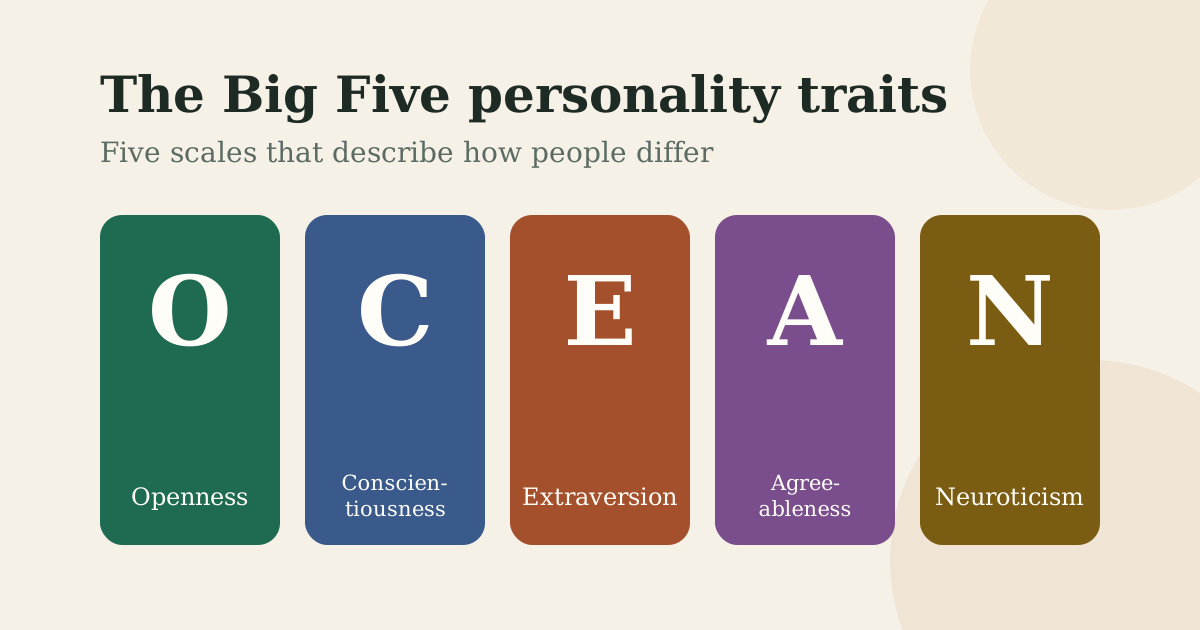
Self-rated EQ is closer to personality than to IQ. In a meta-analysis of 142 data sources covering 36,268 people, questionnaire EQ correlated about 0.85 with the general factor of the Big Five traits, compared with about 0.28 for EQ tested as a skill (van der Linden and others, 2017). The Big Five personality test measures those traits directly.
Which matters more for success, IQ or EQ?
Neither IQ nor EQ matters more in general; each predicts different outcomes. IQ is the stronger predictor of school and exam results. Both predict job performance to a similar degree, and EQ adds most in jobs that involve a lot of contact with people.
How well each predicts job performance
Corrected correlations from two separate meta-analyses, so read them as a rough comparison. The 2022 IQ estimate replaced the older figure of 0.51.
- School: general ability measured at age 11 was strongly linked to exam results at 16 in a large English study (Deary and others, 2007). Emotional intelligence also predicts grades, with a correlation of about .20 across 42,529 students, and ranked third after intelligence and conscientiousness (MacCann and others, 2020).
- Work: EQ measures predicted job performance beyond what IQ and the Big Five already explained, most of all the questionnaire types (O'Boyle and others, 2011).
- People-focused jobs: EQ tested as a skill went with better performance in jobs high in "emotional labour", such as customer service, and not in jobs low in it (Joseph and Newman, 2010).
Two popular claims don't hold up. "EQ explains 58% of job performance" is a figure from TalentSmart, a company that sells EQ tests and training, and no published study supports it. "Success is 20% IQ and 80% EQ" has no traceable source at all.
IQ vs EQ in the workplace and in leadership
In the workplace, IQ and EQ predict job performance to a similar degree, and the more a role depends on dealing with people, the more EQ tends to count. Leadership combines complex decisions with constant work through other people, so leaders draw on both. For how general ability varies across jobs, see IQ by profession.
The link between EQ and leadership is much weaker than it first appears. In a meta-analysis of 62 samples, emotional intelligence correlated .59 with inspiring, "transformational" leadership when the same person rated both, but only .12 when different people did the rating. Self-rated EQ questionnaires showed stronger links than skill tests (Harms and Credé, 2010). So a leader who scores high on an EQ questionnaire is not necessarily seen as a better leader by their team. Our guide to emotional intelligence at work covers the skills, the jobs where they count most and EQ tests in hiring.
IQ vs EQ in relationships and well-being
Relationships and well-being are where EQ research finds some of its clearest links. A meta-analysis of 25 studies (8,520 people) found a correlation of .32 between emotional intelligence and subjective well-being, meaning life satisfaction and happiness. The link was weaker, at .22, when emotional intelligence was measured with skill tests rather than questionnaires (Sánchez-Álvarez and others, 2016).
In couples, self-rated emotional intelligence correlated .32 with relationship satisfaction across six studies of 603 people, and a person's emotional intelligence was also linked to their partner's satisfaction (Malouff and others, 2014). These are correlations from fairly small sets of studies: they show that the two go together, not that a higher EQ causes a happier relationship.
Can you have a high IQ and a low EQ?
Yes. Because IQ and EQ are only weakly linked, a high IQ with a low EQ is common, and so is the reverse. The brilliant person who struggles with people exists, but is not the rule: on average, people with higher IQs score slightly higher on emotion skill tests. For example:
Strong reasoning and good with people.
Solves problems well but may misread how others feel.
Reads people well and stays calm under pressure.
Both sets of skills respond to learning and practice.
What a lower EQ looks like day to day, and why a checklist can mislead, is in our guide to the signs of high and low emotional intelligence.
How are IQ and EQ measured?
IQ is measured with timed reasoning tests that have one right answer; EQ is measured either with scenario tests that have a best answer or with self-rating questionnaires. Most free online EQ tests are questionnaires. The MSCEIT, EQ-i 2.0, TEIQue and others are set side by side in emotional intelligence tests compared.
Pattern, logic, spatial and number puzzles. Professional versions such as the WAIS are given in person by a psychologist; online tests give an estimate.
Take the free IQ testSkill tests ask what a person in a scene would feel, or what would help most. Questionnaires ask how much statements describe you, much like a personality test.
Take the free EQ testCan you improve your IQ or EQ?
EQ: emotional intelligence can be trained to some degree. A 2019 meta-analysis of 58 studies found a moderate improvement in EI scores after training (Mattingly and Kraiger). Exercises for each skill and a four-week plan are in how to improve emotional intelligence.
IQ: education raises measured IQ modestly, by about 1 to 5 points per extra year of schooling and 3.4 points on average (Ritchie and Tucker-Drob, 2018). Read more in can you increase your IQ? and, on the role of genes, is intelligence hereditary?
IQ, EQ, SQ and AQ: what do the other "quotients" mean?
IQ is the only one of these with long-established standard tests; EQ is a researched but debated idea, and SQ and the "adversity" AQ come from popular books.
Intelligence quotient: reasoning and problem solving.
Emotional quotient: emotional intelligence, tested as a skill or self-rated.
"Spiritual intelligence", from Danah Zohar and Ian Marshall's 2000 book SQ.
"Adversity quotient", from Paul Stoltz's 1997 book. In research, AQ is the Autism-Spectrum Quotient, a questionnaire about autistic traits.
Frequently asked questions
What are the full forms of IQ and EQ?
The full form of IQ is intelligence quotient, and the full form of EQ is emotional quotient. EQ is a popular name for emotional intelligence, the ability to recognise, understand and manage emotions.
Are IQ and EQ the same thing?
IQ and EQ are not the same thing. IQ covers reasoning with information, while EQ covers recognising and handling emotions, and the two are only weakly correlated.
Is EQ more important than IQ?
EQ is not more important than IQ in general. IQ is the stronger predictor of school results, both predict job performance, and EQ adds most in jobs that depend on dealing with people.
Can you have a high IQ and a high EQ?
A person can have both a high IQ and a high EQ. The two are positively but weakly related, so every combination of high and low is common.
Are IQ and EQ inversely proportional?
IQ and EQ are not inversely related. Research finds a small positive correlation, about 0.25 when EQ is tested as a skill.
Is EQ scored like IQ?
EQ is not scored like IQ. IQ tests share a scale with an average of 100, while each EQ test uses its own scale, so EQ scores from different tests can't be compared.
What is a good EQ score?
A good EQ score depends on the test that produced it. Compare your result with other people who took the same test rather than looking at the number alone.
Does EQ matter in relationships?
Higher emotional intelligence goes with happier relationships. A meta-analysis of six studies (603 people) found a correlation of .32 between self-rated emotional intelligence and romantic relationship satisfaction, including the partner's satisfaction.
Does EQ help at school?
Emotional intelligence is linked to better grades, but less strongly than IQ. Across 42,529 students, the correlation was about .20, and emotional intelligence ranked third as a predictor after intelligence and conscientiousness.
Which matters more for leaders, IQ or EQ?
Leaders need both: IQ for reasoning through complex problems and EQ for handling people. Research on EQ at work finds the clearest benefits in roles with a lot of contact with people.
Sources
- Salovey and Mayer (1990), Imagination, Cognition and Personality: the first academic definition of emotional intelligence.
- Fiori and others (2014), PLOS ONE: the MSCEIT and the four-branch model of Mayer and Salovey.
- Mayer, Caruso and Salovey (2016), Emotion Review: the ability model of emotional intelligence, principles and updates.
- Joseph and Newman (2010), Journal of Applied Psychology: meta-analysis of emotional intelligence, cognitive ability, personality and job performance.
- Kong (2014), Personality and Individual Differences: the MSCEIT and overall, verbal and non-verbal intelligence.
- van der Linden and others (2017), Psychological Bulletin: overlap between emotional intelligence and the general factor of personality.
- O'Boyle and others (2011), Journal of Organizational Behavior: emotional intelligence and job performance.
- Sackett and others (2022), Journal of Applied Psychology: revised validity of selection methods, including general mental ability.
- Deary and others (2007), Intelligence: intelligence and educational achievement.
- MacCann and others (2020), Psychological Bulletin: emotional intelligence and academic performance.
- Harms and Credé (2010), Journal of Leadership and Organizational Studies: emotional intelligence and leadership.
- Sánchez-Álvarez, Extremera and Fernández-Berrocal (2016), Journal of Positive Psychology: emotional intelligence and subjective well-being.
- Malouff, Schutte and Thorsteinsson (2014), American Journal of Family Therapy: emotional intelligence and relationship satisfaction.
- Mattingly and Kraiger (2019), Human Resource Management Review: can emotional intelligence be trained?
- Ritchie and Tucker-Drob (2018), Psychological Science: how much education improves intelligence.
- TalentSmart, The Business Case for Emotional Intelligence: the source of the 58% claim.
- Stoltz (1997), Adversity Quotient: Turning Obstacles into Opportunities (Wiley).
- Zohar and Marshall (2000), SQ: Connecting with Our Spiritual Intelligence (Bloomsbury), book listing.
- Baron-Cohen and others (2001), Journal of Autism and Developmental Disorders: the Autism-Spectrum Quotient (AQ).
Assessivo's tests give estimates for self-understanding. They are not clinical assessments or hiring tools.
Measure the IQ side first
Our free IQ test covers pattern, logic, spatial and number reasoning and shows your estimated score and percentile. No sign-up.
Start the test