In short: Type A describes people who are driven, impatient and competitive; Type B describes people who are relaxed and easygoing. The idea came from two heart doctors in the 1950s, but the large studies that followed found no link between Type A and heart disease. Only anger and hostility showed a small link, and much of the early research was paid for by tobacco companies. People also aren't two types: everyone sits somewhere on a scale. Psychologists now measure the traits behind "Type A" one by one, with the Big Five.
Type A people are more likely to have heart attacks.
Myth. The largest studies found no link. Reality check 1 shows the data.
Frequent anger is linked with heart disease.
Fact. Yes, but only slightly: about 19% higher risk across 25 studies of healthy people.
Most people are clearly Type A or Type B.
Myth. Studies find one smooth scale, not two groups. Most people are a mix.
What is a Type A personality?
"Type A" is shorthand for a pattern of behaviour: always in a hurry, ambitious, competitive and easily irritated when things are slow. It isn't a diagnosis or an official personality type. It describes one end of a scale that everyone sits somewhere on.
What is a Type B personality?
Type B is the other end of the same scale: patient, unhurried and hard to rattle. It was first defined simply as "not Type A", which is why it gets less attention, even though more people search for it.
- Time urgency: walks, talks and eats fast; hates queues.
- Ambition and competitiveness: high goals, keeps score, even in games.
- Doing several things at once: answers emails during calls.
- Impatience: annoyed when others are slow.
- Hard to switch off: feels guilty resting.
- Relaxed about time: deadlines matter, but don't cause panic.
- Less driven by winning: enjoys the game more than the score.
- Slow to anger: stays calm when plans change.
- Reflective: takes time to think things through.
- Rests without guilt.
Is Type B lazy? No. Type B describes pace and temper, not effort or ability. A Type B person can be just as organised and successful as a Type A person; they simply get there with less hurry.
Type A, B, C and D personality compared
Two more letters were added later. Here is how each label is usually described, and how well the research supports it.
| Label | Described as | Health claim | Evidence | Big Five match |
|---|---|---|---|---|
| Type A | Driven, hurried, competitive, quick to anger | Heart disease | Didn't hold up | High achievement-striving and activity, lower agreeableness |
| Type B | Relaxed, patient, easygoing | Protective | Didn't hold up | The reverse of Type A |
| Type C | Cooperative, eager to please, holds back emotions | Cancer | Discredited | No clear match |
| Type D | Worried, gloomy, socially inhibited | Worse outcomes in heart patients | Some, smaller than claimed | High neuroticism, low extraversion |
Big Five matches from Ramanaiah and others (1997) and Denollet (2005). Sources are listed at the end of the page.
Where the idea came from
Type A was named by two cardiologists, Meyer Friedman and Ray Rosenman, not by psychologists. As Friedman told it, the chairs in their San Francisco waiting room wore out unusually fast, and an upholsterer remarked that their patients must be very restless. They described the behaviour pattern in 1959.
Then came the big studies. In 1975, a study of 3,154 men followed for 8.5 years found Type A "strongly related" to heart disease. The studies that followed were larger, and none of them found the link.
The heart studies: how many people, and what they found
Seven reality checks about Type A and Type B
Each check sets a popular belief against what the studies found, with the numbers behind it.
"Type A gives you heart attacks"
In the largest test, the MRFIT study, 12,772 men filled in a Type A questionnaire. If Type A raised the risk, the bars below would climb from left to right. They don't. Across every long-term study up to 1998, covering 74,326 people, the link between Type A and heart disease was r = 0.003: effectively zero. Blood pressure, cholesterol and smoking predicted heart disease; Type A didn't.
Men who had a first major heart event, by Type A score
Each bar is one fifth of the men, ranked by their Type A score (crude risk). Shekelle and others, 1985.
Sources: Shekelle and others, 1985; Ragland and Brand, 1988; Myrtek, 2001.
The twist nobody mentions
Among 231 men who survived a first heart attack, the Type A men were less likely to die of heart disease over the following 12 or so years than the Type B men. After adjusting for other risks, their rate was 42% lower. The researchers called it "surprising".
Heart-disease deaths per 1,000 person-years, after a first heart attack
Source: Ragland and Brand, 1988, New England Journal of Medicine.
Who paid for the research
A personality cause of heart disease was useful to an industry being blamed for it. Tobacco company documents show that the industry was a major funder of Type A research for about 40 years, and that most of the positive findings came from studies or researchers with tobacco funding. Philip Morris called one of its projects its "crown jewel".
Philip Morris funding for Type A research (US dollars)
Source: Petticrew, Lee and McKee, 2012, American Journal of Public Health.
Ambition isn't the risky part. Anger might be.
Split Type A into its pieces and only one shows a link: anger and hostility. Across 25 studies of healthy people, it went with a 19% higher risk of heart disease. Being driven or busy did not. Even this link is small, and one large review called it too small to have "practical meaning" for prediction.
Risk of heart disease, compared with people low in the trait
Sources: Chida and Steptoe, 2009; Myrtek, 2001.
"You're either Type A or Type B"
Two studies with more than 4,600 people repeated the key 1989 test that seemed to show two separate groups. They found one smooth scale instead, and concluded there is "no evidence for the type" in Type A. A review of 177 papers found the same for normal personality in general: traits are scales, not boxes.
Illustrations of the two possible results, not plotted data.
Sources: Wilmot and others, 2019; Haslam and others, 2012.
"Type C personality causes cancer"
King's College London reviewed the studies by Hans Eysenck and Ronald Grossarth-Maticek on personality and physical health, which were the best-known support for a "cancer-prone personality". It judged them "unsafe" and asked journals to retract them. In a newer study of 42,843 people, none of the Big Five traits predicted getting or dying of cancer.
Big Five traits linked to cancer risk, in 42,843 people
Also no link with cancer deaths, among the 21,835 people with that data.
Sources: King's College London, 2019; Jokela and others, 2014.
"Your type is fixed for life"
Genes explain part of personality, but not most of it. And across 207 studies, therapy and similar programmes measurably changed personality trait scores within about 24 weeks on average; emotional stability changed most. Personality is stable, not set in stone.
Where differences in personality come from
Average across studies with more than 100,000 people.
Sources: Vukasović and Bratko, 2015; Roberts and others, 2017. More in our guide to whether personality is genetic.
Being driven, fast-paced or quick to anger are real, measurable traits. They just don't come bundled into two types, and only one of them, hostility, has even a small health link.
What is a Type C personality?
DiscreditedType C describes someone cooperative, patient and eager to please, who keeps emotions, especially anger, to themselves. It isn't a mix of Type A and Type B; it was proposed separately, as a "cancer-prone personality".
Is Type C real? The traits exist, but the cancer claim doesn't stand (reality check 6). At work and in relationships, a Type C person as described is easy to work with and caring, but may avoid conflict and leave their own needs unspoken.
What is a Type D personality?
Some evidenceThe D stands for "distressed". Psychologist Johan Denollet defined it as two traits together, measured with a 14-question scale called the DS14:
worry, gloom and irritability
Close to high neuroticism (r = 0.68)holding back with other people
Close to low extraversionIn heart patients, Type D went with worse outcomes, but the effect shrank as studies improved, and there was no link in patients with heart failure.
Link between Type D and worse outcomes in heart patients (odds ratio)
An odds ratio of 1.0 would mean no link. Grande, Romppel and Barth, 2012.
Self-check: where do you sit on the scale?
There's no official Type A test, and a quiz that hands you a letter can't place you on a scale. Answer these five questions instead and see where you lean on each trait. It's a reflection, not a test, and nothing is saved.
Do you get irritated in queues or slow traffic?Impatience
Do you do two things at once to save time?Pace
Do you need to win, even at a casual game?Competitiveness
Do you feel guilty when you rest?Drive
Do small delays make you angry?Hostility
Your answers on the scale
Answer all five to see your pattern.
Can you be both Type A and Type B? Yes, and most people are. Because Type A is a scale, you can be ambitious at work but relaxed at home, or fast-paced but slow to anger. Feeling "a bit of both" is exactly what the research predicts.
What to measure instead: the four traits inside "Type A"
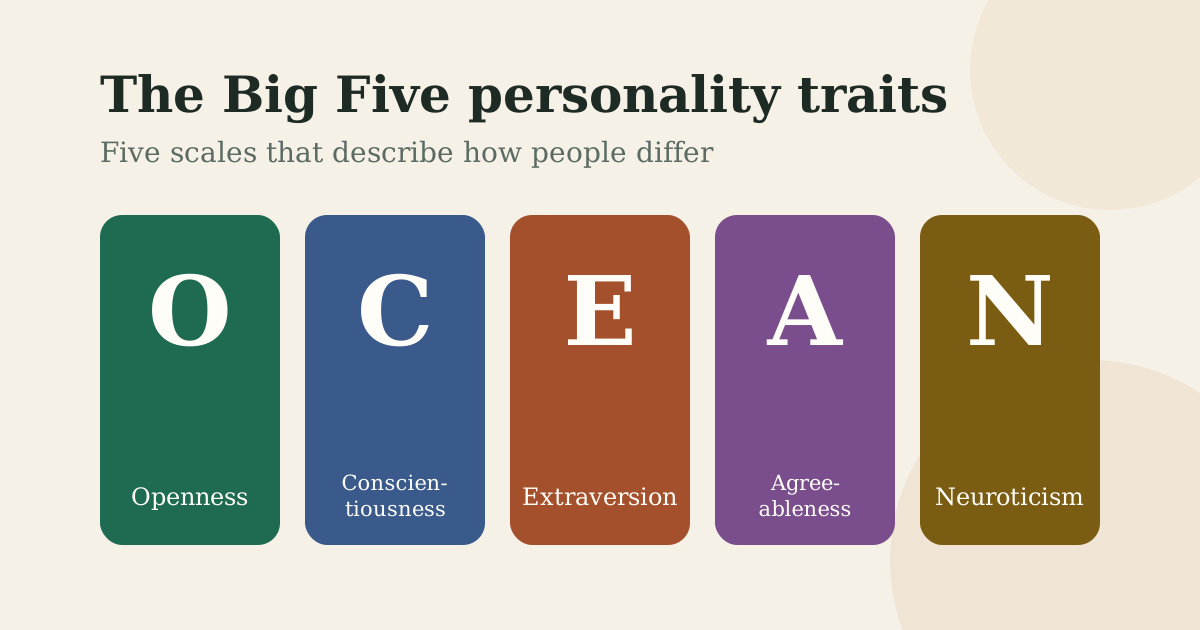
Researchers recommend replacing the Type A label with separate trait scales. The traits it bundles together are all part of the Big Five, and our free Big Five personality test scores each of them.
- Achievement-strivingDrive to reach goals · ConscientiousnessNo health link
- Activity levelPace of life · ExtraversionNo health link
- AngerHow quickly you get irritated · NeuroticismSmall heart link
- Cooperation (low)Readiness to argue · AgreeablenessRelated to hostility
Health links from Myrtek (2001) and Chida and Steptoe (2009).
Type A and Type B at work and in relationships
No job "fits a type", and we found no study showing that Type A and Type B people are more or less compatible. What matters is how the separate traits play out.
| Situation | Strength | Watch out for |
|---|---|---|
| More Type A at work | Deadlines, high standards, drive | Overwork, friction with colleagues |
| More Type B at work | Calm, careful, long-term work | Leaving things late |
| In relationships | Different paces can balance each other | How disagreements are handled matters more than the letters |
| With children | Notice the separate traits | Avoid labels: children's traits are still developing |
Nurses, students and managers often ask which type suits their role. The same split applies everywhere: ambition and pace can help, constant hostility doesn't. If you're choosing a direction, our free career test matches your interests to real jobs, and our guide on how to choose a career walks through the decision.
Type A vs OCD, ADHD and "Type B personality disorder"
Type A and Type B are everyday descriptions, not health conditions. They often get mixed up with three different things.
Often confused
Type A isn't OCD
Obsessive-compulsive disorder is a mental health condition with unwanted, recurring thoughts and repeated behaviours that are hard to stop. Liking order or high standards is not OCD.
Source: NIMH
Often confused
Type A or B isn't ADHD
ADHD is a diagnosed condition that affects attention, activity and impulse control. Being relaxed or restless is not a sign of it, and there's no single test for it: a professional evaluation is needed.
Source: CDC
Doesn't exist
"Type B disorder"
People usually mean Cluster B personality disorders (antisocial, borderline, histrionic and narcissistic), a medical grouping that has nothing to do with Type B.
Source: MSD Manual
If you're worried about any of these, speak to a doctor or psychologist.
Frequently asked questions
Is Type A personality real?
The traits are real, but the type isn't. Being hurried, competitive or quick to anger are real, measurable traits. But studies of more than 4,600 people found one smooth scale from more Type B to more Type A, not two separate groups, and the large heart studies found no link between Type A and heart disease.
Is Type B personality bad or lazy?
No. Type B describes pace and temper, not effort or ability. A Type B person can be just as organised, hard-working and successful as a Type A person; they simply work with less hurry and are slower to anger.
Is there a real Type A test?
Researchers used questionnaires such as the Jenkins Activity Survey and structured interviews, but there is no official Type A test, and online quizzes that give you a letter are not validated. A Big Five personality test is a better option: it scores the separate traits behind Type A, such as achievement-striving, activity level and anger, on scales.
Is Type A personality genetic?
Partly. A meta-analysis of studies with more than 100,000 people found that about 40% of the differences in personality traits between people are linked to genes and about 60% to environment and experience.
Can you change your personality type?
Traits can change. Across 207 studies, therapy and similar programmes changed personality trait scores within about 24 weeks on average, most of all emotional stability. People also tend to become calmer and more conscientious with age.
Is Type A personality linked to anxiety?
Type A is not an anxiety disorder. The part of it closest to anxiety is worry and irritability, which the Big Five measures under neuroticism; Type D, not Type A, is the label built around worry. If worry is affecting your daily life, speak to a doctor or psychologist.
What does the D in Type D stand for?
Distressed. Psychologist Johan Denollet defined Type D as a combination of negative affectivity (worry, gloom and irritability) and social inhibition (holding back with other people), measured with a 14-question scale called the DS14.
Is Type A the same as OCD?
No. Obsessive-compulsive disorder is a mental health condition with unwanted, recurring thoughts and repeated behaviours that are hard to stop. Liking order, working fast or having high standards is not OCD.
How does Type A relate to MBTI or the enneagram?
They are separate systems: Type A and B is not one of MBTI's 16 types or an enneagram type. Like Type A and B, MBTI sorts people into categories, while researchers prefer the Big Five because it measures traits on scales.
Which is better, Type A or Type B?
Neither. A more Type A style often helps with deadlines and goals, and a more Type B style with calm, careful work. The one part with a health link is frequent anger and hostility, and even that link is small.
Are Type A and Type B compatible?
We found no study showing that Type A and Type B people are more or less compatible. Differences in pace can cause friction, but how a couple handles disagreements matters more than the letters.
What is a Type C personality?
Type C describes someone cooperative, patient and eager to please, who keeps emotions, especially anger, to themselves. It was promoted as a cancer-prone personality, but the best-known studies behind that claim were judged unsafe, and a study of 42,843 people found no personality trait that predicted cancer.
How Type A compares with 16-type tests: see Big Five vs MBTI.
Sources
- Friedman and Rosenman (1959), JAMA: the first description of the behaviour pattern.
- Rosenman and others (1975), JAMA: Western Collaborative Group Study, 8.5-year follow-up.
- Shekelle and others (1985), American Journal of Epidemiology: the MRFIT behaviour pattern study.
- Ragland and Brand (1988a), American Journal of Epidemiology: 22-year follow-up of the same 3,154 men.
- Ragland and Brand (1988b), New England Journal of Medicine: survival after a first heart attack.
- Myrtek (2001), International Journal of Cardiology: meta-analyses of Type A, hostility and heart disease.
- Petticrew, Lee and McKee (2012), American Journal of Public Health: tobacco industry funding of Type A research.
- Chida and Steptoe (2009), Journal of the American College of Cardiology: anger, hostility and heart disease.
- Wilmot, Haslam, Tian and Ones (2019), Journal of Personality and Social Psychology: no evidence for the type.
- University of Toronto (2018), news summary of the Wilmot study.
- Haslam, Holland and Kuppens (2012), Psychological Medicine: categories versus dimensions in personality.
- Ramanaiah, Sharpe and Byravan (1997), Psychological Reports: Type A and the five-factor model.
- King's College London, statement on the Eysenck and Grossarth-Maticek publications (2019, updated 2025).
- Retraction Watch (2019), report on the King's College London enquiry.
- Jokela and others (2014), British Journal of Cancer: personality and cancer in 42,843 people.
- Grande, Romppel and Barth (2012), Annals of Behavioral Medicine: Type D and heart patients' outcomes.
- Denollet (2005), Psychosomatic Medicine: the DS14 Type D scale.
- Roberts and others (2017), Psychological Bulletin: personality trait change through intervention.
- Vukasović and Bratko (2015), Psychological Bulletin: heritability of personality.
- National Institute of Mental Health, Obsessive-compulsive disorder (reviewed December 2024).
- Centers for Disease Control and Prevention, Diagnosing ADHD.
- MSD Manual, Overview of personality disorders (the three clusters).
- Scientific American, the waiting-room story, as Friedman told it.
This guide is general information, not medical advice.
Get your real profile, not a letter
See your scores on the five big traits and all 30 facets, including the four behind "Type A". Free, no sign-up.
Take the free Big Five test